English

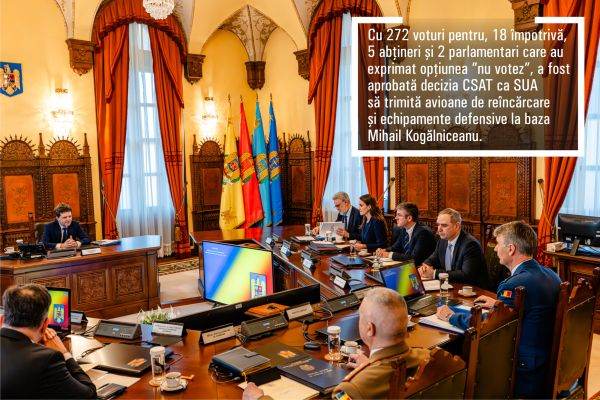
An act of courage and personality in Romanian politics appears to be the decision of the Supreme Council of National Defense (CSAT) to approve the US army to use the Mihail Kogălniceanu military base selectively, only for equipment that is "defensive and not equipped with actual weaponry” - as President Nicuşor Dan expressed it.
Possibly, in this way it transferred to Parliament the responsibility to allow the Americans the deployment of fighter aircraft (F-35 or F-16) intended for offensive missions (if this request has indeed been addressed to us, as is rumored).
The US request for the deployment of fighter aircraft is not official information (at this moment), but is leaked to the press from the Ministry of National Defense and logically deduced.
Spain's refusal to allow the US army to use its military bases in Rota and Moron (Andalusia) in the war with Iran prompted the Americans, in search of alternative routes, to request from us the use of the Mihail Kogălniceanu base, but for what?
Logically, for the same things refused by the Spaniards.
According to international sources, Washington requested permission from the Madrid government to use its military bases as launch and support points for Operation "Epic Fury” (the conflict with Iran):

- The US requested full access to the naval base in Rota (for warships and destroyers equipped with the Aegis system) and to the Moron air base (for logistical support).
- Fighter aircraft: The request explicitly included permission for the takeoff and transit of fighter aircraft (F-35 and F-18), as well as heavy bombers, in order to carry out direct attack missions on targets in Iran.
- Tanker aircraft: The use of the KC-135 refueling aircraft fleet to support long-distance flights to the Middle East.
These should logically also be the purposes of the American request for Romania.
But this is a decision which, going beyond military (and economic) calculation, also enters the area of moral and legal responsibility.
• The legal criterion: the legality of intervention
From the perspective of international law, armed interventions are regulated by the UN Charter. Article 2(4) prohibits the use of force, and Article 51 allows individual or collective self-defense. In the absence of an explicit mandate or a direct aggression against an ally, military support may become legally debatable.
For NATO member states, obligations of solidarity are not automatically equivalent to participation in external operations. The Treaty provides mechanisms for consultation and support, but does not eliminate the sovereign responsibility of each state to evaluate compliance with international law.
• The moral criterion: responsibility regarding escalation
The morality of the decision cannot be reduced to the calculation of national interest.
Participation in military actions without robust legal legitimization can contribute to the erosion of international norms and to the multiplication of conflicts. At the same time, refusing support may be perceived as weakening collective solidarity in the face of real threats.
The moral dilemma lies in the balance between preventing global violence and protecting the credibility of alliances. Europe has historically oscillated between these two imperatives, and the current case resumes this tension.
• Our strategic reality
The strategic structure of Romania's security does not give it the possibility of a refusal "de plano” to the US request, as Spain did.
Romania tends to support the US operationally, within the limits of the NATO framework and existing agreements.
The probability of following the Spanish model is reduced:
1.Dependence on the American military guarantee
Romania bases its defense on the US military presence and on Article 5 of the NATO Treaty.
The base in Deveselu and the rotations of American troops indicate a profound operational integration.
2.Geographical position and the pressure of the regional conflict
The war in Ukraine places Romania in an area of direct risk.
In this context, Bucharest avoids gestures that may erode the strategic relationship with Washington.
3.The political tradition of pro-American alignment
Since 2005, Romanian foreign policy has consistently pursued the consolidation of the strategic partnership with the US.
Examples include participation in NATO missions and facilitating military infrastructure.
4.The structural difference compared to Spain
Spain has greater strategic autonomy.
Its economy is less dependent on American military security.
Madrid has a diplomatic tradition of balance in Middle East conflicts.
• Internal legal limits in Romania
The Constitution allows military cooperation within the framework of ratified international treaties.
The political decision is based on CSAT and on existing bilateral agreements.
Romania is much more dependent on the American military guarantee than Spain. Its geographical position on NATO's eastern flank, the proximity of the war in Ukraine and the operational integration with US forces reduce the margin of strategic autonomy.
Under these conditions, we tend to offer the Americans logistical or operational support, within the limits of existing agreements and the NATO framework. The probability of a position similar to that of Madrid is reduced, because the security costs would be perceived as greater than the legal or symbolic benefits.
• Europe, between norm and power
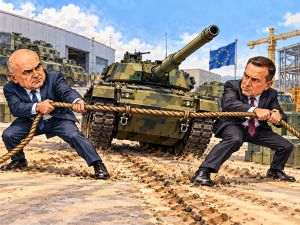
The divergence between European states reflects a deeper fracture: the relationship between legal order and geopolitical reality. The case of Spain expresses the aspiration for normative autonomy. The positions of the states on the eastern flank reflect strategic constraint.
In the end, Romania's decision results from the intersection of these two logics.















 Euro
Euro Dolar SUA
 Franc elveţian
 Liră sterlină
 Gram de aur