English

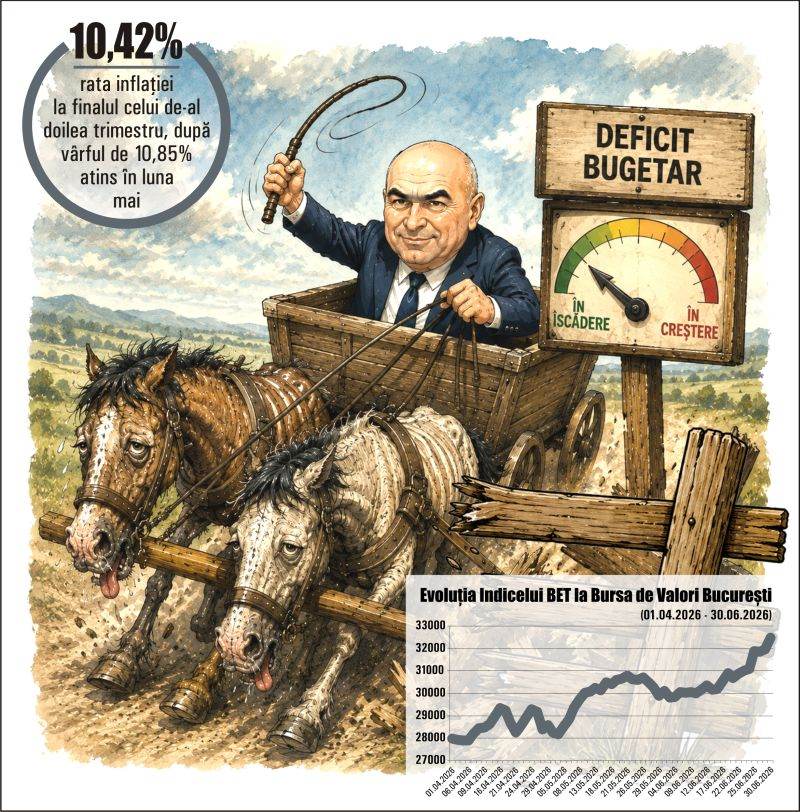
The government managed, in the second quarter of this year, to reduce the budget deficit by almost half compared to the similar period in 2025, without stopping public investments, but this fiscal correction was accompanied by the economy entering a technical recession, the return of inflation to values over 10%, the depreciation of the leu, the maintenance of the highest financing costs in the European Union and a political crisis that left the country, at the beginning of May, without a Government with full powers.
After a deficit of 21.09 billion lei, or 1.03% of GDP, at the end of the first quarter, budget execution reached - according to data published by the Ministry of Finance after the first five months (budget execution for June will be published at the end of July) 35.94 billion lei, equivalent to 1.75% of GDP, compared to 64.23 billion lei and 3.35% of GDP in the similar period in 2025. The reduction of over 28.3 billion lei in the deficit in five months was supported by the increase in total revenues to 279.49 billion lei, 9.2% above last year's level, by the nominal decrease of 1.5% in expenditures, to 315.43 billion lei, and by the decrease in personnel expenses to 68.17 billion lei. Public investments were not sacrificed, but rose to 44.73 billion lei, compared to 40.57 billion lei in 2025, over 71% of payments being related to projects financed from non-reimbursable external funds, including through the PNRR.
Behind this numerical correction, the real economy sent increasingly harsh signals: GDP in the first quarter contracted by 1.2% in annual terms on the gross series, household consumption decreased by 1.8%, unemployment rose to 6.4%, consumer confidence fell to a 15-year low, and the economic confidence indicator recorded in June the most severe monthly deterioration since the outbreak of the pandemic.
The second financial quarter was, therefore, the period in which the fiscal consolidation that began in 2025 came into direct collision with political instability and the weakening of the economy. In April, the Boljan government intervened aggressively in the fuel market, expanded social measures, accelerated energy projects and put on the table the listing of 22 state-owned companies on the Bucharest Stock Exchange. The initiative broke the coalition, caused the withdrawal of PSD ministers from the government and led to the motion of censure adopted on May 5. Thus, in May, Romania was left with an interim government even at the decisive stage of the implementation of the PNRR, while inflation rose to 10.85% and the NBR maintained the key interest rate at 6.50%. In June, President Nicuşor Dan failed in two attempts to form a new government, Moody's warned that the political deadlock threatens fiscal consolidation, the leu exceeded the threshold of 5.24 lei for one euro on the interbank market, and the Competition Council imposed record fines on the ten largest banks, totaling 3.73 billion lei in the case regarding the alleged manipulation of the ROBOR index. In the same period, the state continued to lend massively to the population through the Tezaur and Fidelis programs, from which it attracted 21.7 billion lei in the first semester, obtained approval for a new payment request of 2.62 billion euros from the PNRR, and signed financing contracts for projects totaling 16.68 billion euros to be carried out through the European SAFE mechanism.
• April: State intervention in the economy and the listing of public companies break the coalition
April marked the transition from the prudent fiscal consolidation of the first quarter to a much more visible form of economic interventionism. The conflict in the Middle East continued to keep oil prices high, fuel costs were being transmitted to transportation, agriculture, manufacturing and food, and inflation was preparing to exceed the 10% threshold again. Under these conditions, the Government tried to distribute the cost of the energy crisis between the public budget, oil companies and consumers.
The first major intervention consisted of a temporary reduction of 30 bani per liter of the excise duty on standard diesel, from 2,804.29 lei to 2,504.29 lei for 1,000 liters. The measure was to be applied for the entire duration of the state of crisis declared on the oil and fuel market and had an estimated budgetary impact of approximately 610 million lei. The stated aim was to limit the knock-on effects of the diesel price hike, but the excise duty cut meant that part of the cost of the crisis was being borne directly by the budget at a time when the state was trying to reduce the deficit. To partially compensate for the loss of revenue and to transfer some of the burden to the oil industry, the Executive introduced a solidarity contribution applicable to the operators who extract and market crude oil or energy products obtained from the processing of oil extracted in Romania. The contribution becomes applicable when the Brent oil price exceeds 70 dollars per barrel and varies between 1.5% and 9.9%, depending on the international price level. The additional revenues were estimated in a very wide range, between 70 and 650 million lei, which shows how dependent the efficiency of the measure is on the volatility of foreign quotations. The government also limited the freedom of fuel traders to change prices at the pump, allowing a maximum of one increase per day, until 12:00.
The intervention did not stop at fuels. The government tried to clean the market for connections to the electricity grids of speculative projects that blocked access to real investors. Romania had accumulated technical approvals for connection for approximately 80,000 MW, almost nine times more than the daily needs of the economy, estimated at around 9,000 MW, but less than 10% of the approved projects had actually reached the implementation phase. To discourage speculative booking of network capacity, the Executive proposed increasing financial guarantees, either to a fixed amount of 30 euros for each kW installed, or through a mixed formula that would combine 50% of the connection tariff with 20 euros/kW. Abandoned projects would lose all the guarantees deposited.
In the same month, inflationary pressure forced the Government to expand social protection. Approximately 3.1 million individuals and families were included in a new "Solidarity Package”. Almost 2.9 million pensioners with incomes of up to 3,000 lei were to receive aid in two installments, in May and December: 1,000 lei for pensions up to 1,500 lei, 800 lei for those between 1,501 and 2,000 lei and 600 lei for incomes between 2,001 and 3,000 lei.
The budgetary signals published in April seemed to give the Government the necessary space for these interventions. The deficit in the first three months had fallen to approximately 22 billion lei and 1% of GDP, from over 44 billion lei and 2.3% of GDP in the same period in 2025. S&P Global Ratings reconfirmed on April 3 the BBB-/A-3 ratings, keeping Romania in the investment-grade category, but maintained the negative outlook. The agency estimated the deficit to decrease from 7.7% of GDP in 2025 to 6.5% in 2026 and 5.5% in 2027, but predicted that the Romanian economy would grow by only 0.25% in 2026. Dependence on energy imports, estimated at around 30%, one of the lowest in the European Union, was a strategic advantage, but not sufficient to eliminate the risks caused by political instability, inflation and poor budget collection. The NBR remained on the defensive, keeping the key interest rate at 6.50%, the lending facility at 7.50%, the deposit interest rate at 5.50% and the minimum reserve requirement unchanged. The central bank warned that the rise in oil and natural gas prices, the effects of the expiry of the electricity price cap and the VAT and excise duty increases in 2025 were expected to push inflation in the second quarter above previously forecast levels.
However, the fragile balance was broken from within the coalition. On April 16, the Government approved the report of the inter-ministerial committee led by Deputy Prime Minister Oana Gheorghiu, through which 22 state-owned companies were evaluated for listing, restructuring, merger or exit from the public portfolio. Among them were ELCEN, Oil Terminal, CFR SA, MINVEST, REMIN, Avioane Craiova, ROMAERO, CNCIR, CFR Călători, Metrorex, TAROM, CFR Marfă and several railway companies. The executive presented the listing as a tool for attracting capital, financing investments and improving corporate governance. The PSD, the opposition and the unions interpreted it as a preparation for the accelerated privatization of strategic assets.
On April 23, PSD ministers withdrew from the Government, and resignations continued at the level of state secretaries and the leadership of the General Secretariat of the Government. On April 28, PSD and opposition parties submitted a motion of censure, read a day later in the plenary session of Parliament.
• May: Bolojan Government falls, deficit decreases, and inflation exceeds 10%
May began with the adoption, on May 5, of the motion of censure against the Bolojan Government. The motion received 281 votes in favor, four against, and three votes were canceled. Of the 431 parliamentarians present, only 288 cast valid votes. The executive remained interim, with limited powers, at a time when Romania had to accelerate the PNRR reforms, implement the 2026 budget, and convince rating agencies that fiscal adjustment can continue in the absence of a functional majority.
The reaction of the foreign exchange market was immediate. The euro approached 5.3 lei in the first days after the dismissal of the Government, after which the exchange rate banking stabilized around the level of 5.2 lei. The depreciation showed how quickly political instability can be transformed into financial cost, especially in a country with high public debt and more than half of it denominated in foreign currency.
In contrast to the political deterioration, the budget execution at four months provided the best fiscal figures of the quarter. The deficit stood at 23.95 billion lei, respectively 1.17% of GDP, compared to 55.97 billion lei and 2.92% of GDP in the first four months of 2025. The difference of over 32 billion lei resulted from the increase in total revenues by 12%, to 223.83 billion lei, and from the nominal reduction in expenditures by 3.2%, to 247.79 billion lei. As a share of GDP, spending fell from 13.4% to 12.1%, while revenues increased by 0.5 percentage points. The external imbalance also improved. The current account deficit fell to 5.338 billion euros in the first quarter, from 6.153 billion euros in the same period in 2025, supported by the reduction in the trade deficit.
Rating agencies responded to the political crisis with a combination of patience and warnings. S&P conducted an unscheduled review on May 16, triggered by the government's dismissal, and reconfirmed the BBB-/A-3 rating, with a negative outlook. The agency estimated a deficit of 6.25% of GDP for 2026 and a period of economic stagnation, followed by a possible growth of 2.5% in 2027. The next assessment is scheduled for October 2, which gives our country a few months to demonstrate that the collapse of the coalition will not stop fiscal consolidation.
Fitch Ratings sent a similar message on May 18. The fiscal measures adopted in 2025 were producing results, and the interim administration could continue executing the budget built on a deficit target of 6.2% of GDP. However, political uncertainty reduced visibility on fiscal strategies for 2027 and 2028 and threatened access to European funds. Fitch showed that the economy had contracted strongly in the first quarter, and growth in 2026 risks being well below the 1.1% forecast used in the previous assessment.
Against this background, the incident caused by the crash of a Russian Geran-2 drone into a block of flats in Galaţi shifted part of the public agenda from the economy to security. The convening of the Supreme Council for National Defense and the reassessment of the protection of critical infrastructure provided additional justification for accelerating military and logistical investments. The approval of the SAFE agreement with the European Commission transformed this security need into an economic program. Romania can access up to 16.68 billion euros, the second largest allocation in the European Union after that intended for Poland. Approximately 4.2 billion euros are foreseen for strategic transport infrastructure, and the Ministry of Defense estimates that almost 60% of the value of the program can be run through the national industry.
In parallel, the PNRR has entered the critical stage. Over 11,000 projects financed from the PNRR and other European programs were in various stages of execution, while some of the 45 milestones and targets analyzed had not yet been met. The interim government could manage ongoing projects, but its limited capacity to adopt new measures turned each political delay into a financial risk.
• June: National economy seriously impacted by the continuation of the political crisis
The first month of summer transformed the political crisis into a prolonged institutional deadlock. On June 4, President Nicuşor Dan appointed MEP Eugen Tomac as prime minister, but he resigned ten days later after failing to obtain the necessary support. On the same day, the head of state nominated the liberal Adrian Veştea, but this proposal caused tensions even within the PNL and was rejected by the USR.
The Veştea Cabinet reached the Parliament's vote on June 22, but obtained only 189 of the 233 votes needed for inauguration. The AUR parliamentarians left the chamber before the vote, although their support had been taken into account in the negotiations. Parliament subsequently entered the summer recess without having inaugurated a new Executive, and Romania remained under the leadership of the Bologna interim Government. As the Constitution does not establish a limit on the period during which a dismissed cabinet can administer current affairs, the interim government could continue, but at the cost of blocking important political and legislative decisions.
In financial terms, the budget execution after five months confirmed its consolidation, but also its fragility. The deficit reached 35.94 billion lei, or 1.75% of GDP, compared to 64.23 billion lei and 3.35% of GDP in the similar period in 2025. Compared to the deficit of 23.95 billion lei at the end of April, almost 12 billion lei accumulated in May alone, which shows that the pace of spending has accelerated. The ones that increased were the expenditures on goods and services, which increased by 6.9%, to 40.94 billion lei, mainly due to higher health payments. The increase in expenditures was also contributed by those on interest payments, which reached 26.81 billion lei.
Public investments rose to 44.73 billion lei, from 40.57 billion lei in the same period in 2025. Over 71% of the payments were intended for projects financed from non-reimbursable external funds related to the 2021-2027 financial framework and the PNRR. European reimbursements and external financing exceeded 24 billion lei, almost 10% above last year's level. The adjustment was therefore not achieved by stopping investments, but by restricting current expenditures and by making more intensive use of European funds. The problem remained sustainability: the annual deficit target was 6.2% of GDP, while the total financing needs exceeded 12% of GDP.
The pressure on financing was amplified by Moody's. On June 26, the agency warned that the lack of a parliamentary majority and the prolongation of the government crisis could compromise fiscal consolidation and reforms. Interest payments could reach 9.2% of budget revenues in 2026 and 9.6% in 2027. With over half of the public debt denominated in foreign currency, the depreciation of the leu could directly increase the debt burden.
The warning came at a time when the euro had exceeded 5.24 lei on the interbank market, and the official exchange rate of the NBR had set a new record, of 5.2180 lei. The leu had become the weakest currency in the region in June 2026, and Romanian government bond yields remained the highest in the European Union, about one percentage point above their end-February levels.
The real economy was even more dire. The INS revised the GDP contraction in the first quarter to 1.2% in annual terms on the gross series and to 1.1% on the seasonally adjusted series. The nominal value of GDP was estimated at 403.915 billion lei on the gross series and to 497.820 billion lei on the adjusted series. Construction had a positive contribution of 0.4 percentage points, and entertainment and recreational services of 0.3 points, but trade, transport and HoReCa withdrew 0.8 points, information and communications 0.3 points, and industry 0.2 points. Household consumption fell by 1.8% and alone reduced GDP growth by 1.2 percentage points. The European Commission's economic confidence indicator fell to 83.5 points in June, from 90.8 points in May, marking the most severe monthly deterioration since the outbreak of the pandemic. Compared to June 2025, the decrease was 14.3 points, the largest in the European Union and almost double the 8.8-point decline in Bulgaria. The average of the indicator was 95.1 points in the European Union and 95 points in the euro area. In services, the indicator fell to minus 23.8 points, from minus 6.3 points, and consumer confidence reached minus 34.6 points, the lowest in the last 15 years. The economy was, according to Erste Group Research, in technical recession territory for the fourteenth consecutive month, and the baseline scenario for the whole year had become a mild recession. The unemployment rate rose to 6.4% in May, which meant about 522,100 people were unemployed.
Another shock wave came from the banking system. On June 7, the Competition Council announced fines totaling 3.73 billion lei, about 710 million euros, against the ten banks participating in the ROBOR setting mechanism. The largest sanction in the authority's history was justified by alleged exchanges of confidential and strategic information that would have affected the independence of the quotes transmitted in the daily fixing procedure. The banks rejected the accusations and announced they would contest the sanctions. The Romanian Banking Association argued that the institutions had complied with the NBR regulations, and that the information exchanges invoked by the Competition Council stemmed from the technical functioning of the fixing. The NBR requested further clarification on June 11, warning that the decision should not be interpreted as an invalidation of ROBOR or as evidence that the 2021-2023 interest rates were artificially set. According to the central bank, the increase in the index reflected the explosion of inflation, the energy crisis, the war in Ukraine and the international interest rate hike cycle.
In this atmosphere, the European Commission approved Romania's fourth payment request from the PNRR, worth 2.62 billion euros, and the program's implementation rate reached approximately 70%. However, over 11,000 projects remained in various stages of execution, with the deadline of August 31, 2026 fast approaching. The lack of a fully-fledged government turns the political crisis into a direct risk of losing European funds.















 Euro
Euro Dolar SUA
 Franc elveţian
 Liră sterlină
 Gram de aur