 English


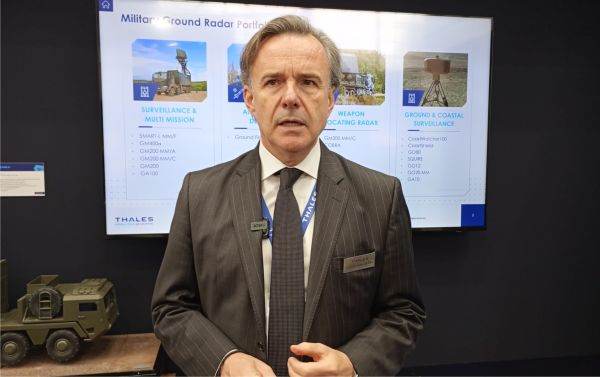
Ensuring freedom of navigation in the Black Sea, for both commercial, civilian and military vessels, represents a challenge for defense industry companies, after the Russian Federation strengthened its dominance over the entire area following the occupation of the Crimean Peninsula and the illegal start of the war against Ukraine four years ago. Therefore, in order to support the Romanian authorities, Thales, through its subsidiary Thales Romania, presented yesterday, at the international exhibition of armaments, equipment and military technology - BSDA 2026 - a system that could be used by both the Romanian Naval Forces and the commercial vessels of our country.
Cristian Sfichi, Thales regional director for Romania, Ukraine and the Caucasus, stated in a press briefing: "The Black Sea is a contested sea. This contestation, in a way, affects us too, not just Ukraine, it affects all the countries in the vicinity of the Black Sea in two directions. One direction is traffic - maintaining commercial traffic and freedom of navigation, and the second is the war that is underway in Ukraine. That is why we propose a system called Pathmaster. It is an anti-submarine warfare system and a mine warfare system. As you know, drifting mines are a substantial danger to freedom of navigation. Pathmaster is a software solution developed by our colleagues not only from France, but also by my colleagues from Thales Romania, who contribute to the permanent update and customization of this solution. It consists of two systems: a system that creates a database with marine targets, where the reconnaissance part intervenes visual, artificial intelligence and underwater threat analysis, and a detection system. Thales is a world leader in anti-submarine warfare systems through the Captas sonar range (ranging from Captas 1 to Captas 4) and through helicopter-borne sonar systems. We believe that the Black Sea needs equipment and technological solutions that allow the preservation or strengthening of national sovereignty. Starting next year, natural gas exploration and extraction activities will begin, at which point the need to have technologies that protect the entire infrastructure in the exclusive economic zone will become essential. Pathmaster is the solution that we propose to the Naval Forces and we believe that it will be a multiplier of anti-submarine protection in the Black Sea”.
The head of Thales Romania stated that the novelty of the Pathmaster system is that it can be mounted on any ship, be it civil or military, and there is even the possibility of transferring this system from one ship to another, providing the necessary flexibility in the current and future projects of the Romanian Army.
We note that according to the data presented by the company, Pathmaster is applied on 468 ships, operated by 33 naval forces and/or merchant marines around the world.
• Latest generation radar for the rapid detection of drones sent by the Russian Federation
Also within BSDA 2026, Thales also presented the GM200 MM/A radar, which the Ministry of National Defense is to acquire through the SAFE mechanism and which is intended for anti-aircraft defense.
Cristian Sfichi said: "We are talking about a state-of-the-art radar that, we hope, will enter the Romanian Armed Forces in the future. It will be able to increase the armed forces' capability to identify targets from a distance of approximately 200 kilometers, so as to allow the necessary measures to be taken to shoot down the drones in question or to see if they represent a direct threat to the national territory or are directed towards the conflict zone in Ukraine. (...) Discussions with the Ministry of National Defense are ongoing. Since the signing of the contract, delivery could be made in a very short time, because we have increased production capacity to 40-50 radars per year. The first deliveries could be made even next year. Part of these radars will be made in Romania. The technology of a 4G AESA radar is very complex and expensive, using gallium nitride transmitter-receivers. The quantity of 12 radars does not justify the manufacture of these diodes in Romania, but the parts that can be made locally include the truck, the antenna and everything that means integration, homologation and testing. For now we are in discussions and the information will be made public to the extent that commercial partners and the Ministry of Defense wish it to be so”.
We mention that the radar offered by Thales for the Romanian Army can be operational in 15 minutes and can be serviced both remotely and from inside, by two operators. The truck-mounted variant is optimal because it can be easily moved from one place to another. The radar was tested in combat conditions on the Ukrainian and Middle Eastern fronts.
Asked if Thales could offer a solution for an integrated system regarding the different types of radar used by the armed forces in our country, Mr. Sfichi presented the latest solution launched worldwide by the French group a few weeks ago.
"This is Sky Defender, an integrated multi-level air defense system, because today's conflicts require a layered defense, starting from anti-drone systems. We have the system called Force Shield, which can identify and counter targets in the region between 5 and 7 kilometers. After that, we have the SAMP/T NG system, which is the European equivalent of the American Patriot system. For this system, we provide the GF300 (Ground Fire 300) radar. Later, moving into the anti-ballistic defense area, we offer identification at very long distances, up to 5000 kilometers. All of this is connected through communications and information from ISR satellites. Thales has a joint venture with Thales Alenia Space, where we produce both communications and ISR (surveillance, intelligence and reconnaissance) satellite systems,” Cristian Sfichi told us.
Also at BSDA 2026, Thales presented the latest generation of Helmet Mounted Display Scorpion, produced by its US subsidiary for the US Air Force. The helmet is used by most pilots on F-16 fighter jets, because, by inserting modern capabilities and technologies, it allows pilots to better use and improves the targeting and weapons use performance of these fourth-generation aircraft.


















 Euro
Euro Dolar SUA
 Franc elveţian
 Liră sterlină
 Gram de aur





























