English


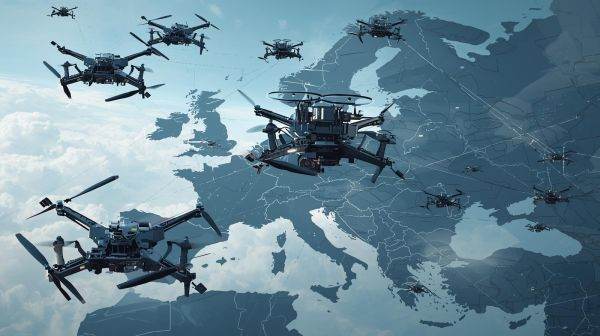
The European Parliament is to debate and adopt a resolution on drones and new warfare systems in plenary on 22 January 2026, based on a report approved last month by the Committee on Security and Defence. The report was adopted by the committee members at their meeting on 3 December 2025, with 31 votes in favour, 4 against and 2 abstentions. Among the MEPs who voted for this report were Vasile Dîncu and Cristian Terheş.
The report represents one of the most extensive and harshest assessments ever carried out by a European institution on how drone warfare has fundamentally changed the nature of armed conflicts and exposed the European Union to major strategic vulnerabilities, both military and civilian. The document starts from the conclusion that drones have become the dominant weapon of the 21st century, surpassing tanks, artillery or classic aviation in terms of impact. The experience of the war in Ukraine is repeatedly invoked, the report showing that drones have caused more casualties than any other type of weapon and have transformed the battlefield into a permanently monitored space, saturated with sensors and cheap precision strikes. The front is no longer linear, strategic depth no longer offers protection, and the difference between military and civilian areas is rapidly blurring. The document also shows that drone production has reached industrial levels: Russia manufactures several million units annually, with technological support from Iran and China, while Ukraine has developed a capacity of over 4.5 million drones per year, becoming the most advanced drone warfare laboratory in the world.
The cited report mentions that this reality is no longer limited to the Ukrainian front and states that the European Union is already directly exposed, through repeated incursions by Russian drones into the airspace of some member states, such as Poland, Romania and the Baltic states. These episodes are explicitly defined in the report as violations of sovereignty, not simple incidents or vague "hybrid" actions. The cited document claims that drones are used to test the response capacity, for intimidation and for mapping critical infrastructure, from energy networks and logistics hubs to military bases and external borders. The report warns that a drone costing several thousand euros can close an airport, block a port or cause panic in a city, without automatically triggering the classic collective defense mechanisms.
A central point of the document is Europe's structural dependence on external suppliers, especially China. About 60% of the drone components used in the European Union come from the United States and China, and in the case of critical components, Chinese dominance is almost total. China controls about 74% of the global market for commercial drones, produces most of the optical sensors and guidance systems, and refines about 98% of the rare earths used in batteries, engines and electronic systems. In addition, Beijing owns about 85% of the global production capacity for lithium batteries. The introduction of severe export restrictions on key materials and technologies in October 2025 has shown how quickly the European defence industry can be affected, with the report warning that the EU's entire capacity to produce drones and anti-drone systems could become dependent on political decisions taken outside the continent.
The document harshly criticises the current anti-drone defence model, which is considered economically unsustainable. Using interceptors or missiles costing hundreds of thousands or even millions of euros to shoot down cheap drones is described as a losing equation. The report insists on the need for simple, robust and mass-produced solutions: electronic warfare, lasers, acoustic sensors, distributed detection networks and cheap, rapidly adaptable interceptors. The experience of Ukraine is again invoked as an example of an effective combination of modestly priced technology, local production and rapid adaptation based on lessons from the front.
Another key aspect is the role of SMEs and start-ups, which represent around 80% of the European drone industry. The report shows that these companies are the main sources of innovation, but are stifled by slow procurement procedures, bureaucratic criteria and certification systems designed for traditional defense contractors. The European Parliament calls for a radical simplification of these procedures, direct financing with tolerance for risk and failure, and the creation of regional production and testing ecosystems, especially in the states on the eastern flank of the Union.
The report gives a central role to Ukraine, not only as a recipient of military support, but also as a strategic partner. The Ukrainian drone industry, its capacity for rapid innovation and combat experience are considered essential for redefining European military doctrines. The document calls for Ukraine's integration into the European defense industrial base and its access to European funding programs, emphasizing that Europe can no longer afford to ignore the experience of the most exposed state on the continent.
The civilian dimension of the threat occupies an important space in the report. Drones are presented not only as a military problem, but as a direct risk to the population, critical infrastructure and social stability. The need for early warning systems, shelters, population training and close cooperation between the military, police, local authorities and the private sector is explicitly mentioned. Drones are already being used by terrorist organisations for targeted attacks, the transport of explosives and intimidation operations, and the report warns that Europe can no longer treat these scenarios as improbable.
On a political and legal level, the document introduces a sensitive discussion on the application of the mutual assistance clause provided for in Article 42(7) of the Treaty on European Union. The report shows that the Union must be prepared not only theoretically but also operationally for the situation in which drone attacks can be assimilated to an act of armed aggression. Drone warfare is not announced by official declarations, but by repeated incidents, calibrated to avoid a firm response, and the lack of a coordinated response can encourage escalation.
The stakes of this debate go beyond the adoption of a political text: it is about how the European Union assumes the end of the security illusions of the post-Cold War era and decides whether it will become an actor capable of defending itself in an era dominated by drones or whether it will remain a vulnerable space, constantly tested and pressured from the air.






















 Euro
Euro Dolar SUA
 Franc elveţian
 Liră sterlină
 Gram de aur