English

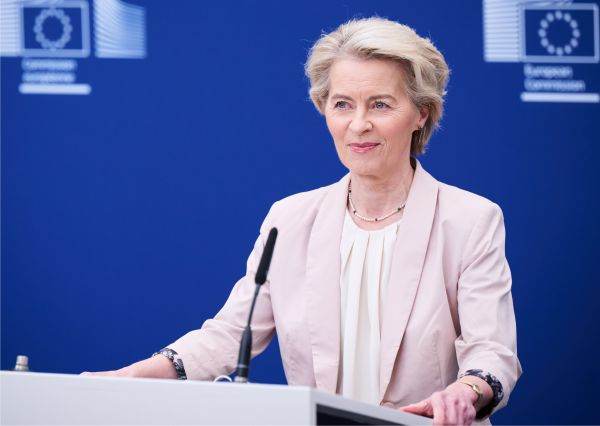
European citizens' bank deposits have been brought back into the spotlight by Ursula von der Leyen, the President of the European Commission, who is unhappy that the money is sitting in banks instead of financing national economies and, implicitly, the European economy, and companies on the old continent.
In a speech at the annual French Entrepreneurs Conference last week, Ursula von der Leyen said: "The second challenge is financing our economies. In Europe, we have no shortage of technology or savings. But we still lack sufficient capacity to develop European companies on a large scale. Too many projects are stalled because the initial investment is too risky, demand is too uncertain or capital is too expensive. Our companies know how to start in Europe. But they also need to be able to grow here. Too often, they go elsewhere for the financing they need. They shift their centre of gravity. Or they are bought out. Of course, we will not finance all this with public funds alone. But Europe has savings. And unfortunately, these savings are lying unused. Today, euro10 trillion of household savings are kept in bank accounts. And a large part of Europe's savings is invested outside our continent.
Europe must now to put these savings to work for their companies. This is the objective of the Economic and Investment Union. We have put forward proposals on securitisation, investment by banks and insurance companies, and the integration and supervision of our markets. Together, these measures could unlock up to euro470 billion in additional investment”.
This is not the first time that Ursula von der Leyen has referred to the euro10 trillion that European citizens have in banks. As the BURSA newspaper pointed out, the Strategy for the Economic and Investment Union (EUI), published by the European Commission in March 2025, states: "Bank deposits are safe and easy to access, but they usually earn less money than investments in capital markets. EUI can support the well-being of our citizens by giving them the choice and opportunities to pursue better returns by putting their savings to work in capital markets. At the same time, more investment in capital markets supports the real economy, allowing companies across Europe to grow and prosper. This can create better jobs with more competitive wages for European workers and boost investment and growth across all economic sectors - especially in areas that the EU has identified as strategically important, such as technological innovation, decarbonisation and security.”
This position was expressed at the beginning of 2025, at the World Economic Forum in Davos, by Francois Villeroy de Galhau, governor of the National Bank of France, who stated that, in order to finance the digital and ecological transition, it is necessary to mobilize 300 billion euros, including from the private savings of European citizens. Moreover, since this amount cannot be covered by public subsidies or bank loans, the only source remains the savings of Europeans, according to a report by the General Directorate of the French Treasury, quoted by the daily Le Figaro.
As can be seen, in just one and a half years the amount needed to finance companies in the European Union has increased from 300 billion euros to 470 billion euros, according to the latest statement by Ursula von der Leyen.
Don't be scared, though. The European Commission is not preparing a forced redirection of the amounts in the bank deposits of European citizens or any nationalization of these amounts, but the possibility for those citizens to keep, if they wish, more of their savings in capital market instruments with higher yields. However, for now, these instruments do not exist and European states do not seem interested in creating them, as long as the need to finance their budget deficits from domestic lending is a priority.
For example, at this moment it is very convenient for the Romanian state to attract citizens' savings through Fidelis and Tezaur, as it is equally convenient for the respective citizens who are sure that, at maturity, they will receive from the state the credit and the related interest for the government securities and bonds.
Under these conditions, the financing of small and medium-sized private enterprises by citizens represents a high risk for them, even if they use current financial instruments.
The loan granted to the state is one that, once due, is certain, liquid and due, that is, it is returned in full immediately and with the yield/interest established by the state from the beginning. Therefore, what Ursula von der Leyen wants is very difficult to achieve in the current European Union where the need to cover/finance the budget deficit is the first necessity of the member states.























 Euro
Euro Dolar SUA
 Franc elveţian
 Liră sterlină
 Gram de aur