English

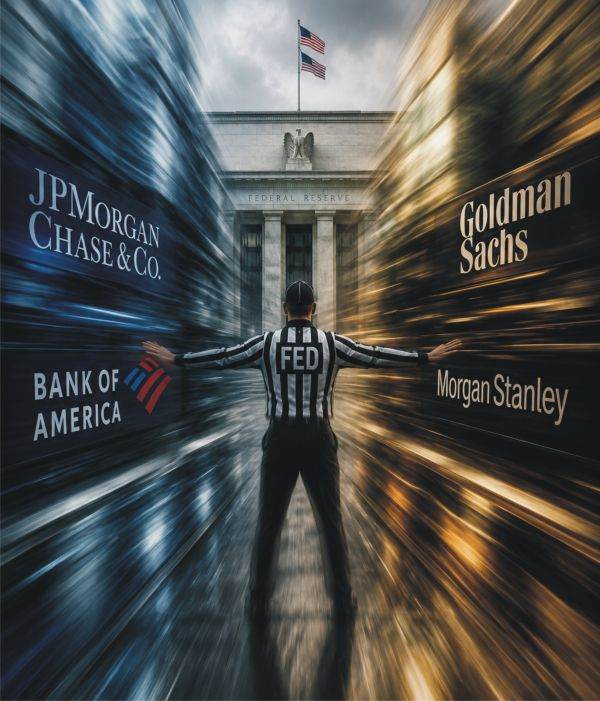
The big US banks fought together to ease capital regulations. The alliance fell apart when it became clear how the gains from the relaxation would be shared.
JPMorgan Chase and Bank of America are challenging a change to the Fed formula that would reduce their expected advantage by about $22 billion.
Goldman Sachs and Morgan Stanley would come out on top, relatively speaking.
Behind the numbers lies a bigger question: how harshly should a banking model dependent on short-term funding and capital markets be taxed, after this very vulnerability played a central role in the 2008 crisis.
Reuters reported on August 27, 2026, that JPMorgan estimates a loss of about $13 billion in the capital that would have been freed up by the reform. Bank of America estimates about $9 billion. Goldman Sachs and Morgan Stanley could each receive an additional $1-2 billion. All four banks want relief.
No more fighting over direction.
They're fighting over distribution.
• From common front to bank war
On March 19, 2026, the Fed proposed revising Basel III and changing the GSIB surcharge, the additional capital requirement for global systemically important banks.
Michael Barr, a member of the Fed's Board of Governors and former vice chairman for supervision, who cast the only vote against the package, showed that, together with the stress test changes, the CET1 requirements of the largest banks would decrease by 4.8%. With the recent changes to the additional leverage ratio, the reduction in Tier 1 requirements for GSIBs would reach 6%, equivalent to about $60 billion, Michael Barr said in his statement published on the Federal Reserve website.
The dispute arises not in a tightening but in a loosening. When the rule threatened the entire sector, banks had the same adversary.
When freed capital became likely, the question changed: who benefits most?
• The two changes in the formula
At stake is short-term wholesale funding, called short-term wholesale funding (STWF) in US regulation: money borrowed on a short-term basis from other banks and institutional investors or through market operations, as opposed to relatively stable customer deposits.
The Fed includes this funding in the GSIB surcharge because money that needs to be refinanced frequently can quickly turn a crisis of confidence into a liquidity crisis.
The March 19 proposal does two important things.
It reduces the contribution of short-term wholesale funding to the aggregate Method 2 risk scores from about 30% to 20%, the level the Fed originally envisaged. It also changes how this funding is measured, eliminating its reference to risk-weighted assets. The second change significantly alters the distribution of benefits.
JPMorgan has a very large absolute volume of short-term wholesale funding, but it is diluted in the current formula by being referenced to a huge base of risk-weighted assets. Removing the denominator changes the hierarchy among banks. Together with the recalibration of STWF weights, the new formula gives Goldman Sachs and Morgan Stanley a relative advantage and reduces the capital relief anticipated by JPMorgan and Bank of America. Federal data cited by Reuters show that this funding represents 37% of Morgan Stanley's liabilities and 30% of Goldman Sachs's, compared with 24% at Bank of America and 21% at JPMorgan.
According to the cited source, JPMorgan argues that the same amount of unstable funding should attract the same cost of capital at all large banks, and Goldman Sachs argues that short-term funding and risk-weighted assets do not necessarily evolve together and that reporting one to the other distorts the measurement of risk. Each defends a conception of risk that benefits its own model.
• The Fed does not arbitrate only four banks
The Fed thus ends up arbitrating between different banking models.
Rungporn Roengpitya, Nikola Tarashev and Kostas Tsatsaronis analyzed the characteristics of the balance sheets of 222 international banks and identified three main models: the commercial bank funded predominantly by retail deposits, the commercial bank funded wholesale and the bank oriented to capital markets. The BIS Quarterly Review study, published on December 7, 2014, found that institutions focused on commercial banking had lower costs and more stable profits than those more involved in market activities, mainly trading.
A subsequent BIS study, published on 14 December 2017, based on 178 banks over the period 2005-2015, robustly identified retail and wholesale funded business models and, with less statistical robustness, trading and universal banking focused models. The two business models exhibited lower cost-income ratios and returns on capital more stable than the trading model.
JPMorgan and Bank of America are universal banks, but deposits and lending are more structurally important in their funding. Goldman Sachs and Morgan Stanley are closer to the capital markets-oriented model.
If the Fed reduces the wholesale funding penalty, the regulatory cost of the more market-dependent model falls relatively. If it keeps the penalty higher, the more deposit-based model benefits relatively.
The prudential rule thus also becomes a competition rule.
• Why the penalty exists
The 2007-2008 crisis showed how quickly short-term funding can disappear.
Gary Gorton and Andrew Metrick described, in their article "Who Ran on Repo?", a central component of the crisis as a panic in the repo market, where institutions obtain short-term funding by pledging securities as collateral. They estimate that net repo funding provided to U.S. banks and broker-dealers fell by about $1.3 trillion between the second quarter of 2007 and the first quarter of 2009, more than half of its pre-crisis level.
A customer's deposit and money borrowed for a few days from the market are not as stable when confidence is eroded.
The institutional lender may refuse to refinance.
The bank must then quickly find other resources, sell assets, or reduce its balance sheet.
If several institutions do the same thing simultaneously, an individual liquidity problem can become systemic.
• The Fed Paradox
The Fed originally intended that short-term wholesale funding would account for about 20 percent of its Method 2 scores. In practice, this component has grown to about 30 percent, as large banks use more of this funding than anticipated.
The current proposal seeks to recalibrate the formula so that the contribution returns to 20%.
Michael Barr, however, reads the same data in reverse.
If wholesale funding is more widespread than the Fed thought when it built the formula, the risk the authority was trying to control may be greater than it originally estimated.
Barr shows that the ratio of short-term wholesale funding to risk-weighted assets of US GSIBs increased from about 30% to 40% between 2016 and 2024. His conclusion is explicit: the greater prevalence of this type of funding means that the problem the Fed was trying to control was greater than it originally estimated.
The same data thus allow for two interpretations.
First: the formula produces a larger penalty than projected and needs to be recalibrated.
Second: the phenomenon that the formula penalizes has been amplified, so reducing the penalty makes the risk appear smaller without actually decreasing it.
This is the real prudential controversy.
• The lobby splits
The economic theory of regulation offers another perspective on the conflict.
George Stigler argued in 1971 that regulated industries have strong incentives to influence the rules that apply to them.
In this case, however, the industry no longer has a single interest.
JPMorgan and Bank of America want one formula. Goldman Sachs and Morgan Stanley want another.
Reuters reported on August 27 that JPMorgan and Bank of America have tried to persuade the Fed to drop the contested amendment, while Goldman Sachs and Morgan Stanley are in favor of maintaining it. The conflict can be viewed in terms of a form of competitive regulatory capture: the lobby seeks not only to reduce regulation but also to distribute the cost of regulation in a way that is favorable to its own business model.
This is an analytical interpretation, not proof that the Fed has been captured by either camp.
The demonstrable facts are the existence of divergent economic interests and lobbying.
The outcome of the influence remains open.
• Capital is not just a cost
Banks argue that additional capital requirements reduce profitability and may limit lending. JPMorgan adds to the current dispute that the proposed formula favors trading at the expense of lending, according to Reuters.
But the capital freed up by relaxing regulation does not have a mandatory destination. It can support loans, allow the expansion of market activities or facilitate the distribution of capital to shareholders.
But capital also performs a prudential function: it absorbs losses.
The more equity a bank has in relation to the risks assumed, the longer losses can be borne by shareholders before the institution's solvency is threatened.
The question is therefore not only whether the approximately $60 billion freed up by the set of changes produces more economic activity, but how much additional systemic risk society accepts for this activity.
• Stakes beyond $22 billion
Final rule not adopted.
Reuters reported on August 27 that the Fed is looking to complete reforms them by the end of 2026.
Capital rules don't just set how safe the banking system needs to be. They change the relative price of activities: lending versus trading, deposits versus market funding.
When JPMorgan loses $13 billion from the anticipated easing, Bank of America another $9 billion, and Goldman Sachs and Morgan Stanley gain relatively, the Fed doesn't just change an equation, it changes incentives.
And today's incentives shape tomorrow's balance sheets.
The decisive question is not which bank will win the lobbying war, but whether the formula rewards the model that is more resilient to the next liquidity crisis or the model that uses capital more efficiently until the crisis occurs.
Ultimately, the dispute boils down to a choice of risk measurement: does it matter more how dependent a bank is on short-term funding or the absolute volume of money that can disappear when lenders refuse to renew it?
This is the Fed's real arbitrage.
























 Euro
Euro Dolar SUA
 Franc elveţian
 Liră sterlină
 Gram de aur