English

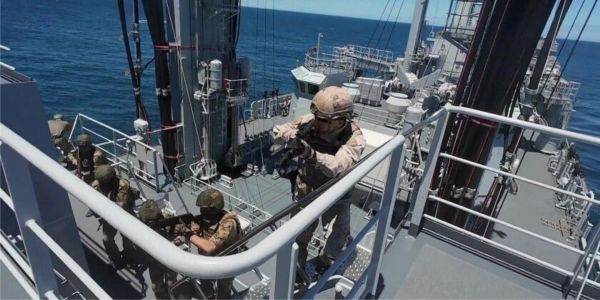
The BRICS joint naval exercise, "Will for Peace 2026,” held from January 9 to 16 off the coast of South Africa, marks a watershed moment in the architecture of global maritime security and sends a message hard to ignore to the West - the protection of maritime trade is no longer a monopoly - according to an article published by the Zerohedge website.
The cited source claims that the conduct of the maneuvers right near Simon's Town, one of the most sensitive strategic points between the South Atlantic and the Indian Ocean, is no coincidence, but a calculated demonstration of force, presence and geopolitical ambition. For the first time, China, Russia, Iran and South Africa have acted within an explicitly BRICS multilateral military framework, moving from one-off cooperation to an incipient form of security coordination with a global impact.
Beyond the official rhetoric about peace, military exchanges and combating terrorism, the exercise has put on the table an uncomfortable truth for Washington and its allies: states targeted by sanctions, pressure and economic blockades are building their own mechanisms to defend vital trade routes. The simulations of hostage rescue, ship recovery, armed interventions and countering maritime threats clearly show that BRICS is not preparing only for abstract scenarios, but for realities already experienced on the world's seas, where ships of Iran, Russia and Venezuela have become recurrent targets of captures, sabotage and confiscations disguised under legal or security pretexts. In this context, "Will for Peace 2026" appears as a direct response to a new form of geopolitical piracy, a sophisticated one, in which Western sanctions are extended at sea through selective seizures and naval intimidation. For the BRICS states and their partners, the message is clear: energy and trade security can no longer depend exclusively on coalitions led by powers that use global trade as a political weapon. Building an autonomous naval intervention capability becomes a matter of economic survival and sovereignty.
However, according to the cited source, the exercise also revealed the bloc's deep fragilities. South Africa's decision to downgrade the Iranian fleet to observer status at the last minute is a brutal X-ray of the limits of the BRICS. Under direct pressure from the United States and the risk of losing preferential access to the American market through the AGOA program, the central authorities in Pretoria have chosen economic pragmatism over strategic solidarity. This episode shows how quickly the bloc's cohesion can be cracked when national interests clash with the reality of commercial dependencies on the West.
Then, the absence of India, one of the world's largest maritime powers and a founding member of BRICS, from this naval exercise is equally revealing, claims the cited source who also shows that tensions with China and India's commitments in security formats such as QUAD demonstrate that BRICS is far from being a homogeneous alliance, capable of acting as one. Likewise, new members such as Saudi Arabia or the United Arab Emirates, deeply anchored in the American security architecture, view with caution any initiative that could be interpreted as a direct challenge to Washington.
However, the impact of the exercise should not be underestimated. For China, "Will for Peace 2026" normalizes naval presence in distant seas and consolidates its role as an alternative leader of the global South. For Russia, it is a demonstration of strategic continuity despite the Western isolation generated by the war in Ukraine. For Iran, it is a breath of geopolitical oxygen and a form of military legitimization in a hostile environment. Even with only four members involved, the exercise sets a dangerous precedent for the existing order: the emergence of a parallel system of guaranteeing the security of trade routes.
In essence, "Will for Peace 2026” is not the birth of an anti-Western naval alliance, but the first test of a multipolar world taking shape at sea. It is a pilot project, imperfect and fragmented, but with explosive potential. If it evolves, global trade could enter a new era, in which straits, energy routes and oceans are no longer overseen by a single dominant power, but by several actors capable of defending their interests. And for the West, the signal is clear: the era of exclusive control over maritime security is approaching an inflection point.






















 Euro
Euro Dolar SUA
 Franc elveţian
 Liră sterlină
 Gram de aur