English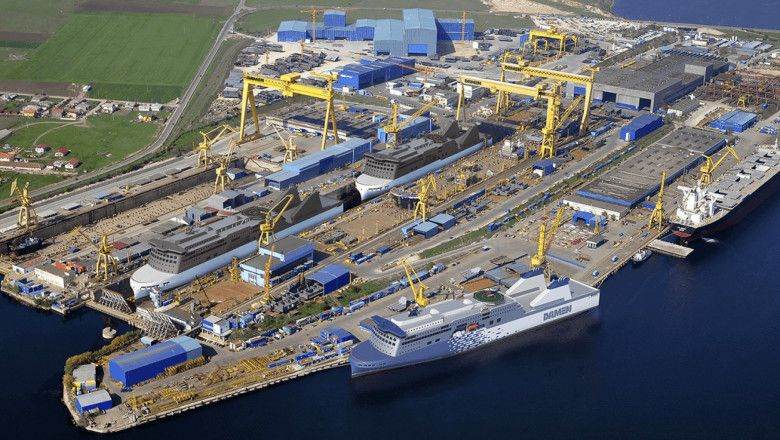
The government is preparing the ground for one of the most sensitive and controversial industrial moves in recent years: the full takeover of the Damen Mangalia Shipyard, followed by its transfer to a strategic circuit controlled, according to political and military sources, by the German giant Rheinmetall, in order to build military ships financed through the European SAFE mechanism. The indications regarding the full takeover of the Damen Mangalia Shipyard come from two clear directions: the new legislative framework prepared by the Executive and the increasingly direct statements of the Minister of Defense, which indicate a massive intervention by the state in an asset in collapse.
The draft emergency ordinance analyzed in first reading in the government meeting on March 19 formally introduces the instruments through which the state can intervene directly in companies considered "of strategic interest", including through preemptive rights over assets and participations, monitoring mechanisms and, above all, the possibility of intervention in situations where the functioning of certain capacities is affected or risks being affected.
The list of areas targeted leaves no room for interpretation: the defense industry, the maritime and port industry, transport and energy production, are all explicitly included. In other words, including the Damen Mangalia Shipyard.
Beyond the technical formulations, the essence of the draft emergency ordinance is deeply political and strategic: the state creates its legal framework to take control of industrial assets in difficulty, under the pretext of protecting the national interest. The Mangalia case is the perfect manual for such an intervention. With a liquidation value of only 85 million euros and debts that have reached 162 million euros and are constantly growing, the shipyard is practically stuck in an area from which the market can no longer save it.
The statements of the Minister of National Defense, Radu Miruţă, on February 5, foreshadowed this legislative picture: "That shipyard can only be saved if in the immediate future it produces such ships,” he said, referring to corvettes and other military ships financed including through SAFE. It is not just an opinion, but a condition: the rescue is directly linked to the militarization of production and the integration of the shipyard into a European armament program.
At this point, the two plans, legislative and military, overlap almost perfectly. The state is creating its instruments to take over a strategic asset in difficulty, and the Ministry of Defense is already indicating the use of that asset for military production financed from European funds. What is missing from the official discourse, but increasingly clear from information coming from political and military sources, is the next stage: who will actually operate this shipyard.
The cited sources converge on a name with weight in the European defense industry: Rheinmetall, which has recently entered the German naval industry. The company, already involved in multiple military projects in Europe and interested in expanding production capacities in the east of the continent, would receive access to the Mangalia platform after the Romanian state cleans up the legal and financial situation of the shipyard through a takeover. Basically, the state would absorb the losses and blockages accumulated in recent years, in order to subsequently offer the "clean” infrastructure to a strategic player capable of quickly delivering the ships required under SAFE.
This sequence of steps also explains the insistence of the Minister of Defense on the fact that it is not just about saving a shipyard, but about integrating Romania into an accelerated European military production chain, in which speed of execution is essential. The problem is that the Damen Mangalia Shipyard, in its current form, does not have the capacity to deliver these ships in a timely manner, and this is known even at the industry level, where it is openly stated that other facilities, such as those in Galaţi, are much more prepared for such contracts.
However, this is where the political factor comes in. Instead of a market solution, based on real industrial capacity, the state seems to be betting on a combination of legislative intervention, public financing and subsequent strategic partnership. It is, in essence, the continuation of the model that led the shipyard to its current situation, but on a much larger scale and with direct geopolitical implications.
Under these conditions, if the military ships are not ready by the deadline, the end of 2030, the risk is the loss of the SAFE allocation for the naval sector in our country. Military sources have told us that the Bologna government's initiative repeats the mistakes of 2018, without taking into account that now the stakes are no longer just a construction site, but Romania's positioning in Europe's defense industrial architecture. And the cost of a wrong decisions could be much higher than the 162 million euros of debt accumulated so far by Damen Mangalia Shipyard.
In the absence of a transparent strategy, a clear restructuring plan and guarantees regarding economic efficiency, the scenario that is emerging is one in which the state becomes the savior of last resort, only to later transfer control to an external actor, at a time when the pressure of deadlines and European commitments will make any step back impossible. And if this plan is confirmed, Damen Mangalia Shipyard will no longer be just a symbol of an industrial failure, but also an example of a strategic bet made in haste, under the pressure of time and the geopolitical context.


























 Euro
Euro Dolar SUA
 Franc elveţian
 Liră sterlină
 Gram de aur