 English


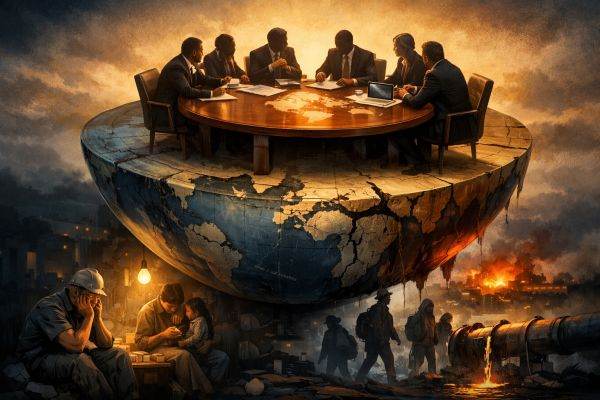
Thousands of global finance officials are gathering in Washington this week for the spring meetings of the World Bank and the International Monetary Fund (IMF), events overshadowed by the US-Israeli war with Iran, which threatens to slow global growth and fuel inflation, according to thearabweekly.com.
The extent of the conflict's impact on the economy will depend on the durability of the two-week ceasefire announced by US President Donald Trump in recent days. The ceasefire has stopped most attacks, but it has not ended Iran's effective blockade of the Strait of Hormuz, which has caused the world's largest disruption to energy supplies, nor has it calmed the parallel war between Israel and the Iranian-backed Hezbollah in Lebanon, the source cited notes.
• World Bank President Warns of Huge Job Shortage
World Bank President Ajay Banga has sounded the alarm about the risk of a huge job shortfall for the 1.2 billion people who will reach working age in developing countries in the next 10 to 15 years. On the current trajectory, those savings will only create about 400 million jobs, leaving a shortfall of 800 million, Banga told Reuters.
Ajay Banga, the former CEO of Mastercard, acknowledges that it is difficult to maintain focus on long-term issues given a series of short-term shocks that have hit the global economy in the wake of the Covid-19 pandemic, most recently the war in the Middle East. Ajay Banga wants to make sure that finance officials stay focused on long-term challenges, such as creating jobs, connecting people to electricity and providing clean water. "We have to do more than one thing at a time. There are short-term issues, the ones we are going through now, but in the long term, we have the jobs and water issues,” Banga said.
The World Bank's Development Committee has outlined plans to work with developing countries to simplify policies and regulations that have hindered investment and job creation for years.
Discussions at the current meeting will cover topics such as transparency in licensing, fighting corruption, labor laws, land rights, barriers to starting a business, logistics, more efficient trading systems and non-price trade barriers, Banga said.
The World Bank official is optimistic that solutions can be found to help young people find jobs and to create opportunities for private companies to meet their needs. "I don't think we will reach an ideal situation in the next 15 years where everyone has a job, but if we do nothing, the consequences will be serious, including illegal migration and instability,” Banga said. United Nations data shows that more than 117 million people have been displaced worldwide as of 2025.
In addition to jobs, access to water will be a focus of the meetings, according to the source. The World Bank, together with other development banks, is set to announce an effort to provide safe drinking water to an additional billion people, in addition to existing initiatives to connect 300 million households in Africa to electricity and improve healthcare.
• Global Growth Uncertainty
The IMF and World Bank have already signaled they will cut their global growth forecasts and raise their inflation forecasts in the wake of the Iran war, with emerging markets and developing countries seen as the hardest hit.
Few countries are immune to the disruption of energy shipments through the Strait of Hormuz. Dozens of governments have already taken action to conserve energy or support consumers, the source said.
Germany's coalition government, for example, which initially resisted calls for support, has agreed to cut fuel prices for consumers and businesses by 1.6 billion euros ($1.9 billion) by cutting excise taxes on diesel and gasoline.
"This war is the real cause of the problems we are also facing in our own country,” Chancellor Friedrich Merz said.
The Swedish government, for its part, said it would cut fuel taxes and increase electricity subsidies in a package worth about $825 million"It is a signal that we will do whatever is necessary to cushion the blow to households caused by what is happening now,” said Swedish Finance Minister Elisabeth Svantesson.
British Chancellor Rachel Reeves is due to present her approach to helping businesses struggling with high energy prices later this week. Writing in the Sunday Times, Reeves said UK manufacturers "have been faced with uncompetitive energy prices for too long.”
Separately, Prime Minister Keir Starmer told the BBC: "We live in a world of major conflict, great uncertainty, and I firmly believe that the UK's interests lie in a stronger and closer relationship with Europe.”
• Central bank policy hinges on Iran war outcome
The Iran war is also influencing central bank policy around the world as policymakers try to understand how much the conflict will hurt economic growth and push up inflation.
European Central Bank (ECB) Vice President Luis de Guindos said yesterday that any interest rate hike by the ECB would depend on how crude oil prices affect prices more broadly.
Bank of Japan policymakers are also keeping their options open ahead of this month's rate-setting meeting, but the chances of a hike - once considered a possibility - are fading.





















 Euro
Euro Dolar SUA
 Franc elveţian
 Liră sterlină
 Gram de aur





























