 English

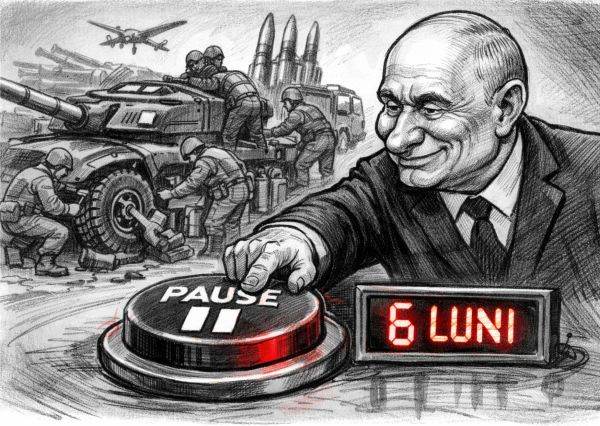
A possible ceasefire in Ukraine would not mean stability, but could open a window of extreme risk for European security, in which Russia would be able to attack another neighboring state, says the Munich Security Report 2026, which prefaces the Munich Security Conference to be held from February 13 to 15, as an unprecedented strategic alarm signal.
"A ceasefire in Ukraine would not necessarily mean stability. Russia could use such a pause to rebuild its forces and could be able to attack another neighboring country within six months,” the report says, in an assessment that radically changes the meaning of any discussion about peace, de-escalation or freezing of the conflict.
This information was apparently already on the table of NATO decision-makers, since allied forces conducted a military exercise in Lithuania, the scenario of which refers to the invasion, by the Russian Federation, in October, of an Alliance member state, according to a news report presented by Fox News.
This vulnerability is amplified by the broader political context described in the report, which places the risk of a new Russian aggression in a world that has entered a phase of "wrecking ball” politics, in which the destruction of the existing order has become not an accidental consequence, but an assumed strategy. The Munich Security Report 2026 shows that, more than eight decades after its construction, the post-1945 international order, built and guaranteed by the United States, is subject to accelerated erosion even by its main architect. This reality does not remain without effect on the Kremlin's calculations, which operates in a strategic environment in which rules are increasingly fluid, and the costs of violating them seem increasingly difficult to anticipate and impose.
The cited document emphasizes that Europe has entered a prolonged era of confrontation, amid Russia's large-scale war of aggression and the expansion of its hybrid campaigns, which target not only Ukraine, but also the political, economic and social stability of European states. At the same time, Washington's gradual withdrawal from its traditional role as the main guarantor of Europe's security, reflected in hesitant support for Kiev and in the increasingly aggressive rhetoric regarding Greenland, amplifies the feeling of insecurity on the continent. The United States' approach to European security is perceived, according to the report, as volatile, oscillating between reassurance, conditionality and coercion, a combination that seriously complicates the strategic planning of European allies.
This ambiguity is all the more dangerous as the data presented by the cited source indicate a growing discrepancy between real risks and public perception. Although Russia continues to wage a war of attrition in Ukraine and to strengthen its military and hybrid capabilities, in many G7 states the perception of Russia as a major risk has decreased compared to the previous year, being overtaken by fears related to domestic economic crises, disinformation, political instability or trade wars. The report implicitly warns that this "strategic fatigue” may create exactly the window of opportunity that Moscow could try to exploit after a possible ceasefire, using the pause not for de-escalation, but for the regeneration of forces and testing of NATO's eastern flank. In this context, the idea of a ceasefire presented as a quick solution to stop the war in Ukraine appears, when reading the report, as a dangerous illusion. The authors show that freezing conflicts has not historically produced lasting stability, but has allowed the aggressors to return under more favorable conditions. The assessment that Russia could be capable of attacking another neighboring state within six months of a ceasefire is operational, not rhetorical, and reflects analysis of military capabilities, the pace of force recovery, and previously observed strategic behavior.
For Europe, this perspective overlaps with an incomplete transition from security consumer to security provider. While European states have responded by increasing defense spending, forming flexible leadership coalitions, and providing Ukraine with the means to continue its war effort, the report raises serious questions about the sufficiency of these measures in the absence of a functioning Pax Americana. Doubts about Europe's ability to compensate for the erosion of American guarantees constantly loom over risk assessments.
The Munich Security Index 2026, an index included in the aforementioned report, confirms this assessment in a brutal statistical manner. In all G7 countries analyzed, the perception that the policies of current governments will make future generations more prosperous is in the minority, while the expectation that they will leave future generations "worse off” is dominant, reaching absolute majorities in France, Germany and the United Kingdom. This loss of confidence is not marginal but structural, and feeds exactly the climate described by the report: disillusionment with reform, rejection of incrementalism and acceptance of demolition as a legitimate political solution.
In this psychological framework, the perception of global risks has radically reconfigured. According to the aggregate G7 rankings for the period 2021-2025, the risks considered the most serious are no longer environmental, although the real costs of climate change are growing rapidly, but threats perceived as immediate and conflictual: cyberattacks on one's own country, a domestic economic or financial crisis, disinformation campaigns by hostile actors and trade wars. Between 2021 and 2025, disinformation from the "enemy” rose nine places in the G7 hierarchy, trade wars rose ten, and the perception of domestic economic risk rose five places, signaling a world in which insecurity is experienced more as a deliberate attack than as a systemic phenomenon.
In this tense context, the Munich Security Conference on February 13-15 takes on a significance that goes far beyond the usual format of transatlantic dialogue. The presence of the United States through Secretary of State Marco Rubio takes place at a time when the American administration is perceived as one of the main factors in the reconfiguration of the global order, and the messages coming from Washington are analyzed not only for their declarative content, but also for their implications for real deterrence. For European allies, the stakes are not only to clarify the US position on Ukraine, but also to assess the credibility of American commitment in a scenario in which Russia would decide to test the Alliance in an extremely short time frame.
The Munich Security Report 2026 sends an unequivocal message: the world is rapidly moving away from the logic of reform and towards a logic of demolition, in which fragile armistices, transactional agreements and strategic ambiguity can become catalysts for violence. If this warning is ignored or diluted in vague diplomatic formulas, the risk that Europe will face a new major security crisis, just a few months after a possible armistice in Ukraine, will increase significantly.


















 Euro
Euro Dolar SUA
 Franc elveţian
 Liră sterlină
 Gram de aur





























