English

The fight within the judiciary, waged less and less discreetly between the power core coagulated around the Section for judges of the Superior Council of Magistracy and the opposition group vocally represented by members of the Section for prosecutors, re-emerge with unprecedented force after the Court of Justice of the European Union invalidated the approach of the High Court of Cassation and Justice on the matter of prescription for serious fraud affecting the financial interests of the European Union, and the European Commission noted, in its 2026 Rule of Law Report, the lack of progress in investigating corruption in magistracy, the pressures exerted even from within the judicial system and the blocking of some steps to reform the Justice Laws.
The conflict is no longer a doctrinal one, carried out between specialists concerned with the subtleties of criminal law, but has become an open confrontation for the control of justice, for establishing the relationship between judges and prosecutors and, ultimately, for defining the limit to which the independence of the magistrate can be invoked without it turning into an institutional screen of impunity.
In one camp is the dominant core of the Judges' Section of the Supreme Court of Justice, publicly associated with Lia Savonea, the current president of the High Court of Cassation and Justice, former president of the Council and one of the most influential figures in the judicial system in the last decade. On the other side is a group formed around some prosecutors from the Supreme Court of Justice, some critical magistrates and voices demanding a return to a criminal justice system capable of investigating corruption within the judiciary as well.
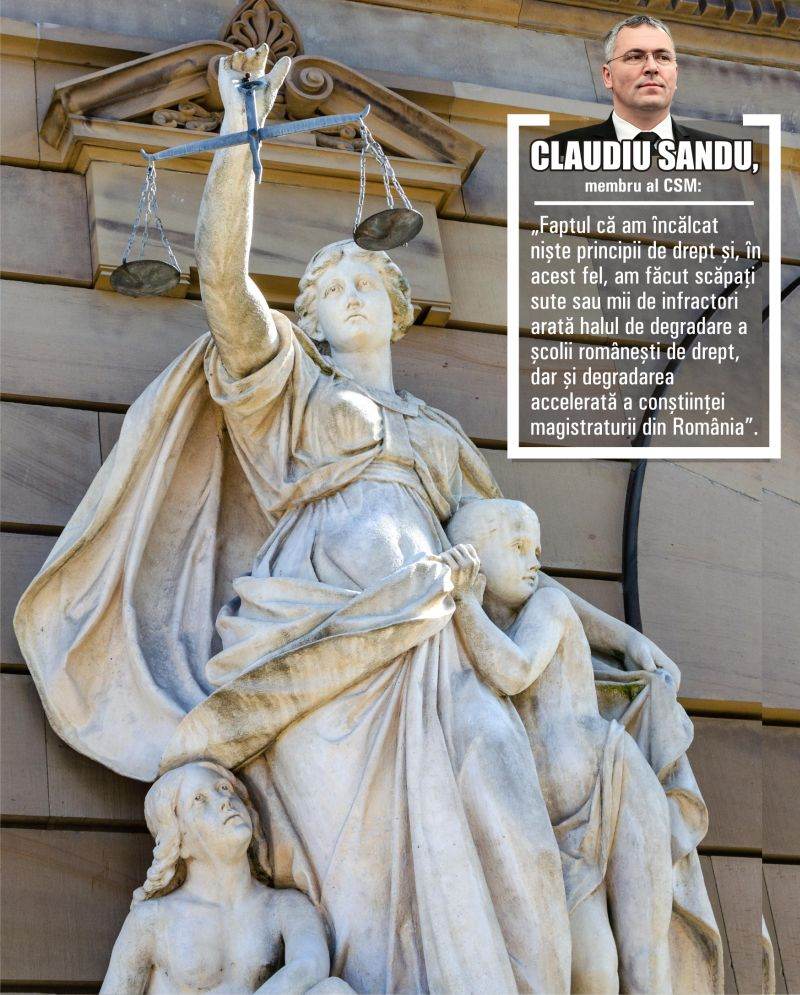
The most outspoken representative of this camp is prosecutor Claudiu Sandu, a member of the Supreme Judicial Council and former vice-president of the Council, who, after the CJEU ruling in the Lin II case, launched a devastating attack on the way in which the Romanian justice system allowed a huge number of criminal cases to be closed by prescription.
"The fact that we violated some legal principles and, in this way, let hundreds or thousands of criminals escape shows the state of degradation of the Romanian law school, but also the accelerated degradation of the conscience of the Romanian judiciary,” said Claudiu Sandu. The prosecutor's verdict does not only target a legal misinterpretation, but an entire institutional mechanism that he claims has cultivated impunity: "Through decisions of the CCR, decisions of the ÎCCJ, by annulling evidence, returning files, by forgetting files in files, by granting tens and hundreds of deadlines until the statute of limitations expires, we have amplified the feeling of impunity of criminals, therefore we have directly contributed to amplifying the desire for anarchy".
• CJEU ruling - an indictment regarding the acquittal of "white collars" by the ÎCCJ
The stakes of the dispute have been settled legally, at least for the cases still pending regarding serious fraud affecting the Union budget, by the judgment delivered by the CJEU on 16 July 2026 in case C-280/25, Lin II. The European Court has established that the approach adopted by the ÎCCJ after the first Lin ruling is not in accordance with Union law. The dispute stems from the combined effects of the Constitutional Court decisions of 2018 and 2022 concerning the interruption of the prescription period and the 2022 Decision of the ÎCCJ, by which the absence of causes of interruption was extended, by virtue of the more favorable criminal law, also to crimes committed between 2014 and 2018. In Lin I, the CJEU had asked Romanian courts to leave this standard unapplied in cases concerning serious fraud against the financial interests of the Union, in order to avoid a systemic risk of impunity. However, the ÎCCJ responded, in 2024, that Romanian judges could not do so without violating the principle of legality and the prohibition of constructing a third law through judicial means, known as lex tertia. Lin II explicitly rejected this interpretation.
The European Court of Justice has ruled that fraud affecting the financial interests of the Union must automatically be considered "serious” when its total value exceeds 50,000 euros, even if the part of the damage actually borne by the European budget is below this threshold. The CJEU also stated that its first ruling does not oblige Romanian courts to invent a new criminal law and does not violate either the principle of legality of criminalisation and punishment, or the guarantees of the European Convention on Human Rights. The conclusion is categorical: the standard resulting from the 2022 CJEU Decision cannot be used in ongoing cases to produce p rescript of serious fraud against European financial interests. Final closed decisions are not automatically reopened, because the CJEU protects the authority of res judicata, but cases still under appeal in cassation cannot, in principle, be treated as definitively closed. This is the exact limit of the decision, beyond the maximalist interpretations that have appeared in the public sphere.
The High Court reacted by claiming that it has always applied European law in good faith and that the fidelity of the supreme court does not belong to a particular case-law solution, but to the fundamental values of the rule of law. However, the CJEU decision does not sanction the declared intentions of the ÎCCJ, but the concrete legal effect of its interpretation: the extension of a solution that considerably increases the risk that serious fraud will go unpunished. This is precisely where the rupture between the two camps lies. For the core around the leadership of the High Court, the declared priority is the protection of criminal legality, legal certainty and the independence of the judge. For its critics, the same principles have been transformed, through successive interpretations, into a mechanism that has closed cases, nullified responsibilities and reinforced the belief that time systematically works in favor of the defendants.
Claudiu Sandu took the accusation to the end: "Ultimately, that general risk of impunity that the CJEU speaks of is the most dangerous for a state governed by law, for a democracy, because it transforms a country into a paradise for criminals. From here to anarchy is just one step away.” In his opinion, the Lin II ruling is "a true lesson in law, the kind that makes you wonder what law school you graduated from,” and the retrial of definitive cases through extraordinary appeals, followed by a radical change in solutions, would demonstrate "both ignorance and bad faith.” These are extremely serious statements coming not from a politician, an activist or a commentator, but from a member of the constitutional body tasked with guaranteeing the independence of the judiciary.
• Rule of Law Report - a document that highlights the problems of the Romanian judiciary
However, the root of the conflict is much older than the Lin decisions. It goes back to the period of maximum DNA strength, when anti-corruption prosecutors could initiate criminal prosecutions against judges suspected of corruption, and the mere opening of a file caused fear in the system that the prosecutor's investigative power could be used to intimidate the courts. From this, two incompatible narratives emerged. The first claimed that prosecutors, especially those of the DNA, had acquired excessive power over judges and that the independence of the judicial act could be affected by criminal files, technical surveillance and institutional pressure. The second warned that removing magistrates from the DNA's jurisdiction and building a separate criminal circuit around the Section for the Investigation of Crimes in Justice will create a protected zone in which corruption in the judiciary will no longer be investigated effectively.
Established in 2018, the SIIJ took over from the DNA exclusive jurisdiction over crimes committed by judges and prosecutors. The structure was criticized by the European Commission, the Venice Commission and the CJEU, on the grounds that, in the absence of objective justifications and sufficient guarantees, it could become an instrument of pressure on magistrates. The SIIJ was abolished in 2022, but its powers did not return to the DNA, but were distributed to specially designated prosecutors within the General Prosecutor's Office and the prosecutor's offices attached to the courts of appeal. So, the institution is gone, but the fundamental controversy remains: who investigates magistrates, who selects the investigators, and how effectively can judicial corruption be investigated in a closed system, where careers, delegations, promotions, and leadership positions depend on a small number of decision-makers?
The European Commission's 2026 report provides ammunition for the prosecutors' camp. The document shows that no further progress has been made in ensuring effective investigation and prosecution of corruption crimes in the judiciary and recommends that Romania take concrete measures. The report also mentions concerns regarding the 430 leadership positions held by delegation out of a total of 657 at the beginning of 2026, the withdrawal of cases from judges, secondments and transfers to other panels, the transparency of promotions, the composition of the governing boards, and the representativeness of the SCM. More seriously, the Commission notes that, in three cases in 2025 and 2026, the High Court of Justice upheld the challenge of judges due to their intention to ask questions to the CJEU or to request an advisory opinion from the European Court of Human Rights. The judges in question were the very ones who had initiated the preliminary references in Lin II and Lin III. For the European Commission, the freedom of the national judge to refer the CJEU is an essential component of the European legal order, not an indication of a lack of impartiality.
The report also shows that the High Court of Justice suspended, on 25 March 2026, the Prime Minister's decision to establish the Committee for the Analysis and Revision of Justice Laws, blocking its activity, and the Bucharest Court of Appeal subsequently annulled, on 6 July, the act establishing the committee. The body had been created to analyse precisely the issues that divide the judiciary today: massive delegations, changes in panels, promotions, management appointments and the concentration of administrative power. The Commission also notes that the committee's report recommends returning to the DNA the competence to investigate corruption offences committed by magistrates.
• The fight between magistrates affects the political scene
This is the context in which an apparent administrative dispute regarding the salaries of public sector employees has acquired the significance of a new front in the war between the judiciary and the government led, even temporarily after the dismissal by motion of censure, by Ilie Bolojan. On July 21, the Bucharest Court of Appeal admitted the request of the Sanitas Union and suspended the "procedure of the draft law on the salaries of personnel paid from public funds”, published on the website of the Ministry of Labor under the "Press releases” section. The request was resolved in a few hours, without subpoenaing the ministry, according to Minister Dragoş Pîslaru. A provisional procedure can be tried under certain conditions without subpoenaing the parties, but the essential legal question remains which administrative act producing legal effects was suspended and what was the imminent damage that justified the court's intervention. The definitive answer cannot be formulated before the publication of the reasoning for the decision.
The minutes do not suspend a draft law adopted by the Government or any normative act in force, but a "procedure” presented in a press release. The dismissed Government could no longer adopt the project in the usual procedure, and the Ministry of Labor claims that it was only carrying out technical activities and consultations, with the eventual initiative to be taken up by parliamentarians. Dragoş Pîslaru reacted without reserve: "The cuckoo has sung again”, a transparent allusion to the influence he attributes to Lia Savonea in the system. "We thus note a new speed record of the judicial system, which seems to operate on automatic fire when it comes to decisions against the current Government and the mandate of PNL president Ilie Bolojan”, stated the minister. He qualified the suspension as "simply without the object of the work” and announced that the social dialogue and technical substantiation will continue.
The decision is all the more sensitive as the new salary law also concerns magistrates, and its adoption is associated with a PNRR milestone valued at 770 million euros, with the deadline indicated by the authorities for August 31. The speed of the procedure, the absence of a summons from the ministry and the unusual wording of the minutes fuel the perception of a judiciary that intervenes directly in the political confrontation. However, until the publication of the motivation and the resolution of the possible appeal, it cannot be rigorously stated that the decision was ordered, coordinated or adopted in the interest of a camp in the judiciary.
On the same day, the other front of the Romanian justice system was activated at the Ilfov County Council and the Ilfov County Hospital, where the European Prosecutor's Office carried out seven searches in a file regarding a project of approximately four million euros, financed by the PNRR for the prevention of nosocomial infections. The investigation, currently in the in rem phase, concerns suspicions of fraud in public procurement and abuse of office. According to the information made public, the value of the project was artificially inflated, and the documentation contained almost 70 inauthentic price offers. The file was initially notified by the DNA, and OLAF later submitted a report on the suspicions of fraud and provided operational support. The Ilfov County Council announced that it had handed over all the requested documents and that any officials who violated their duties must bear the rigors of the law.
The President of the Ilfov County Council, Hubert Thuma, is one of Ilie Bolojan's internal political opponents, a fact that inevitably projects the investigation into the broader context of the conflict within the PNL. The coincidence is explosive: on the same day, a court abruptly suspends an important procedure for Ilie Bolojan, and European prosecutors search the institution led by one of his internal opponents.
• The War in Justice increases citizens' distrust in the third power in the State
In the background, the CJEU accuses the existence of a systemic risk of impunity generated by the interpretation of the ÎCCJ, the European Commission complains about the lack of effective investigations into corruption in the judiciary, and a member of the CSM describes Romania as "a failed country" in which "everything is permeated by corruption". Separately, each episode has its own legal explanation. Together, they paint the picture of a system torn in two, in which almost every decision, investigation, delegation or appointment is read through the grid of the war for power.
The major danger does not consist only in the victory of one of the camps. A justice system dominated by prosecutors, in which the criminal investigation can become an instrument of pressure on the judge, is incompatible with the independence of the court. But a justice system dominated by a closed judicial apparatus, in which the bosses control the delegations, panels, promotions and institutional reactions, and the investigation of the corruption of magistrates is almost paralyzed, can also become equally dangerous. Independence cannot mean immunity, just as criminal responsibility cannot become intimidation.
The confrontation between the two sections of the CSM is, in reality, the fight for the answer to a question that the Romanian judicial system has been postponing for almost a decade: who guards those who dispense justice? The Lin II judgment and the European Commission Report show that the answer provided so far no longer convinces either Luxembourg or Brussels and, increasingly evidently, no important part of the Romanian judiciary. If the camps continue to use the independence of the judiciary as a weapon against each other, the result will not be the strengthening of the rule of law, but the collapse of public trust. And in a system in which judges suspect prosecutors of abuse, prosecutors accuse judges of having built impunity, politicians denounce judicial decisions with dedication, and citizens no longer distinguish between law and influence, the "criminals' paradise” invoked by Claudiu Sandu risks no longer being just a rhetorical formula, but the diagnosis of a justice system that is consumed in a war with itself.
























 Euro
Euro Dolar SUA
 Franc elveţian
 Liră sterlină
 Gram de aur