English


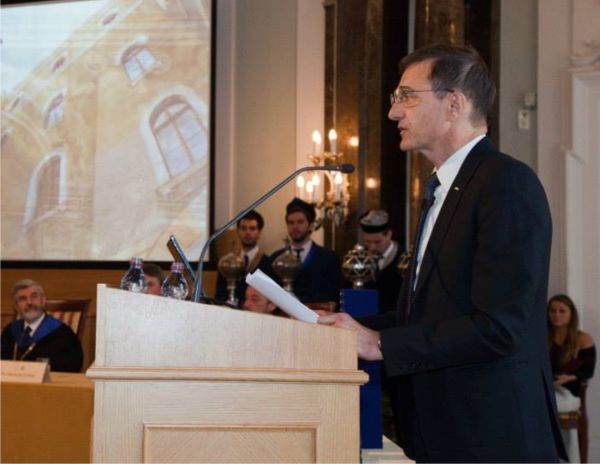
The President of the Romanian Academy, Ioan-Aurel Pop, declared that the current context in the Republic of Moldova represents "the most important moment in history” to start a unification action, underlining the decisive role of cultural and scientific cooperation in this process. The statements were made during the meeting to establish the Romanian Academic Council (CAR), a platform for collaboration at the highest level between academic institutions in Romania and the Republic of Moldova. Ioan-Aurel Pop drew attention to the difficulties encountered in establishing a branch of the Romanian Academy in Chisinau, mainly due to the restrictive legislative framework. According to him, the 2001 law explicitly limits the number of branches of the Academy, which prevents the institution from expanding: "We are not succeeding in a country where 82% of the inhabitants declare themselves Romanian or Moldovan and where, by the Constitution, the language of the country is Romanian,” said Pop. The President of the Academy explained that the institution has initiated steps to amend the law, but the legislative process is progressing slowly, requiring a firmer intervention at the parliamentary level.
• Model of other states: the Hungarian example
In comparison, Ioan-Aurel Pop offered the example of the Hungarian academic community, which managed to establish a branch in Cluj within a period of approximately one year. "We have been struggling for so long and we are not succeeding,” he said, emphasizing the differences in institutional efficiency and political will. The President of the Academy of Sciences of Moldova, Ion Tighineanu, indicated that approximately 80% of the members of the institution he leads would support an institutional rapprochement with the Romanian Academy.
According to Ioan-Aurel Pop, such a project cannot be achieved without a consistent effort by the Romanian state, including from a legislative and financial point of view.
• Unification, through culture and science
The head of the Romanian Academy pleaded for the resumption of a historical model, evoking the Union of Bessarabia with Romania in 1918, achieved - according to him - by consolidating cultural and scientific unity. "If we set an example through what we are doing here, society will understand that things can move forward," Pop declared, warning that the lack of action could postpone such objectives for another "50 years." The event at the headquarters of the Romanian Academy marked the official launch of the Romanian Academic Council, a structure for scientific cooperation in the Romanian space. Ioan-Aurel Pop's statements go beyond the strictly academic sphere and send a signal with political and symbolic implications, at a time when relations between Romania and the Republic of Moldova are in a phase of consolidation.




















 Euro
Euro Dolar SUA
 Franc elveţian
 Liră sterlină
 Gram de aur