English

After two weeks of armed conflict in the Middle East and with Israeli military (IDF) officials stating on Sunday, March 15, as quoted by the Jerusalem Post and The Times of Israel, that operations are planned for at least another three weeks, the economic stakes are no longer just the evolution of the military front, but the duration of the energy shock and the capacity of the global economy to absorb it.
The oil market has already passed the emotional reaction phase: Brent surpassed the $100 per barrel threshold last week and even reached a peak of $119.50, and Reuters journalists noted that Brent and WTI are 40% higher in price compared to February. In parallel, the International Monetary Fund warned that a prolonged oil shock could fuel global inflation, and the International Energy Agency (IEA) stated that the Strait of Hormuz remains a critical point, with almost 20 million barrels per day passing through it in 2025, while alternative routes can only take 3.5-5.5 million barrels per day.
Under these conditions, three working scenarios can be outlined, built as analytical estimates based on current market data, the relationship between oil prices, inflation and economic growth, as well as the current pace of disruption of energy flows.
Reuters notes that the IEA sees a decrease in global supply of about 8 million barrels per day for March and that member states have decided on a coordinated release of 400 million barrels from strategic reserves, which shows the magnitude of the shock, but also the fact that the authorities are trying to buy time, not to solve the problem from a structural point of view.
• Scenario I: Three more weeks of war
This is the scenario of a severe but still manageable crisis. The basic assumption is that there is no widespread and irreversible destruction of the energy infrastructure in the Gulf, that flows through the Strait of Hormuz remain very low but not completely canceled in the long term, and that releases from strategic reserves temper panic. In such a framework, the price of Brent oil would be in the range of $95-115 per barrel, with brief episodes of $120-130 if new energy targets are hit or additional naval incidents occur. Reuters already reports that Goldman Sachs has raised its estimate for the March Brent average to above $100 per barrel, and the market continues to include a serious geopolitical premium.
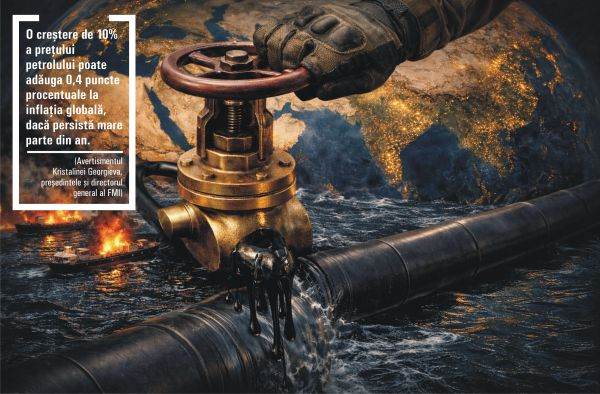
At the macroeconomic level, the three more weeks of conflict announced by the IDF would most likely mean an additional increase in global inflation in 2026 of about 0.1-0.3 percentage points and a reduction in the pace of global growth of 0.1-0.3 percentage points. The estimate derives from the warning of Kristalina Georgieva, the President and Managing Director of the IMF, that a 10% increase in oil prices, if it persists for most of the year, could add 0.4 percentage points to global inflation. In this first scenario, the effect would not be long enough to produce a global recession, but it would be strong enough to push central banks towards more caution and to postpone interest rate cuts. The fastest transmission channel would be fuels, transport, aviation, marine insurance and fertilizers. In the context in which the price of urea has already risen from 487 to 700 dollars per ton in two weeks, according to data presented by Reuters, extending the conflict for another three weeks would maintain pressure on agricultural costs and, implicitly, on food, without generating another generalized food crisis.
• Scenario II: three more months of war
In this scenario, the conflict ceases to be a simple market shock and begins to transform into a global macroeconomic shock. The hypothesis is that the Strait of Hormuz remains only partially functional, that attacks on infrastructure and shipping continue intermittently and that strategic reserves offer time, but do not restore normality. In this scenario, the price of Brent oil would be at 110-140 dollars per barrel, with a credible risk of rising to 150 dollars. Reuters quotes Wood Mackenzie, which considers a level of 150 dollars per barrel possible in a scenario of severe blockade in the Gulf.
Over this horizon, global inflation could be pushed up by 0.4-0.8 percentage points, and global economic growth could lose 0.4-0.8 percentage points. We are not just talking about the spot price of oil here, but about the incorporation of the crisis into contracts, logistics costs, insurance, safety stocks and companies' investment plans. Financial markets would start to rewrite profit and interest rate scenarios, and the dominant risk would become one of moderate stagflation: high inflation, concomitant with weak growth. Reuters already shows that investors are reassessing the trajectory interest rates precisely in light of the new oil shock.
In this second scenario, the pressure on food becomes much more important. Not only does energy become more expensive, but also agricultural inputs, transport and processing. The most vulnerable regions would be the emerging economies importing energy and food, as well as Europe, via the LNG channel, given that the IEA estimates that almost a fifth of global trade in liquefied natural gas depends on Hormuz.
• Scenario III: six more months of war
This is the scenario of a major global shock, with clear signs of stagflation and a high risk of regional recessions. The hypothesis is that there is no credible reopening of the Strait of Hormuz, that energy infrastructure remains under threat, that a significant part of Gulf production remains blocked and that strategic reserves are no longer perceived as a solution, but only as a temporary buffer. In such a configuration, the price of Brent oil could be at 130-170 dollars per barrel, with episodes of exceeding this value depending on military escalations and possible new attacks on oil terminals and fields, Reuters noted that the current crisis threatens key export facilities and that markets are preparing for further increases if energy infrastructure remains exposed. At the macro level, such a scenario could add 0.8-1.5 percentage points to global inflation and could reduce world growth by 0.8-1.5 percentage points, according to the IMF. At this level of duration, the relationship is no longer linear: the effects accumulate in the cost of living, in consumption, in investment, in trade and in monetary policy. Some energy-importing economies would likely enter a technical recession, and governments would be pushed to fiscal compensation measures, temporary subsidies and more aggressive interventions to protect the population and vulnerable sectors. In parallel, companies would accelerate the regionalization of supply chains and investments in energy sources perceived as more secure from a geopolitical point of view.
The essential difference between the three scenarios is an economic one. Three more weeks of war announced by the IDF means, mainly, a risk tax applied to energy, transport and inflation. Three more months already means an increase in price pressures at the macroeconomic level and a serious risk of stagflation. Six more months means the transition to a generalized cost crisis, with effects on food, public finances, interest rates and global growth. That is why the decisive variable is not only the military intensity of the conflict, but its duration and the degree to which the energy blockade in the Gulf transforms from a temporary exception into the new normal.


















 Euro
Euro Dolar SUA
 Franc elveţian
 Liră sterlină
 Gram de aur