English

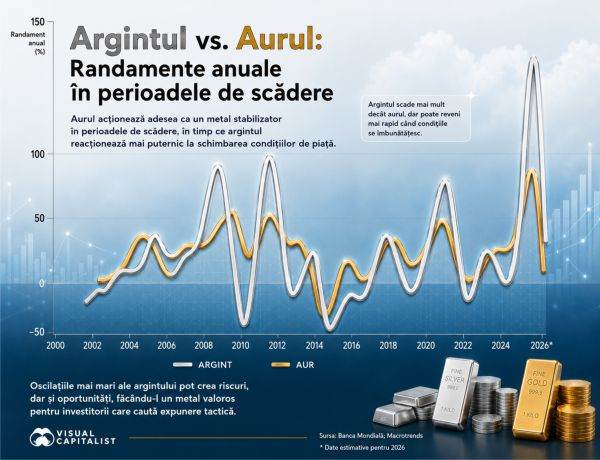
Silver has historically experienced greater volatility than gold during recessions and market downturns. In 2008, for example, the price of gold rose by 3.4%, while silver fell by 26.9%, after which silver recovered, rising by 57.5% in 2009 and by 80.3% in 2010, according to visualcapitalist.com.
Gold and silver are both precious metals, but data shows that they can behave very differently under stress. Gold tends to act as a more stable metal, while silver reacts more sharply as investor sentiment and industrial demand change.
The cited source presents, in partnership with Global X Canada, a comparison of the annual returns of gold and silver during recessions and declines, using data provided by the World Bank and Macrotrends.
• Silver has outperformed gold in both directions
Silver has historically outperformed gold in both directions, according to the source. In 2025, silver rose nearly 150%, more than double the 65% gain for gold. Silver's price spikes have also been followed by significant corrections. In 2008, silver fell 26.9% while gold rose 3.4%, demonstrating the yellow metal's relative resilience during the global financial crisis.
Yet silver has rebounded strongly in the recovery years that followed, rising 57.5% in 2009 and 80.3% in 2010.
• A dual-role precious metal
Silver's sharper moves reflect its dual role as both a precious metal and an industrial input. When markets weaken, silver can come under pressure as industrial demand slows. But when conditions improve, it can bounce back quickly as both investor demand and industrial activity recover.
This is important because silver's volatility can create bigger declines, but also wider price moves. For investors, this makes silver a more tactical precious metal exposure than gold.
As demand for solar, electrification and industrial applications increases, silver remains a key metal to watch for investors interested in long-term supply and demand trends.
• World Gold Council expects central bank purchases to increase
Central banks are expected to increase their gold purchases over the next 12 months, according to a study published in June by the World Gold Council (WGC), conducted between February 5 and May 19, according to Reuters.
According to the WGC, 45% of public reserve managers surveyed, up two percentage points from last year, expect their own institutions to increase their gold holdings over the next 12 months. The majority, 54% of 74 central banks that responded to the WGC's annual survey, say their holdings will remain unchanged, while 1% expect a decline, Agerpres notes.
Most of the responses came after the outbreak of conflict in the Middle East in late February, which led to a rise in oil prices and a drop in the price of gold.
Central bank demand for gold will fall by 15% in 2026 in terms of tonnage, according to consultancy Metals Focus, but remains above pre-2022 levels. According to the WGC, 93% of respondents already reported holding gold, up from 81% a year ago. They say the reasons are driven by gold's performance during times of crisis, its status as a store of value and portfolio diversification. 85% of public reserve managers in developing and emerging markets highlighted gold's role in hedging geopolitical risks.
As some central banks continue to relocate their gold, 9% of respondents said they had increased their domestic storage capacity in the past 12 months, up from 5% last year, and 10% reported diversifying their external storage capacity, up from 2%.



















 Euro
Euro Dolar SUA
 Franc elveţian
 Liră sterlină
 Gram de aur