English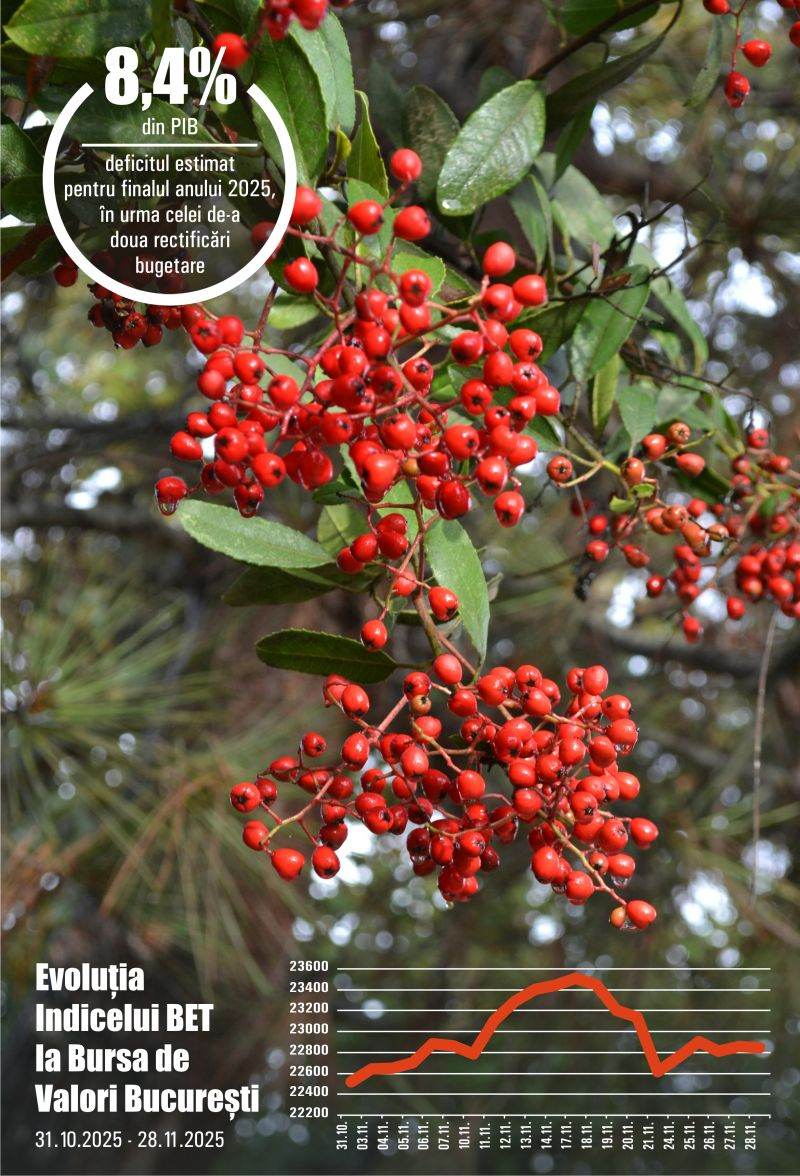
The economic and financial situation of our country has recognized a revival during the last month of autumn, even if the Government continued to allocate amounts for various investments financed from the national budget and from European funds. According to data provided by the Ministry of Finance during November, the budget deficit has slowed marginally, public investments have accelerated, and the Government has continued fiscal consolidation in an economic climate dominated by inflation, financial turbulence and unprecedented security pressures.
The budget execution at ten months confirms a timid correction, of only 0.55 billion lei compared to 2024, but the gap remains huge, i.e. 108.87 billion lei, respectively 5.72% of GDP, a sign that our country is still operating at the limit of fiscal sustainability.
In parallel, the Government adopted the second budget rectification of 2025, through which it ordered the rearrangement of state priorities in order to maintain the budget deficit target for 2025 negotiated with Brussels, while the Fiscal Council sharply warns that the public debt, which has reached almost 59% of GDP, is pushing the country towards the systemic risk zone if reforms are postponed. The pressure was also amplified by the NBR's decision to maintain the reference interest rate at 6.50%, in a context in which inflation is galloping back towards 10%, and the economy is almost stagnating, with a forecast growth of only 0.6%.
In this context, the population continued to finance the state budget through the Fidelis and Tezaur programs. According to the Ministry of Finance, at the end of last month the amount attracted to the state budget through the Fidelis program since its launch amounted to 60.62 billion lei.
Amidst these tensions, the political and institutional scene was shaken last month by two scandals: the resignation of Ionuţ Moşteanu from the position of Minister of National Defense and the searches in the Euroins file.
Regarding defense, the Supreme Council of National Defense approved the new national security strategy and the projects that will be financed with 16.8 billion euros from the SAFE program.
• Ten-month budget deficit, down compared to 2024
On November 27, Alexandru Nazare, Minister of Finance, presented the execution of the general consolidated budget in the first ten months of 2025. According to data provided by the Minister of Finance, the budget execution at the end of October shows a change in direction for Romania's finances, with a deficit of 108.87 billion lei, or 5.72% of GDP, down compared to the same period in 2024, when the level was 109.42 billion lei, or 6.22% of GDP.
The reduction in the deficit by 0.55 billion lei indicates that the measures adopted by the Romanian Government are beginning to show their efficiency, given that revenues have grown robustly and resources have been directed primarily towards investments, which have reached a record pace.
General budget revenues totaled 531.55 billion lei in the first ten months of 2025, an increase of 12.3% compared to the previous year, a sign of improved tax collection capacity. At the same time, expenditures amounted to 640.42 billion lei, registering an advance of 9.9%, which highlights an evolution in which the growth rate of revenues exceeds that of expenditures. Revenues from payroll and income taxes reached 48.62 billion lei, up 19.5% due to a significant advance in dividend tax receipts, increased by 71.8% due to the distribution of dividends in 2024 and the application of the 8% tax rate. Insurance contributions totaled 172.89 billion lei, up 10.5%, while corporate tax revenues totaled 38.14 billion lei, up 15.8% due to the performance of economic agents. Net VAT revenues reached 108.38 billion lei, up 9.2%, an evolution influenced by the increase in refunds, which reached 27.2 billion lei in the period January-October 2025, compared to 25.2 billion lei in the same period in 2024. VAT has registered an accelerated pace since August, with monthly revenues of over 12 billion lei, and October set a new high of 13.6 billion lei. Excise tax revenues totaled 39.66 billion lei, up 10.2%, due to increases in excise duties on energy products and tobacco. Non-tax revenues reached 46.32 billion lei, boosted by payments from the NBR's net revenues and the trading of greenhouse gas emission certificates. In addition, reimbursements from the European Union and donations totaled 40.59 billion lei, up 31.9%.
On the expenditure side, the state spent 140.34 billion lei on personnel, 5% more than last year, but with a lower share in GDP, by 7.4%, due to the reduction of some bonuses and the limitation of salary increases in 2025. In October, personnel expenses were 500 million lei lower than in October 2024, continuing a downward trend that began in July. Expenditure on goods and services rose to 79.71 billion lei, up 5.5%, with positive dynamics especially at the level of local budgets and the National Single Fund for Social Health Insurance, where the costs of medicines increased by 9.8%. Interest expenses reached 46.77 billion lei, 13.91 billion lei above the level in 2024, reflecting the high financing costs. Social assistance cost the state 209.12 billion lei, an increase of 12.7%, strongly influenced by the recalculation of pensions from September 1, 2024, according to Law no. 360/2023, as well as the energy bill compensation scheme, which amounted to 2.86 billion lei over ten months. Subsidies totaled 10.06 billion lei, mainly covering passenger transport, support for agricultural producers and compensation for electricity and natural gas consumption for non-household consumers, where 909.08 million lei were allocated. Projects financed from non-reimbursable external funds involved expenditures of 51.44 billion lei, an increase of 24.56%, while public investments reached 96.04 billion lei, 8.65% more than last year, confirming the direction of resources towards development and modernization.
• Second budget revision, in line with maintaining the deficit target
The government approved, in its meeting on November 28, the second budget revision of 2025, after the one carried out in September. Last month's adjustment was made against the backdrop of an economy estimated to grow by only 0.6%, with a GDP of 1,902 billion lei, an average inflation of 7.1% and an average gross salary of 8,700 lei per month. The new budget configuration significantly changes the structure of public spending: personnel expenses are reduced by 255 million lei, interest is reduced by one billion lei, but spending on goods and services, subsidies and transfers between institutions increases, while funds for projects financed from the PNRR and other European programs are reduced consistently. The adjustments are justified by the need to correlate the budget execution in the first ten months with the financial planning, to ensure the continuity of the activity of public institutions and to cover social, salary and medical payments in an end of the year marked by pressures on public finances.
The rectification brings important supplements for the Ministry of Health, which receives over 1.5 billion lei to finance the medical system and to cover the needs from the Single National Health Social Insurance Fund, while the Ministry of Transport benefits from an additional 750 million lei, and the Ministry of Agriculture from almost 81 million lei. At the opposite pole, the major cuts are found at the Ministry of Finance, the Ministry of Investments and European Projects, the Ministry of Economy, the Ministry of Public Affairs and other institutions where the savings come mainly from projects financed from the PNRR and non-reimbursable external funds, areas where absorption remains well below potential.
The state social security budget is in turn rectified so as to allow the full payment of pensions in December, by increasing revenues by 222.8 million lei and social assistance expenditures by 250 million lei, while other categories of expenditures are adjusted downwards. The unemployment insurance budget registers decreases in both revenues and expenditures, but increases its surplus by over 34 million lei.
Before adopting the rectification, the Fiscal Council issued a decisive preliminary opinion: the new budgetary coordinates remain compatible with a deficit of 8.4% of GDP in 2025, a huge level, but which, in the absence of the adjustments made, would have already exceeded the 9% threshold. The Council's analysts point out that the revisions made are marginal compared to the previous rectification, but they faithfully reflect the current budget execution and make it possible to maintain the deficit within the limits agreed with the European institutions. The main vulnerability remains the absorption of European funds, especially those from the PNRR, where the pace remains insufficient to support the necessary robustness for an economy undergoing a difficult process of fiscal correction.
The Fiscal Council emphasizes, with a sincerity rarely seen in official assessments, that Romania is facing a harsh reality: years of excessive deficits have pushed public debt from 35% of GDP in 2019 to approximately 59% in the summer of 2025, and the beginning of the adjustment process takes place in a fragile international context and in a tense domestic atmosphere. A budgetary consolidation of such magnitude cannot take place without social and economic costs, b ut the postponement would push the country into the risk zone of a sovereign debt crisis, with dramatic implications for living standards and financial stability. The idea of a miraculous increase in collection that would allow avoiding reforms is categorically rejected, and a steep reduction in spending is considered impossible without destabilizing the functioning of the state.
The report reveals a major vulnerability: Romania has the lowest tax collection in the region, at just 28.7% of GDP, well below the Czech Republic and Hungary, below Poland and well below the European average of over 40%. Under these conditions, improving collection becomes a genuine national security issue, and the ANAF reform, including the deep digitalization of the institution, is considered essential for the sustainability of public finances after 2026. In parallel, public investments estimated at 7.8% of GDP following the rectification can temper the restrictive impact of the fiscal adjustment, especially in a context in which 2026 will mark the end of PNRR funding.
The Fiscal Council warns that the coming years with increasing military spending will exert additional pressure on the budget, but the European funds made available through the SAFE program can ease the burden of consolidation and can support the strengthening of defense capacity. At the same time, support measures for the economy can no longer come through fiscal relaxation or direct budgetary interventions, but only through European mechanisms and fiscal credit-type instruments, given that monetary policy must remain prudent in order to avoid pressure on the national currency.
The macroeconomic analysis shows that Romania is still below the desired level in terms of absorption of European funds: at the end of October 2025, the MFF 2021-2027 had an effective absorption of only 11.7%, and the PNRR, on the grant component, stood at 31.6% at the end of September. These figures confirm that Romania has a long way to go, but also that there is a clear direction: strengthening fiscal discipline, accelerating reforms and a total mobilization to maintain economic stability in a period in which the margin of error has become almost non-existent.
• NBR maintains the reference interest rate
In light of the country's economic and financial situation, in the meeting of November 12, the Board of Directors of the National Bank of Romania unanimously decided to maintain the monetary policy interest rate at 6.50%. In making this decision, the NBR management analyzed the new turbulences generated in the economy by the acceleration of inflation and the persistent pressures on macroeconomic indicators.
At the center of the discussions was the abrupt evolution of inflation, which rose to 9.88% in September, a jump attributed to the expiration of the electricity price cap scheme and the increase in VAT and excise duties, measures that had direct and immediate effects on prices. NBR members argue that the increase in the price of electricity has become the main driver of inflation, while fuels have added additional pressure, only slightly cushioned by the cheaper prices of some seasonal food products. Adjusted CORE2 inflation also advanced rapidly, reaching 8.1% in September, amid the accelerated price increase of services and processed foods, a sign that underlying pressures are increasingly being transmitted to the economy. The Council noted that the effects of the VAT increase were almost entirely passed on to prices, fueled by high inflationary expectations and still robust demand in certain sectors. Wage costs, the increase in the prices of some agri-food commodities and the depreciation of the leu completed the picture of pressures that keep inflation high. Also, short-term inflationary expectations of companies and consumers recorded large increases in the third quarter, corrected only marginally later, while long-term ones adjusted moderately upwards, amplifying the risks of persistent inflation. The Council also shows that the purchasing power of the population suffered greatly in the face of these price increases, while the economy continued to move slowly, confirming the modest advance of 1.2% in the second quarter of 2025. Household consumption began to recover slightly after the decline in the first quarter, but investments decreased, and the contribution of inventory changes decreased sharply. Net exports performed better, mitigating the negative impact on GDP, amid a steeper decline in imports compared to exports, which also led to a notable reduction in the trade deficit in the first eight months of the year. However, indicators suggest a likely stagnation of economic activity in the second half of the year, amid the implemented fiscal measures and high inflation, with a deepening of the aggregate demand deficit, in parallel with a slight acceleration in the annual GDP growth rate.
In this context, nominal wages continued to grow at a more moderate, but unit labor costs remained high, putting pressure on external competitiveness and fueling future inflationary risks. Therefore, the Council members drew attention to the risks of wage pressures reaccelerating, despite the dampening effects generated by budgetary consolidation and measures to restrict public sector employment. According to the NBR, the inflation outlook has deteriorated significantly compared to the previous forecast, especially in the short term. Inflation is expected to decline only marginally in the coming quarters, remaining on a high and volatile trajectory, and will return to the target range only in the first quarter of 2027. The new forecast indicates a level of 9.6% for December 2025 and 3.7% for December 2026, values higher than previously anticipated. The Council members underlined the transitory nature of the current inflationary shocks, indicating that their effects will wear off in the third quarter of 2026, which will trigger a sharp correction in inflation. However, risks related to inflationary expectations persist, fueled by the evolution of food and natural gas prices.
We also point out that, from the data published by the NBR on 13 November, it appears that the current account deficit increased to 22.275 billion euros in the period January-September 2025, compared to 20.515 billion in the same period in 2024. The balance of goods and primary incomes contributed to the deepening of the deficit, while services recorded a larger surplus. Non-resident direct investments increased to 5.647 billion euros, signaling robust investment interest, but total external debt rose to 221.283 billion euros, an increase of almost 18 billion euros compared to the end of last year.
• CSAT approves new defense strategy and projects financed from SAFE
The Supreme Council of Defense, meeting on Monday, November 24, 2025, at Cotroceni Palace under the leadership of President Nicuşor Dan, approved the National Defense Strategy for the period 2025-2030, the first document of this type to undergo a public transparency process. The strategy defines Romania's fundamental security directions in a regional context marked by tensions, emphasizing defense modernization, strengthening societal resilience, increasing the Army's response capacity, and revitalizing the national defense industry. The CSAT also validated the risk assessment for 2026, as well as the strategic analysis on the adaptation of the armed forces to new threats, including hybrid warfare and changes in the international environment.
Another major topic was the Defense Industry Investment Plan, for which Romania is requesting funds worth 16.68 billion euros from the European Commission through the SAFE Mechanism, money mainly intended for military procurement and the development of dual infrastructure. All projects must be completed by 2030, and Romanian companies will be integrated into European production chains through a national "match-making" platform.
On November 26, Parliament adopted the National Defense Strategy with 314 votes in favor, 43 votes against and 3 abstentions, after the presentation by President Nicuşor Dan, who warned of the risks generated by Russia's hybrid warfare, corruption, weak administrative capacity and demographic decline. The adoption of the strategy marks a crucial moment for Romania's security and its positioning in NATO and the EU.
• Resignation at the top of the National Defense Ministry
At the end of last month, Ionuţ Moşteanu resigned from his position as Minister of National Defense, following the scandal that erupted in the public sphere regarding his studies and accusations of forgery in his CV. The resignation came on November 28 amid pressure generated by the revelation of a major inconsistency: in an old CV, the minister had stated that he had graduated from Athenaeum University, an institution that officially stated that Moşteanu had never been a student there, and that the specialization in question did not even exist at that time. To calm the scandal, Ionuţ Moşteanu published his real diploma, obtained only in 2015 from Bioterra University, and apologized for the "embarrassing mistake”, stating that he did not want discussions about his academic past to affect the activity of the Army at a sensitive moment for national security.
His resignation coincided with the tensions triggered by another scandal: the DNA investigation into a former social-democratic senator, who allegedly promised one million euros to the Minister of Defense to influence the management of the Romtehnica company in order to conclude commercial contracts. While Moşteanu is not a party to the case, the investigation, which resulted in the preventive arrest of the defendant, increased public pressure on the ministry, contributing to Moşteanu's decision to resign from his position in order "not to overshadow m ision of the Romanian Army”. Following his resignation, the Defense portfolio was taken over on an interim basis by the Minister of Economy, Radu Miruţă.
• Searches in the Euroins Romania bankruptcy scandal
The Euroins Romania scandal has re-emerged in force after prosecutors from the General Prosecutor's Office raided 14 locations in Bucharest and Târgu Mureş, in a case of embezzlement, fraudulent management, money laundering and false reporting that brings to light the biggest collapse in the history of the RCA market. The searches take place almost 1,000 days after the withdrawal of Euroins' license by the ASF, in March 2023, a decision that threw the market into chaos and left millions of drivers without protection.
According to investigators, between 2017 and 2023, the Euroins management, coordinated by the Bulgarian employers, allegedly implemented sophisticated mechanisms fraud, redirecting money from RCA premiums to affiliated entities, while thousands of damage files were rejected, hidden or unreported. An ASF control discovered over 5,800 unjustly rejected files, unpaid obligations of over 60 million lei and penalties that exploded to over 300 million lei. The investigation also reveals a reinsurance mechanism used to extract money from the company when insolvency was becoming inevitable.
Recent revelations show that over 1.5 billion lei were transferred to Bulgaria, while Euroins controlled 31% of the RCA market and generated an unprecedented number of lawsuits - 100,000 in four years. Official sources are talking today about "Euroins clones”, three companies that would try to re-enter the market with the same scheme: low prices, huge portfolios, maximum risk and potential for bankruptcy.
Internationally, Eurohold has opened a new arbitration procedure at ICSID, asking Romania for another 575 million euros, raising its total claims to over 1 billion euros. While the company accuses the illegal withdrawal of the license, prosecutors are seizing documents, servers and phones in an investigation that only now seems to be making up for lost time.
• Fidelis brought over 60.6 billion lei to the state budget
To support budget spending, the Ministry of Finance borrowed from the population last month through a new edition of the Fidelis program, and at the end of the month it launched a new edition of the Tezaur program. The Fidelis edition, held between 7-14 November, confirmed once again the high appetite of Romanians for government bonds, attracting over 1.3 billion lei to the state budget. During the seven days of the offering, 13,864 subscription orders were placed, totaling 477.60 million lei and 164.71 million euros, the equivalent of 823.55 million lei, a result that shows the constant interest of individual investors in this savings instrument. The tranche dedicated to blood donors recorded a remarkable participation, the annual interest of 7.95% and the minimum threshold reduced to 500 lei attracting subscriptions of 88.87 million lei through 2,015 orders. Demand was also strong for lei maturities: 2-year securities, with an interest of 6.95%, attracted 231.66 million lei, and 6-year ones, remunerated with 7.70%, accumulated 121.96 million lei. Euro issues confirmed solid interest, with the 10-year maturity with 6% interest attracting EUR 71.10 million, while the 3- and 5-year maturities totaled EUR 52.10 million and EUR 41.50 million, respectively. Since the launch of the Fidelis program, the amounts attracted have exceeded RON 60.62 billion through 492,864 subscriptions, consolidating its status as the main channel through which the population finances the state, while benefiting from competitive yields and a high degree of safety.























 Euro
Euro Dolar SUA
 Franc elveţian
 Liră sterlină
 Gram de aur