English


The global economy we knew in the first two decades of the 21st century - an open market where capital moved freely, technology spread rapidly, and prices and interest rates tended to converge - no longer exists. In its place has emerged a world fragmented into strategic economic blocs that defend their technology, financing, and supply chains through incompatible rules and divergent interests.
This BURSA dossier, consisting of nine episodes, documents precisely the architecture of this new economic world. It is not a speculative or theoretical analysis, but a rigorous mapping of the reality as of February 2026, based on treaties in force, operational mechanisms, and verifiable data from official sources.
The nine episodes systematically review the major blocs that govern the global economy:
- Episode 1 examines the North American Bloc (USMCA), the industrial stronghold that transformed North America into a production hub protected by regional content rules.
- Episode 2 examines the European Union, which has moved from open markets to geo-economic protection through instruments such as the CBAM and the ACI.
- Episodes 3-4 decode the complex geometry of the Asia-Pacific, where RCEP, CPTPP, and IPEF create a system of overlapping memberships and multi-aligned strategies.
- Episodes 5-6 document the rise of BRICS+ as an alternative financial bloc, including the revolutionary BRICS Bridge infrastructure for digital currency payments.
- Episode 7 reveals the Technology Control Bloc, the restrictive regime through which the US and its allies separate the semiconductor and artificial intelligence ecosystems.
- Episode 8 examines the Gulf Bloc, a unique hybrid - customs and trade integrated, but monetary and fiscally fragmented.
- The Final Episode summarizes the entire analysis, demonstrating how commercial, technological, and financial fragmentation is causing the death of the single base rate and the end of uniform global prices.
The intention of this dossier is twofold: First, to provide investors, analysts, and economic decision-makers with an accurate map of the new global economic reality. Understanding blocs, their rules of operation, and the incompatibilities between them is no longer optional-it is essential for any investment decision, for assessing geopolitical risks, and for anticipating price and interest rate movements.
Second, to demonstrate that fragmentation is not temporary. This is not a crisis that will be resolved by a new round of negotiations at the WTO or by reconciling the great powers. It is the new permanent structure of the world economy, in which each bloc builds its own standards, its own supply chains, and its own financial mechanisms.
For BURSA readers - investors who allocate capital, firms that manage supply chains, professionals who assess risk - the message is clear: the rules have fundamentally changed. The cost of capital, the price of goods, access to technology and the stability of financing now depend on the bloc in which you operate and the strategic relationships of that bloc. The era when you could uniformly calculate the return on a global investment is over. The new rule is difference - between blocs, between rules and between costs. This dossier gives you the tools to navigate this fragmented world with precision and full understanding.
***
• The North American Bloc - the prototype of the new global economic logic
This episode opens the series of analysis of the economic blocs through which the global economy has fragmented in 2026. The North American Bloc, structured by the USMCA agreement, represents the most advanced model of an industrial fortress - an economic space integrated internally, but strongly protected externally by regional content rules and technological barriers.
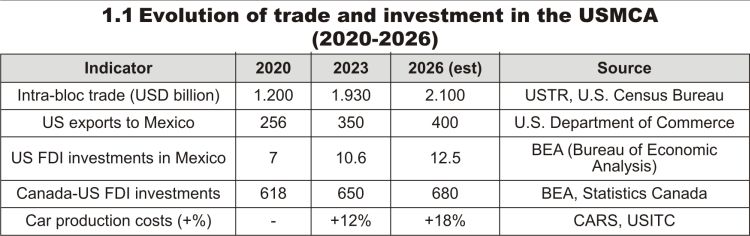
The USMCA is no longer a simple free trade agreement. It is the mechanism by which the United States, Canada and Mexico have transformed the three countries into a coordinated production unit, where components cross borders several times in the assembly process, creating total dependence between factories in the region. The 75% regional content rule for the automotive industry has forced the massive relocation of production from Asia back to North America - this is the essence of operational nearshoring.
• 1. Economic Core: USMCA and the "Continental Factory”
The central pillar of the region remains the USMCA agreement (entered into force on July 1, 2020), which transformed the three states into a coordinated production unit.
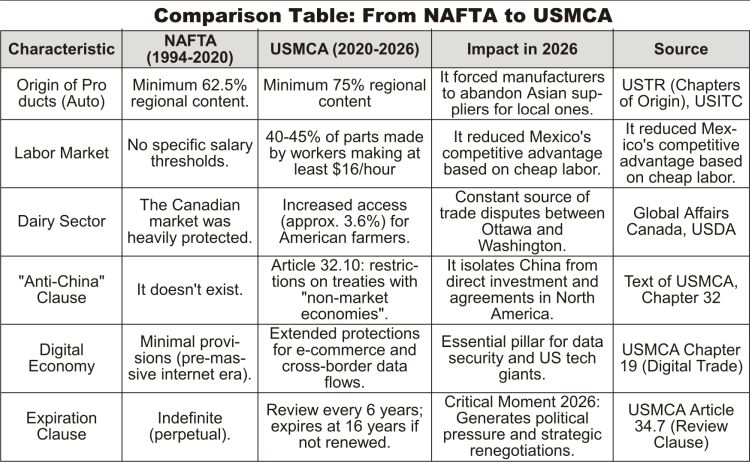
- 75% rule: According to USTR documentation, automobiles must have up to 75% regional content to avoid tariffs. This has forced the relocation of component production from Asia back to the region.
- Automotive and electronics integration: Parts cross borders multiple times in the assembly process, creating a total dependency between factories in the US, Canada, and Mexico.
- Nearshoring: According to UNCTAD (2024), Mexico has become the leading destination for the relocation of supply chains, benefiting from competitive costs and proximity to the US market.
• 2. Technology as a Weapon: The Digital Frontier
The bloc is no longer just a free trade area, but also a mechanism for excluding strategic rivals.
- External barriers: Through the BIS (Bureau of Industry and Security), the US has imposed tough restrictions on the export of advanced chips and lithography equipment, targeting China in particular.
- Friend-shoring: The strategy promoted by the US Treasury encourages exclusive sourcing from "friendly” countries, transforming technology into a national security filter, not just a commercial good.
• 3. Political Frictions: Migration and Security
Despite economic success, the US-Mexico bilateral relationship remains under immense strain.
- Border Crisis: U.S. Customs and Border Protection data (2024-2025) shows record numbers of interceptions, turning migration into a central domestic policy issue in the US.
- Fentanyl: Synthetic opioid trafficking remains the leading cause of overdose deaths in the US (according to the DEA), forcing Washington to view Mexico simultaneously as a vital economic partner and a source of security risk.
• 4. Canada: Stability and Sovereignty
The US-Canada relationship is the most stable, but not without periodic irritations.
- Constitutional Status: Canada firmly maintains its status as a constitutional monarchy under King Charles III, rejecting any fringe rhetoric about a possible political "absorption” by the US.
- Recurring Disputes: Tensions remain in traditional areas: subsidies for lumber, dairy products, and access to critical materials needed for electric batteries.
• 5. Implications for Romania
Opportunities:
- Attracting investment from the US/Canada: Romania can become a regional hub for automotive and IT components thanks to the friend-shoring strategy. For example, Ford Otosan Craiova benefits from integration into global supply chains that adopt resilience standards similar to those in the USMCA to reduce dependence on Asia.
- Exports to the USMCA: Romania's exports to the US reached $2.48 billion in 2024, with potential for growth in the automotive, software and energy equipment sectors, as transatlantic integration progresses.
- Technology partnerships: Romanian IT companies can benefit from collaborations with American firms to align with the security standards of the "Technology Control Bloc", avoiding the restrictions imposed on Chinese ecosystems.
Risks:
- Competition with Mexico: Mexico attracts massive investments that could otherwise end up in Eastern Europe, thanks to preferential direct access to the US market through USMCA.
- Export barriers: Romanian exporters using Asian components may face difficulties in the North American market, as they do not meet the strict regional content rules (75%) required by USMCA for duty exemption.
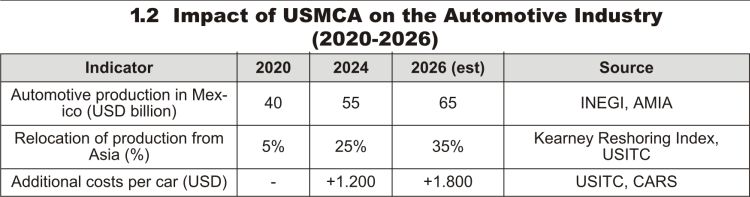
• 6. Case study: Mexico's auto industry after USMCA: integration through rules of origin
After the USMCA agreement entered into force on July 1, 2020, North American auto production operates on the basis of strict rules of origin. Automobiles must reach up to 75% regional content and minimum wage thresholds for part of the production to receive preferential tariff treatment upon entry into the US.
Source: USTR - USMCA text, Rules of Origin, updated 2024.
Manufacturers and suppliers have responded by moving sourcing and production capacity within the region, particularly to Mexico, as a nearshoring destination for the US market. Official analysis shows increased activity among parts and materials manufacturers and higher compliance costs in the automotive sector.
Source: USITC - USMCA Automotive Rules of Origin: Economic Impact and Operation, July 1, 2025.
USITC report shows rising automotive investment in the US and a slight increase in average vehicle prices, with a visible sectoral impact but little macroeconomic impact. The case illustrates the logic of the North American bloc: internal industrial integration and access conditioned by legal rule.
Source: USITC News Release, July 1, 2025.
• 7. Practical recommendations
For Romanian companies:
- Supply chain optimization: Relocating production from Asia to Romania (for the EU market) or to Mexico (for access to the USMCA market), thus avoiding non-compliant regional content taxes.
- Monitoring green standards: Adapting to CBAM for imports and preparing for ESG standards required by USMCA partners.
For public decision-makers:
- Investment incentives: Providing state aid schemes for North American companies in the High-Tech and green energy sectors.
- Trade diplomacy: Supporting green trade corridors with the US and Canada at EU level to facilitate the import of critical components (semiconductors, Li-ion cells) without prohibitive taxes

• Clarifications on sources:
1. USTR (Office of the United States Trade Representative): It is the holder of the final text of the agreement and the main source for the rules of origin.
2. Labor Value Content (LVC): This is the technical name in the treaty for the $16/hour rule, which is monitored by the US Department of Labor.
3. Chapter 32 (Art. 32.10): It is the exact legal source that prohibits USMCA members from concluding free trade agreements with countries such as China without the consent of the other members.
4. Article 34.7: Known as the "Sunset Clause", it is the legal provision that makes 2026 (the current year of the file) the first major turning point for the bloc's future.

























 Euro
Euro Dolar SUA
 Franc elveţian
 Liră sterlină
 Gram de aur