English


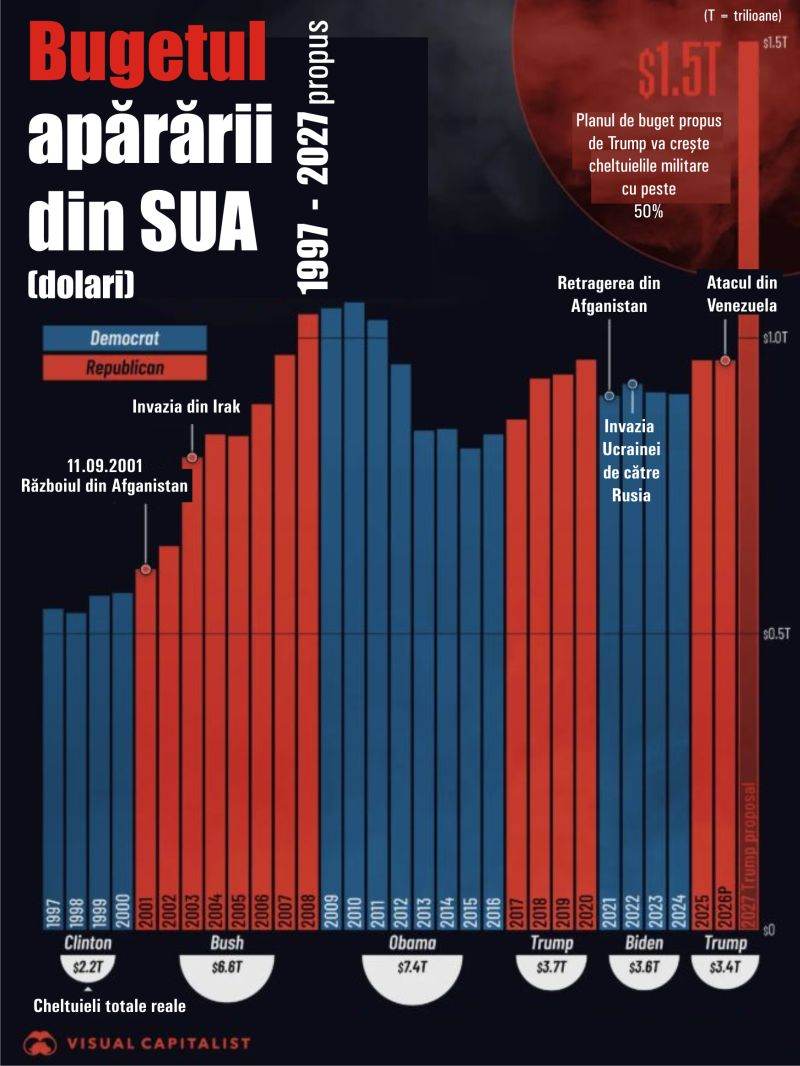
US defense spending has gone through several cycles since 1997, but the long-term trajectory is upward, according to visualcapitalist.com, which has compiled a ranking of these expenditures, based on official data, showing how the amounts have changed under each president and ruling party. For next year, the United States' proposed defense budget is a record $1.5 trillion.
• Steady growth in the 2000s and 2010s
In the late 1990s, during President Bill Clinton's term, US defense spending was around $500 billion (in real terms).
Spending increased significantly in the 2000s, during the George W. Bush administration, in the context of the wars in Afghanistan and Iraq, reaching levels of over $900 billion before 2010. Budgets continued to be kept high throughout his term.
In the early 2020s, spending remained high under Presidents Donald Trump and Joe Biden, with budgets ranging from $900 billion to over $1 trillion. The defense budget for 2026, approved by Congress, reached $901 billion, while proposals for 2027 took this figure even higher.
Recently, President Donald Trump announced a proposal for a military budget of $1.5 trillion in 2027, representing an increase of about 50% over current levels, intended to expand capabilities and accelerate modernization.
• US Congress adopts defense strategy that contradicts Trump's position on Europe
The US Congress adopted the 2026 defense strategy in December, reaffirming its support for US alliances in Europe, contrary to the signals sent by President Donald Trump and his administration, AFP reports, according to Agerpres.
The NDAA, adopted annually by both houses of Congress with a certain degree of consensus between Democrats and Republicans, presents the areas on which the United States should, according to the elected officials, focus its defense efforts for the following year. The 2026 version, more than 3,000 pages long, foresees a total annual budget of more than 900 billion dollars, an increase of 5 billion dollars over the previous year. The bill passed the Senate with 77 votes in favor and 20 against.
"The surest way to secure peace is to keep it by force,” said Senate Majority Leader John Thune, echoing the "peace through strength” slogan adopted by Donald Trump at the start of his second term.
During a speech on the Senate floor, Thune highlighted measures included in this year's NDAA, notably the construction of more warships "to help close the gap” with China's shipbuilding capabilities, as well as the establishment of the "Golden Dome” missile defense system promoted by Donald Trump, and a 3.8% pay raise for military personnel. Thune also highlighted reforms to the Pentagon's procurement processes, including "eliminating dozens of burdensome rules and laws.” The Republican leader did not mention any increase in support for European allies.
The NDAA anticipates that Washington will spend about $400 million in 2026 on US military equipment for Kiev to continue fighting the Russian invasion.
The Pentagon, under Defense Secretary Pete Hegseth, is trying to refocus America's defense strategy on itself, with more strikes in the Caribbean and Pacific Ocean against ships accused of drug trafficking, amid heightened tensions with Venezuela.
But the bill drafted by Congress provides for a continued US presence in Europe. The bill prevents the Pentagon from reducing the number of US troops deployed in Europe below 76,000 without justification to Congress.
Some isolationist Republicans have denounced the bill, especially the provision of military aid to Ukraine.
The White House has proposed a record $1.5 trillion for defense in 2027, more than 50% above current levels.
-------------
The largest historical increases in defense spending align with major security eras, including the post-9/11 wars, renewed competition between great powers and the current rearmament effort.

























 Euro
Euro Dolar SUA
 Franc elveţian
 Liră sterlină
 Gram de aur