 English


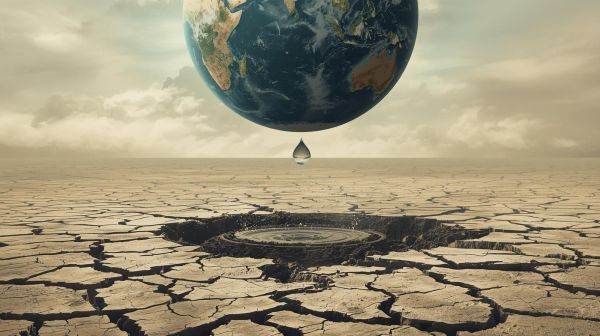
The Earth's continents are losing their freshwater reserves at an alarming rate, equivalent to four Olympic swimming pools every second, according to a new report published by the World Bank and cited by Live Science. The phenomenon, described by experts as "continental aridification,” risks transforming the water crisis from a local problem into a global one, with major economic, social and geopolitical implications. The report shows that the accelerated loss of freshwater from continental masses has become the main factor contributing to rising sea levels, surpassing even the melting of ice caps.
• From melting ice to pumping groundwater
Continental aridification is defined as a long-term decrease in the availability of freshwater over vast areas of land. According to the researchers, this process is fueled by several overlapping factors:
- accelerated melting of snow and ice;
- thawing of permafrost;
- increased evaporation due to global warming;
- intensive extraction of groundwater.
"We always consider water problems to be local. But what we show in the report is that these problems can quickly transcend national borders and become an international challenge,” Fan Zhang, the lead author of the report and the World Bank's global head of Water, Economics and Climate Change, told Live Science in an interview with co-author Jay Famiglietti, a hydrologist and professor at Arizona State University. According to the report, the continents are losing about 324 billion cubic meters of freshwater annually, enough to cover the annual water needs of 280 million people. In symbolic terms, this loss is equivalent to the disappearance of four Olympic-sized swimming pools every second. The data is based on 22 years of observations from NASA's GRACE mission, which measures minute changes in Earth's gravitational field caused by the movement of water masses. The researchers correlated this data with economic and land-use information, feeding it into a complex hydrological model.
• Arid regions worst hit
On average, the amount of freshwater lost annually represents about 3% of global water "income" from precipitation. In arid and semi-arid regions, however, the percentage reaches 10%, amplifying the risks precisely in areas that are already vulnerable. "This is a growing problem," warns Zhang. Recent studies by the same team show that some dry regions are rapidly evolving towards the "super-arid" stage, a critical threshold beyond which recovery becomes extremely difficult.
• Severe economic and social impact
The consequences of aridification are already visible, especially in regions where agriculture is the main economic driver. Sub-Saharan Africa and South Asia are among the hardest hit. "In sub-Saharan Africa, drought shocks are reducing the number of jobs by between 600,000 and 900,000 annually,” explained Fan Zhang. The hardest hit are landless farmers and other vulnerable groups who directly depend on water availability. The effects are not limited to agricultural countries, however. Countries with industrial or service-based economies are indirectly affected, as they import food and raw materials from drying regions, which increases the risks of inflation, food insecurity and economic instability.
• Ecosystems under pressure and more frequent fires
The report also warns of the major ecological impact of continental drying. The phenomenon significantly increases the likelihood and intensity of wildfires, especially in areas with high biodiversity. At least 17 of the 36 recognized global biodiversity hotspots, including Madagascar, parts of Southeast Asia and Brazil, are experiencing a steady decline in freshwater availability and an increased risk of wildfires. The most important cause of the drying up of continents today is over-extraction of groundwater, says Jay Famiglietti. "Groundwater is poorly protected and poorly managed in most parts of the world. In recent decades, there has been virtually unregulated pumping.” As the climate gets warmer and drier, the pressure on these resources will increase as soils dry out and the supply from glaciers and snowmelt diminishes.
Possible solutions: agriculture, the key to reducing losses
According to the World Bank, agriculture is responsible for 98% of the global water footprint. Improving the efficiency of water use in this sector could have a decisive impact. If water use efficiency for 35 key crops, such as wheat and rice, were brought up to global average levels, enough water would be saved for 118 million people annually. l, the report shows.
Among the proposed solutions are:
- adapting crops to local water availability;
- using artificial intelligence to optimize irrigation;
- setting strict limits on groundwater extraction;
- adjusting water and energy prices to discourage waste.
The report also shows that countries with higher energy prices experience slower rates of aridification, as pumping groundwater becomes more expensive, stimulating efficient use of resources. The experts' conclusion is clear: the loss of freshwater on continents is no longer a one-off or regional problem, but an ongoing global crisis that requires coordinated policies, investments and structural reforms. "If we do not act quickly, the effects of aridification will exceed the adaptive capacity of many societies,” warn the authors of the World Bank report.






















 Euro
Euro Dolar SUA
 Franc elveţian
 Liră sterlină
 Gram de aur





























