English


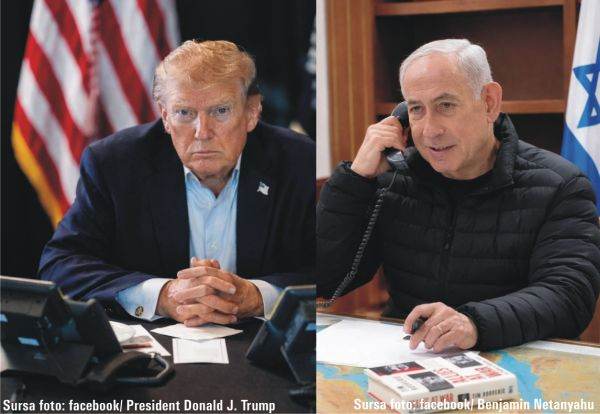
The conflict that erupted in the Middle East, after the US and Israel attacked Iran and dismantled the first echelon of the regime in Tehran, was triggered by Donald Trump and Benjamin Netanyahu, without obtaining the approval of Congress or the Knesset, respectively, and without having support among the civilian population of the two states.
In the US, a Reuters/Ipsos poll indicates that only 27% of Americans support the strikes, while Democrats denounced "an unauthorized act of war", and Republicans were divided between unconditional supporters and conservatives worried about the lack of a mandate from Congress.
However, according to Fox News, Trump's supporters invoke the doctrine of preventive force and believe that the elimination of Iran's main religious and military leaders was a strategic necessity, while, according to CNN, American Democrats claim that the outbreak of the Middle East conflict is a convenient cover for the internal problems that the White House Administration has been facing in recent months, regarding the killing of American citizens by ICE forces and Trump's relationship with Jeffrey Epstein, a case that has been brought back into the media circuit in recent months, with the publication of millions of documents by the Department of Justice. Specialists consulted by PBS, ABC News, CNBC, NBC News believe that the war against Iran tends to coagulate the electorate around the leader, but critics warn that the judicial agenda could be pushed into the background by security rhetoric.
Meanwhile, in Tehran, the constitutional mechanism was quickly activated, with Reuters and Al Jazeera reporting on the formation of an interim council consisting of President Masoud Pezeshkian, Chief Justice Gholam-Hossein Mohseni-Ejei and interim Ayatollah Alireza Arafi, based on Article 111 of the Constitution, until the Assembly of Experts designates a new Supreme Leader. The question dominating the international press is whether the new Ayatollah will come from the same Khamenei hardliners, and assessments by US services, cited by Reuters, indicate the likelihood that the successor will be a cleric or a leader directly associated with Iran's Revolutionary Guard Corps, maintaining a hard-line ideological line. Iran, with approximately 86 million inhabitants, is a theocratic state in which a significant part of the population remains attached to the religious structure of the regime, even if the exact figures regarding loyalty to the former Ayatollah Ali Khamenei vary. According to a report published in 2020 in the Netherlands by the non-governmental organization Gamaan, on the attitude of Iranians towards religious affiliation, carried out in coordination with two Iranian university assistants, only 37.2% of Iranian citizens declared themselves Muslims (of which 32.2% Shia and the remaining 5% Sunni), 22.2% claiming to have no religion, 8.8% declaring themselves atheists, 7.7% Zoroastrians, 5.8% agnostics and the rest other religions or spiritual beliefs. If we refer to the data available on the US State Department website, which cites information transmitted by the regime in Tehran, in mid-2022 Muslims constituted 99.4% of the population of Iran, of which between 90 and 95% are Shia.
In other words, based on the two documents above, it would appear that the population base loyal to the regime in Tehran would be between 30 million and 80 million people. Therefore, the formation of a coherent opposition is made difficult by this support base, but also by the cohesion of the security apparatus.
The Reuters agency noted that, in previous protests, there were no defects among the Revolutionary Guard Corps, and analysts believe that the absence of fractures in the security forces is the main indicator that a civil war is not imminent. And in recent days, the official press in Tehran has increased the number of regime loyalists, speaking of national mobilization and the danger of the country being "dismembered” by foreign powers, while Trump's calls for "Iranian patriots” to "regain their country” have been interpreted in regional media as either encouraging a sovereignist movement or as foreign interference aimed at delegitimizing any domestic opposition. And the Iranian opposition does not seem to be on the side of Reza Pahlavi, the son of the Shah who was ousted from power in 1979. According to a June 2024 report by Gamaan, the only one on these issues, 70% of respondents oppose the continuation of the Islamic Republic in its current form, but only 21% believe that the next form of government should be a monarchy. However, the monarchist movement in Iran speaks as if it represents the entire nation, but The Times of Israel reported in an article published yesterday that during recent protests, students shouted in Tehran and other cities in Iran: "No to monarchy, no to clerical rule, yes to egalitarian democracy.”
It should be noted that 77,216 respondents from within Iran participated in the report by Gamaan. After weighting, a representative sample of the literate adult population of Iran was used to obtain the results presented in the cited document, with an effective sample size of 20,492 people.
In this explosive context, each leader involved has his own internal vulnerabilities: Trump is faced with judicial pressure and a polarized electorate, and Benjamin Netanyahu, who, after managing the hostage crisis, had become eligible for retrial in an old fraud case, now finds himself with his legal agenda pushed to the margins of public debate.
It remains to be seen whether this conflict will reset the balance of power in the Middle East or open a spiral of escalation that will transform the Israel-US versus Iran confrontation into a regional war with global implications, at a time when international legality, Iran's internal stability and the political cohesion of the West are simultaneously being tested.























 Euro
Euro Dolar SUA
 Franc elveţian
 Liră sterlină
 Gram de aur