English

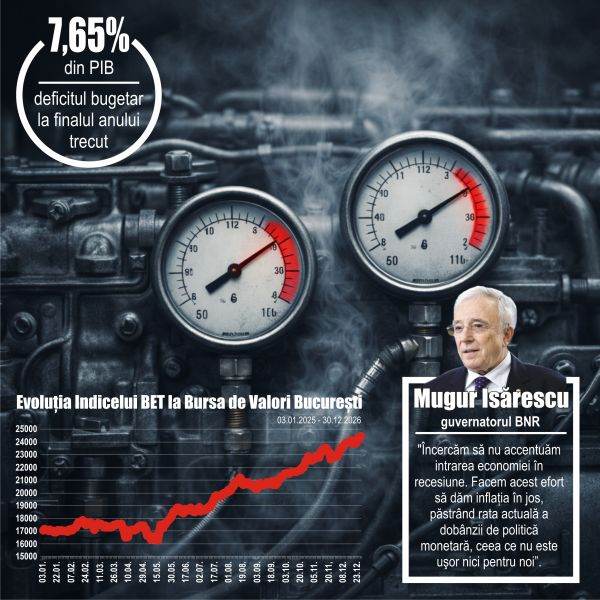
Our country went through one of the most tense periods in its recent history in 2025, a year in which political instability, budgetary imbalances and inflationary pressures formed a dangerous mix that pushed the economy to the limit of support. This was confirmed by data published on Friday by the National Institute of Statistics, which shows that the economy entered a technical recession at the end of last year. INAS specifies that Gross Domestic Product decreased by 1.9% in the fourth quarter compared to the third quarter, when the decline was 0.2%. On the seasonally adjusted series, GDP in Q4 2025 was 1.6% below the level in Q4 2024, while on the gross series there was a slight annual increase of 0.1%. However, at the end of last year, GDP was higher by 0.6%, compared to 2024, according to INS data.
Following the presentation of these data, Prime Minister Ilie Bolojan declared that the technical recession was "anticipated and inevitable", as a result of the transition to an economic model based on investment and fiscal discipline. In response, the leader of the Social Democratic Party, Sorin Grindeanu, described the situation as "a shame for the Coalition", citing the social costs of austerity policies.
In November last year, the Governor of the National Bank of Romania, Mugur Isărescu, said that the economy would not have two quarters of negative growth, which would define a recession.
During a press conference, Mugur Isărescu stated: "We are trying not to accentuate the economy's entry into recession. We are making this effort to bring inflation down, while maintaining the current monetary policy interest rate, which is not easy for us either."
At the end of last year, the National Bank of Romania revised upwards the inflation forecast for the end of this year, to 9.6%, from 8.8%, the previous estimate. For the end of next year, the bank anticipates an inflation of 3.7%, with the rate set to enter the NBR's target range in the first quarter of 2027, according to the report presented in November by Governor Mugur Isărescu.
The first half of the year was marked by the echo of the presidential elections canceled on December 6, 2024 and the previous parliamentary elections, which amplified the sensation of a country caught between systemic crisis and the vague promise of a reset. And this was also evident from the data published by the Ministry of Finance, the National Institute of Statistics and the European institutions at the end of the first semester of last year, data that outlined the image of an economy under extreme stress: budget deficit of 3.68% of Gross Domestic Product (GDP) at the end of June, public debt threateningly approaching the threshold of 60% of GDP and annual inflation of 5.7%, figures that confirmed the accelerated deterioration of macroeconomic balances. In this fragile climate, the National Bank of Romania chose to maintain the key interest rate at 6.5%, a clear signal that the monetary space for maneuver was limited and inflationary risks remained dominant. Against the backdrop of these tensions, the political scene underwent a major mutation. The resignation of Klaus Iohannis in February 2025 abruptly closed a presidential chapter, and the installation of interim Ilie Bolojan came at a time when financial markets, rating agencies and the business community were nervously following every institutional move. The presidential elections in May produced the surprise of the year: the victory of independent candidate Nicuşor Dan, the former mayor of Bucharest, reconfiguring the power relations and decision-making dynamics.
In June, the formation of a pro-European government led by Ilie Bolojan brought the first signals of fiscal consolidation, but also the warning that the bill for the accumulated imbalances was going to be paid quickly and painfully.
The second semester marked the transition from the diagnosis of the crisis to the application of shock therapy. The government resorted to taking responsibility for a first fiscal package that brutally redesigned the taxation architecture: increasing VAT to 21%, introducing a single reduced rate of 11% for basic products, increasing excise duties, additional taxation of dividends and large profits, imposing health contributions for pensions over 3,000 lei, announcing salary and employment freezes for 2026, and revising school scholarships. The measures were justified as inevitable to avoid a fiscal collapse, but the social impact was immediate: decreasing purchasing power, amplifying dissatisfaction, and heightening tensions between the state and taxpayers.
August and September deepened this logic of accelerated adjustment. The second reform package, with a focus on special pensions and corporate governance in public enterprises, generated institutional and social frictions, but reinforced the perception of a government willing to sacrifice political capital for macroeconomic stability. In parallel, the nine-month budget execution showed the real size of the imbalance: a deficit of 102.47 billion lei, equivalent to 5.39% of GDP, while the budget revision confirmed an annual target estimated at 8.4% of GDP and additional expenditures of approximately 27 billion lei. Interest costs rose sharply, reflecting the increase in the cost of financing public debt, and the pressure on the budget became structural. In this context, the decisions of the National Bank of Romania to maintain the key interest rate at 6.5% highlighted the persistence of supply shocks: the liberalization of the energy market, the increase in VAT and excise duties, rigidities in supply chains. Inflation accelerated to 9.7% in December, eroding real incomes and amplifying the public perception of an economy suffocated by price increases. Romania experienced simultaneously the reality of fiscal austerity and inflationary pressure, a toxic combination for consumption, investment and social stability.
However, the end of the year brought an accounting result that tempered the most gloomy scenarios. The budget deficit closed at 7.65% of GDP, below the 8.4% level negotiated with the European Commission, suggesting that the mix of fiscal measures and execution discipline had begun to produce effects. It was not a victory, but rather a postponement of the verdict. Structural vulnerabilities, such as deficient collection, expenditure rigidity, the interest burden and the uneven pace of absorption of European funds, remained heavy anchors that continue to drag down the prospects for stability.
• January: The Coţofeneşti helmet, stolen from a museum in the Netherlands
The year began with a tense economic context: the budget deficit reached 11 billion lei (0.58% of GDP), reflecting sharp imbalances between income and expenditure. Tax revenues were affected by a 1.4% decrease compared to January 2024, caused mainly by the reduction in VAT and European funds. Public spending increased by 4.5%, with increases concentrated in the area of personnel (+18.6%), social assistance (+12.8%) and the reimbursement of medicines (+18.7%).
Investments from external and internal funds recorded significant reductions, by almost 45% and 28%, respectively, compared to the same period last year, reflecting a hesitation of the authorities in starting new projects in an electoral context.
In light of the above financial data, the National Bank of Romania decided to maintain the monetary policy interest rate at 6.5% amid persistent inflation.
Politically and symbolically, January was marked by the robbery of the Drents Museum in the Netherlands, where several Dacian artifacts, including the famous Coţofeneşti helmet, were stolen. The incident sparked a diplomatic crisis and led to the dismissal of the director of the National Museum of History of Romania.
• February: The end of Klaus Iohannis' presidency
February brought two major political events: the adoption of the 2025 state budget by Parliament and the resignation of President Klaus Iohannis.
The budget was built on a projection of economic growth of 2.5% and an estimated GDP of 1,912.6 billion lei. Expenditures were set at 802.2 billion lei and revenues at 667.5 billion lei, outlining a deficit of 7% of GDP. Social and wage expenditures continued to put pressure on the budget: 169.5 billion lei were allocated for wages, and 242.3 billion lei for social assistance. Despite these constraints, the budget included record investments of 150.5 billion lei.
On the political front, the resignation of President Klaus Iohannis, under pressure from an imminent suspension initiated by the opposition parliamentary parties - AUR, SOS, POT and which were to be joined by USR - generated instability. Under these conditions, in accordance with constitutional provisions, the President of the Senate, Ilie Bolojan, took over the interim presidency.
Legally, the former candidate for the 2024 presidential elections, Călin Georgescu, was indicted for instigating unconstitutional acts, more precisely as an instigator of the overthrow of the constitutional order, but also for publicly promoting the acts of Marshal Ion Antonescu, Corneliu Zelea Codreanu, and the Legionary Movement. The Prosecutor General's Office has instituted judicial control for Călin Georgescu, a measure that was extended throughout last year.
• March: The beginning of the new presidential electoral process
The first month of spring was marked by an intensification of strategic and electoral measures.
The government allocated 1.2 billion lei for the expansion of gas networks, using funds from the sale of carbon emission certificates. In parallel, the Valea Jiului Energy Complex benefited from state aid of over 3.12 billion lei for the phased closure of mines by 2032. A partial exemption scheme from the payment of green certificates was launched for large industrial energy consumers, with a total budget of 578.4 million euros until 2031.
In agriculture, the Executive approved support of 1.5 billion lei for farmers, including 600 million lei for livestock breeders and 400 million lei for farmers.
The Start-Up Nation program for the business environment was relaunched with 440 million euros from European funds, aiming to support 7,500 entrepreneurs.
At a strategic level, the CSAT approved an increase in the defense budget and the acquisition of a multirole corvette, purchased directly from a Turkish company.
On the political scene, tensions increased after the Central Electoral Bureau and the Constitutional Court rejected the candidacies of Călin Georgescu and Diana Iovanovici-Şoşoacă, followed by violent protests from Georgescu's supporters, who were left with criminal investigations.
• April: Budgetary reforms postponed due to presidential elections
April was marked by a pre-election frenzy that led the authorities to postpone essential fiscal measures for budgetary consolidation. Although the Prime Minister and the Minister of Finance signaled the urgent need to reduce public spending, the Government launched a series of new social programs and aid schemes.
The Executive launched, in parallel, new grants for agricultural producers (342 million lei for vegetables, 1.5 million lei for livestock breeders who care for pigs of local breeds), and also established a Treasury loan mechanism for co-financing European projects, with an allocation of 1.5 billion lei.
Although the Executive adopted, at the end of April, for amendments to the law on corporate governance for public enterprises, with an emphasis on transparency and selection criteria, in reality things have stagnated, and AMEPIP has not carried out any real activity during the past year.
Also in April, the Ciolacu Government adopted a normative act on the simplification of construction permits to boost public investments made from European funds and funds from the state budget. In light of the need for permanent growth in budget revenues, the Ministry of Finance reported at the end of the first four months of 2025 that, through the TEZAUR and FIDELIS issues, it attracted over 8 billion lei to the state budget, an amount intended to cover part of the budget deficit.
• May: Nicuşor Dan becomes the president of the country
The presidential elections of May 4 and 18, 2025 represented a division in Romanian society, but also in the political architecture of the country. Nicuşor Dan won over George Simion, after the AUR candidate had 20% ahead of the future president of the country in the first round on May 4. The first round was a shock for the traditional parties, as the PSD and PNL failed to convince their voters to push their joint candidate, Crin Antonescu, into the second round. This led to the resignation, effective May 6, of Marcel Ciolacu as head of government and president of the PSD. Following Ciolacu's resignation, the position of interim prime minister was taken over by Cătălin Predoiu - deputy prime minister and minister of the interior, and the position of interim president of the PSD was taken over by Sorin Grindeanu.
In light of these movements on the political scene, the budget deficit rose to 3.39% of GDP in May, despite a 14% increase in tax revenues. GDP grew by only 0.2% in the first quarter, and the current account deficit reached 7.6 billion euros. Foreign direct investment decreased, and the trade imbalance deepened.
Also during May, the Ministry of Finance granted state aid of over 1 billion lei for the chemical, automotive, agri-food and aeronautical industries.
• June: Bolojan Government takes office at Victoria Palace
The interim government led by Cătălin Predoiu remained in office for 47 days, because the new governing coalition, made up of the pro-European parties - PSD, PNL, UDMR, USR and the National Minorities Group in the Chamber of Deputies -, had difficulty agreeing on the government program and what needs to be done urgently to correct the budget deficit and remove the specter of the threat of our country being downgraded to junk status - not recommended for investment - by international rating agencies.
However, on June 23, the Parliament inaugurated the Ilie Bolojan Government, which took office the same day, after being sworn in at Cotroceni Palace. The new Prime Minister, Ilie Bolojan, immediately announced austerity measures: increasing VAT from 19% to 21%, increased excise duties, limiting bonuses and reducing budget spending. In parallel with these measures, the new Executive ordered the extension of the cap on the commercial mark-up on food until September 30 (a measure that was introduced in July 2023) and approved the granting of energy vouchers/tickets of 50 lei/month for 2.5 million vulnerable consumers (budgetary impact: 1 billion lei), in light of the reliberalization of the electricity market starting from July 1, 2025. According to the Ministry of Finance, the budget execution at the end of June, i.e. for the first six months of 2025, showed a deficit of 69.80 billion lei (3.68% of GDP), up from the previous year (63.67 billion lei). Although budget revenues increased by 12.7%, reaching 310.52 billion lei, boosted by the payroll tax and European funds, total expenditures amounted to 380.32 billion lei, 12.1% higher than in the first half of 2024.
• July: First fiscal package increases VAT to 21%
The first month of the second half of the year began with a change of register in fiscal policy. The Bologna government launched the first fiscal-budgetary package, as an emergency instrument to stop the degradation of confidence and the slide towards "junk". The measures were assumed in Parliament on July 7 and promulgated on July 25, after the Constitutional Court rejected the opposition's appeals.
The package included increasing the standard VAT rate to 21% and establishing a single reduced rate of 11% for basic food and medicines, increasing excise duties on alcohol, tobacco and fuel, taxing pensions above 3,000 lei, freezing public sector salaries and pensions for 2026, as well as rebasing the school scholarship system around merit and need criteria. In budgetary terms, the measures were presented with an estimated additional impact of 9.5 billion lei for 2025 and 35 billion lei in 2026, doubled by cuts 57 billion lei in 2026 in public spending, in an attempt to reduce the pressure on the deficit, in the medium term.
In this context, the NBR decided, on July 8, to maintain the key interest rate at 6.50%, warning of the acceleration of inflation with the liberalization of energy and the application of new indirect taxes.
• August: Fitch reconfirms our country rating
In August, fiscal consolidation remained under pressure from rigid costs. Regarding the rating, Fitch reconfirmed BBB-/F3 with a negative outlook, keeping Romania in the investment grade window, but implicitly conditioning stability on the effective delivery of the consolidation. The NBR, in turn, maintained its line of caution on August 8, maintaining the key interest rate at 6.5% and anticipating the peak of inflation in the autumn. The INS recorded, in August, an inflation of 9.9%, which confirmed the materialization of price shocks.
In strategic and geopolitical terms, the transaction through which the Hungarian company MVM would have taken over part of the assets of E.On Romania received a negative opinion from the Foreign Direct Investment Evaluation Committee, the file being pushed to the CSAT due to energy sensitivities and the regional context. Also in August, the disappearance of former President Ion Iliescu and the declaration of August 7 as a day of national mourning reopened historical issues with social significance, at a time when the state was trying to simultaneously manage austerity and maintain cohesion.
• September: The second package of fiscal measures raised the level of social discontent
In the first month of autumn, the Government assumed the second package of reforms, which attracted a wave of political contestation. Four motions of censure were rejected, and the appeals to the CCR were largely rejected, leaving the issue of special pensions as a sensitive one, which would turn into an institutional knot in the following months.
The second package aimed at capping service pensions at 70% of the last salary and increasing the retirement age to 65 for magistrates, staff cuts and allowances in autonomous authorities, resetting corporate governance in public enterprises, anti-evasion measures and against aggressive optimizations, as well as introducing an increased tax on large fortunes for expensive properties and luxury cars. On the business side, the package introduced new rules on the share capital for LLCs, raising thresholds and establishing exceptions for startups and business angel investors, in an attempt to reduce the proliferation of vehicles without economic substance.
In September, Moody's maintained the Baa3 rating with a negative outlook for our country, maintaining access to capital, but emphasizing the conditionality of consolidation.
• October: Institutional conflict over special pensions
The middle of the calendar autumn brought the budget rectification adopted by the Government in the meeting of October 1, on a revised macro foundation: economic growth of 0.6%, GDP of 1,902 billion lei, average annual inflation of 7.1% and deficit targeted at 8.4%. The rectification confirmed the pressure on spending, with significant increases especially in interest and social obligations, reflecting a correction in pace rather than level.
The NBR maintained the key interest rate at 6.50% on October 8, in the context in which inflation remained high and price pressures were transferred from energy and indirect taxes to current consumption.
October was, however, the month in which the institutional conflict over the reform of special pensions became explicit. On October 20, the CCR ruled that the law on the reform of special pensions for magistrates was unconstitutional, citing the absence of the CSM's opinion, even if negative, and the failure to comply with the mandatory stages, which reconfirmed the procedural fragility of reforms conditioned by European milestones.
• November: The Government approves yet another budget correction
The last month of autumn began in the context of a ten-month budget execution that showed a deficit of 108.87 billion lei (5.72% of GDP), down compared to the same period in 2024 as a share of GDP, but maintaining high pressure in absolute values. The Government adopted the second budget correction on November 28, trying to keep the deficit target within the parameters negotiated with Brussels and to correlate allocations with effective execution and fund absorption.
Before the rectification, the Fiscal Council warned that public debt, close to 59% of GDP, pushes Romania towards a systemic risk zone if reforms are postponed, highlighting structural vulnerabilities: low tax collection as a share of GDP and absorption below potential both in the 2021-2027 financial framework and in the PNRR.
The NBR maintained the key interest rate at 6.50% on November 12, indicating a deterioration in the short-term inflation outlook and a postponement of the return to target. Data on the current account, direct investment and external debt have outlined, during this period, a constant external pressure, even if the reserves provided a buffer of stability.
• December: Fiscal measures yield the expected result - budget deficit of 7.65%
December closed the year under the simultaneous pressure of budgetary discipline and an inflationary shock fueled by energy and indirect taxes. In accounting terms, the Government managed to close 2025 with a cash deficit of 146.03 billion lei, respectively 7.65% of GDP, below the 8.4% target negotiated with the European Commission. General budget revenues amounted to 662.70 billion lei, up 15.3% compared to 2024, boosted also by a high level of European funds, while expenditures totaled 808.73 billion lei, being managed more rigorously in the second semester, especially at the end of the year.
Inflation remained, however, the major pressure indicator: in December 2025, the annual rate rose to 9.7%, with significant increases in energy and services, which confirmed the difficulty of calibrating monetary policy in an environment with supply shocks and accelerated price transmission.
At the institutional level, the special pensions file remained pivotal. The Government maintained the central benchmarks of the reform (capping, seniority and retirement age) and assumed its project in Parliament, the opposition unsuccessfully trying to overthrow the Executive through a motion of censure. The dispute moved to the CCR area, with successive postponements and procedural tensions, which showed once again that the reform conditioned by European milestones is vulnerable not only politically, but also procedurally.
At the same time, the Government pressed for the reform of state-owned companies and administrative discipline, through an ordinance on corporate governance aimed at reducing the bottlenecks generated by prolonged temporary appointments and introducing deadlines and sanctions. In the area of local taxation, the Executive strengthened the constraints on the approval of taxes and duties for 2026, including through mechanisms for conditioning budget supplies.
The closing point of the month was the "little train ordinance”, which established the parameters of the fiscal transition for 2026: brakes on spending, adjustments to taxes (including the reduction of the minimum turnover tax in 2026 and its elimination in 2027), clarifications and extensions for fiscal digitalization (RO e-Invoice, RO e-TVA simplifications), targeted measures for the minimum wage and for vulnerable energy consumers, plus strengthening control over excise products through authorizations and financial guarantees.
Overall, the year 2025 cannot be read only as a succession of figures and administrative decisions, but as the radiography of an economy forced to adjust under the pressure of reality, in a volatile political context and in an increasingly polarized society. Our country seems to have avoided extreme slippage, but the social, economic and political costs of this correction remain high.
















 Euro
Euro Dolar SUA
 Franc elveţian
 Liră sterlină
 Gram de aur