English


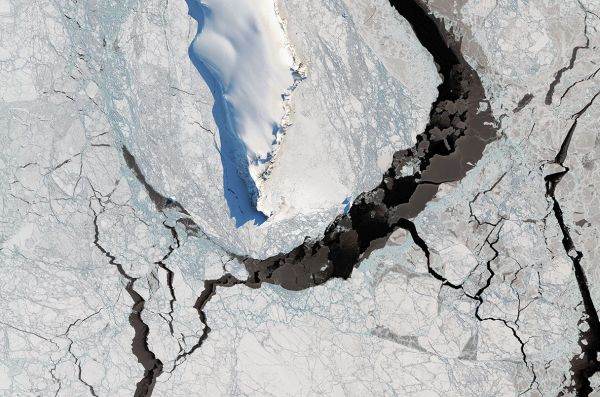
Scientists have produced the most detailed map yet of the terrain beneath Antarctica's ice sheet, revealing a spectacular landscape of mountains, deep canyons, carved valleys and vast plains, as well as thousands of smaller features identified for the first time. The discovery was announced last week and reported by Reuters. The new map was created by combining high-resolution satellite observations with an innovative technique called ice flow disturbance analysis. This method estimates the subglacial topography from how the ice moves on the surface, providing a coherent picture even in regions of Antarctica that had not been mapped before. The data obtained are essential for understanding how the Antarctic ice sheet will respond to global warming. The shape of the terrain under the ice affects the speed of glaciers flowing and how they reach the ocean, where they contribute to sea level rise.
"It is crucial to have the clearest map of the relief under Antarctica, because its shape controls the frictional processes that act on the ice. These processes need to be included in numerical models that estimate how quickly the ice will reach the ocean, melt and contribute to sea level rise,” explained Robert Bingham, a glaciologist at the University of Edinburgh, coordinator of the study published in the journal Science. According to the researchers, the subglacial relief is much more varied than previously thought. The team identified more than 30,000 previously unknown hill formations, with heights of at least 50 meters.
• A huge continent, with a landscape comparable to Europe or North America
Antarctica is about 40% larger than Europe, 50% larger than the United States and has an area comparable to half of Africa. Under the ice sheet, researchers say that an equally diverse landscape hides. "In each of these continents we find high mountain ranges, but also vast plains. The hidden landscape of Antarctica presents the same contrasts. It is not boring at all,” Bingham emphasized. The Antarctic ice sheet is the largest ice mass on Earth, containing about 70% of the planet's freshwater. The average thickness of the ice is about 2.1 kilometers, and in some areas it reaches almost 4.8 kilometers. However, Antarctica has not always been covered in ice. The subglacial relief was initially shaped more than 34 million years ago, before the formation of the ice sheet, and was later reshaped by the dynamics of the ice. The continent was once connected to South America, separated by plate tectonics.
• From "blank spots” on the map to a complete picture
Until now, Antarctica's subglacial terrain has been less well-known than the surface of Mars. Mapping has relied on radar measurements taken by aircraft or snowmobiles, which left gaps of up to 150 kilometers, according to Helen Ockenden, a researcher at the Institute of Environmental Geosciences in France and the study's lead author. The new method fills in those gaps. "By combining calculations of ice flow with high-resolution satellite observations, we can map the entire continent, including previously uncharted areas. This gives us a better understanding of how different landforms are connected,” Ockenden explained. Researchers hope that this map will help improve climate models and sea level rise forecasts, including those used by the IPCC, the UN group that provides governments with the scientific data needed for climate policies.


























 Euro
Euro Dolar SUA
 Franc elveţian
 Liră sterlină
 Gram de aur