English


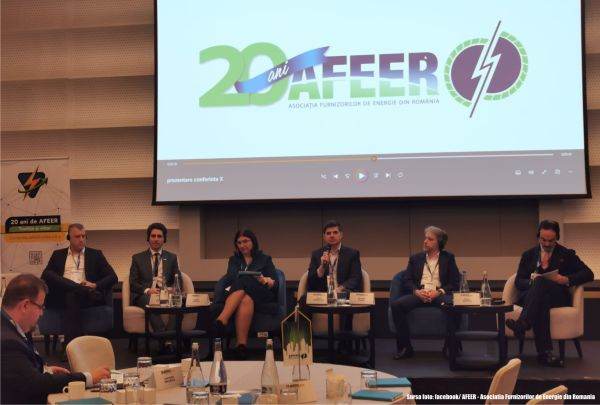
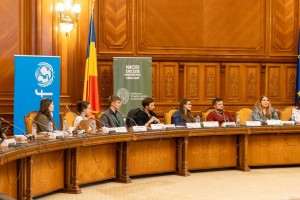
Liquidity, market volatility, digitalization and the use of artificial intelligence are the main current challenges for electricity and natural gas suppliers in our country, said yesterday the participants at the 10th edition of the Annual Conference organized by the Association of Energy Suppliers of Romania (AFEER), entitled "20 years of AFEER. Tradition and future".
At the opening of the event, Laurenţiu Urluescu, president of AFEER, stated: "Energy suppliers in our country are facing several challenges at the moment. First of all, there is the erosion of trust in suppliers and traders. The hardest was the message a few years ago that "suppliers are thieves", followed by various other campaigns to denigrate suppliers and traders, which continue. The second problem is the erosion of trust in the market. This time it is not about the trust of our customers, it is even our trust, because the Romanian market has gone through difficult times, and many of us still do not have full confidence to restart activity at the volumes before the energy crisis. Another aspect concerns the lack of public consultation and impact studies. We have countless unclear and, often, unenforceable legislative provisions, the interpretations of which are left to each market participant and we have amendments without considering an implementation period. Just as For example, OUG 27/2022 (ed. - regarding the price capping of electricity and natural gas) has had about 22 amendments. The overlapping of regulatory levels and the overlapping of authorities result in ambiguous regulations, refusals to clarify from various authorities, which send us from one to the other, and so on. If we think about OUG 27/2022, respectively OUG 6/2025 (which extended the price capping), a big challenge is the delayed settlement of the support scheme, with a massive impact on cash flow and additional costs for financing. And I must mention, with sadness, that the last month confirmed for settlement is January 2024 and I have noticed since December 2025 a total blockage in the confirmation process, meaning that no amount has been confirmed”.
Regarding the fact that the state has large arrears in settling invoices issued to suppliers according to the electricity price cap, Cristian Culea, member of the AFEER Steering Committee, stated: "For the future, we need to have clean competition to ensure what is best for the final customer. In the last energy support scheme, we were discussing 45 days of payment of this pre-financing. Today we are at over 700 days. It is not acceptable, it does not lead to normal competition. We are discussing 9 billion lei difference to be paid by the state to suppliers. We cannot have fair competition when we are faced with this gap for suppliers that go to the final customer."
• The situation in the Middle East has increased the price of natural gas to be delivered in 2027 by 15%
Mr. Urluescu also spoke about the impact of prosumers, recalling that, according to the results of a recent study conducted by AFEER, any megawatt-hour (MWh) injected by prosumers into the network has a cost for the supplier between 200 and 372 lei/MWh, a cost that, of course, is socialized, that is, recovered from other customers.
The AFEER President also said: "Market liquidity is starting to return, but much slower than we would like. Price volatility leads to high exposure, primarily due to the lack of market liquidity and the lack of hedging possibilities. Support schemes in Romania are too general, meaning we support everyone, we do not target those who really need it, such as vulnerable consumers. Moreover, all support schemes have proven to be very complicated to implement. (...) Again, a great exposure and a great challenge for suppliers are excessive fines. Fines are not correlated with the impact created. And here I would just give an example: on REMIT, in Romania, any violation is sanctioned with a fine of at least 15% of turnover”.
Regarding the situation in the Middle East, Laurenţiu Urluescu stated: "Of course, the markets are linked, as gas is linked to oil, electricity is linked to gas, because the production of electricity from gas automatically influences the market. The influence is already visible. After everything that has happened in recent weeks, we have an increase of about 15% in the delivery price for 2027." However, Mr. Culea also referred to opportunities, including abandoning dependence on fossil fuels, especially after the latest events in the Middle East.
Cristian Culea said: "We are talking about a dependence on fossil fuels, which today is visible in prices. I think that each of us, in the last three weeks, is all we see on TV and everywhere. I think that even those who did not know where the price of a commodity is today are dreaming of graphs. What I want to say is that we have the opportunity to move forward and change things. We need to move towards clean energy. We need to have a correct mix of production, where wind turbines, photovoltaics, batteries must contribute to a system in which the price is smart. I do not want to exclude fossil fuel technologies, within a certain limit, and we are also talking about gas here. Everything must be in an area of smart networks, so that it allows us to optimize this entire area. I would like to say that the electrification area should be encouraged. (...) There is a lot of talk about liquidity and traders, who are today seen as a bit of a pariah of the energy society, which I do not think is right, because liquidity is given by traders and suppliers. Let's not forget that the lower price comes from availability. If there is one thing the last three weeks have taught us, it is this. If you don't have availability, the price goes up. The availability of the commodity leads to a lower price. This means investing again in production and storage capacities. We have to play in a fair market. This means that settlements are up to date in the supply area. We have to be smart about consumption and also smart about the production mix. More renewables, reducing dependence on fossil fuels and batteries for flexibility”.
• Sebastian Burduja: "Only through investments will we reach a position where we can have a completely free market and competitive prices”
Former Minister of Energy, Sebastian Burduja, current advisor to Prime Minister Ilie Bolojan, reviewed the investments in energy in recent years, investments that have increased the number of production capacities and that have also partially consolidated the transmission and distribution networks.
Sebastian Burduja stated: "We are at an important moment for Romania and for the whole world and we see that, finally, the importance of energy is recognized. Whether we like it or not, it is that fuel that fuels our economies and daily life, the prosperity of each nation. (...) A very important thing that we have managed to complete is the energy strategy. Romania has not had an energy strategy for 17 years. Basically, it is like driving a car on the highway, at night, without headlights and without GPS, for 17 years, and you wonder why you are not reaching your destination or why you are hitting the guardrail. We now have an energy strategy and it has put the priorities in the right order. The mantra that I have repeated thousands of times during my mandate: energy must be safe, accessible and clean, in this order, in this order of priorities. Then, we managed to attract the 14 billion that we have been talking about. Few people know that Romania has was number one in the absorption of funds from the Modernization Fund. I think it is unprecedented, on any non-reimbursable instrument, for Romania to be in first place in the European Union. We have achieved this performance and we are now seeing the effects (...). We also see projects in the wind energy area, which had been practically frozen for years. We also see new solar parks and we also see batteries, because we keep talking about not having storage. I think that in a year or two we will be in an extremely competitive position in the storage area as well. The priority is to continue implementing these projects, these construction sites, to bring them to fruition, because only through investments will we reach a position where we will be able to have a completely free market, competitive prices and Romanians protected by competition, not by state intervention, because that is the right way to be in a functional market”. The former Minister of Energy mentioned that our country is on a good trajectory and that "the only solution is investments and we cannot fail to be good if we stick to this plan”.
• Alexandru Molnar, ANRE: "Condition for projects regarding new capacities: obtaining the necessary authorizations and financing ensured within a maximum of 12 months”
Regarding the criticisms coming from suppliers towards the regulatory authority, Alexandru Molnar, director of the Wholesale Energy Market Regulations Department within the National Energy Regulatory Authority (ANRE), stated that the settlement process to suppliers will be resumed soon and that future legislative changes in the energy field must take into account new trends, new market challenges and the large wave of projects regarding energy production capacities from renewable sources, which will put pressure on the national energy system.
Alexandru Molnar said: "Over 300,000 prosumers have appeared, over 300,000 actors who are no longer passive, who are active, who, some of them, beyond the consumption they ensure from their own sources, end up injecting into the market, creating both good and bad things. (...) What does ANRE do? ANRE, as you know, applies primary legislation, creates secondary regulations to implement what the Government, the legislator, decides to happen in this country. In addition, we apply European regulations that come in waves, waves. We don't have time to implement some and others are already coming at us. Currently, we have a great concern in implementing energy communities, which were a transposed directive, which supports energy communities, as I said last year. This year, by ordinance, the provisions of the package with the new model, the so-called new market model, will also be transposed, in fact some adjustments to the 2019 market model, which will mean challenges upon challenges for everyone, including us, for you”.
The ANRE representative also referred to the fact that many of the new projects are only on paper, with no chance of being financed.
Mr. Molnar specified: "We have a new wave of producers, of projects that have somehow ended up blocking the system, already creating some problems and we are trying, this year, through the regulations that we have at the moment in the process of approval, to bring a little order here as well. Producers are needed in the market, projects are needed, but those that have a chance of success, that are done correctly, are done completely, are done on realistic bases are needed. An investor who wanted to buy these projects said that he analyzed around 100 photovoltaic power plant projects, around 50 MW each, with or without batteries, and only managed to select three, which they could present further for due diligence with a view to financing. Three. Many of these projects that are only on paper, done in every way just to appear to be done and which today occupy, through the documents they have, the system capacity must somehow be selected”.
Therefore, ANRE wants to amend the legislation and introduce a 12-month deadline in which the respective projects must obtain all the authorizations, including the necessary financing; otherwise, ANRE will not issue the establishment authorization.
• Lack of trust and transparency from authorities, issues raised by foreign investors
Pawel Lont, chairman of the Natural Gas Committee of Energy Traders Europe, the European employers' association of 170 energy companies, said that there is no other developing market like Romania, which attracts so much attention from investors and which has so much potential that still needs to be unlocked in the gas market.
"We are currently in a very difficult geopolitical situation, but the way things have evolved shows that the gas market, which we established for Europe, has done its job. Although prices have increased sharply, it was unfortunately necessary to attract alternative sources of gas. Flows have been redirected where they were needed and there have been no interruptions in consumption, which, given the scale of the disruption, I would call a major success. However, we must continue to insist on better integration, because an integrated market is much more resistant to external shocks and much more attractive as a place for investment. This mechanism can help us protect ourselves against volatility and improve the resilience of Europe, which will remain dependent on imports for many years to come. (...) I believe that Romania has all the assets to become Europe's new champion in this area, capable of changing the situation and helping to restore confidence in the market. The challenges are also about trust and transparency. Some changes arise from In short, they are communicated only in Romanian and are sometimes very difficult to understand for someone who does not speak the language. For example, at the end of last year, after almost two years of consultations on changes to the licensing regime, a decision was made, but we were not able to find out what it was until the law was published in January. This is an uncomfortable situation, which may discourage market participation. The second issue is related to taxation; we have received information about a "clawback” tax. Such a lack of trust simply holds back the process of unlocking the liquidity that Romania could have. Romania has all the premises to have a liquid futures market, which would be a great asset for the future development of the country. There is also the recurring issue of tariffs, which puts pressure on network usage. This is added to the general lack of transparency; for example, in 10 years of experience, I have never had the opportunity to speak to Transgaz, which is strange, given that we are their customers. The potential is huge, but Romania's long-term success will not be built on stopgap solutions. (...) There is no reason to source gas for Ukraine from Greece when you have the largest producer right next door, which is Romania,” said Pawel Lont.
In turn, Bilal Tugrul Kaya, CEO of Enerji Tikaret Derneji (ETD) - the employers' association of energy traders in Turkey, showed that policymakers, regulators and market participants in the European region are going through a profound transformation of global electricity systems, as carbon policies evolve and regional market integration increases. He noted that Romania has a strong electricity market and considerable potential in the gas market, while Turkey brings experience in regional trade, and showed that strengthening cooperation between the two markets can also be achieved through ETD, which offers more opportunities for investors in the field.
• Liquidity, the real gordian knot of the energy market in our country
Herodotus Antonopoulos, Head of Energy Management & Trading Department at Motor Oil Renewable Energy (MORE) in Greece, stated that liquidity is needed for our country to become an energy hub.
He stated: "When we started in the electricity sector in 2008, Romania was a bright spot for us, with liquidity in the markets, unlike Greece or other Balkan countries, where liquidity was zero or the market did not exist. Unfortunately, things have regressed in Romania, and liquidity has moved to Hungary, which has become the regional electricity hub. For Romania to become a gas hub, liquidity is needed, which attracts liquidity; if you have it, you will get more, but if you do not have it, it is extremely difficult to attract it and requires a great effort. This effort requires acceptance of the way markets work and trust in them, something that is lacking in our region (Greece, Bulgaria, Serbia), not just in Romania. The details are different, but the problems are similar. To attract investors, two things are needed: faith in the market (creation of a liberalized framework) and the stability of this framework. Currently, I feel like we don't really believe in markets; we talk about them, but we don't believe in them. (...) Romania is one of the most attractive countries on paper, being a vast country, with resources, an industrial base, interconnections and potential, but it needs a stable framework to avoid cycles of liquidity in and out".
Finally, we would like to mention that the event held yesterday marked two decades of AFEER's activity and the role played by the organization in the development of the Romanian energy market. The conference brought together over 150 participants from the country and abroad, including representatives of authorities, companies in the energy sector, professional organizations and the media. The meeting brought to the fore the most important developments in the energy market, with the discussions structured in two panels dedicated to the strategic directions for the development of the Romanian energy sector, respectively the current challenges faced by the actors in the field.











 Euro
Euro Dolar SUA
 Franc elveţian
 Liră sterlină
 Gram de aur