English

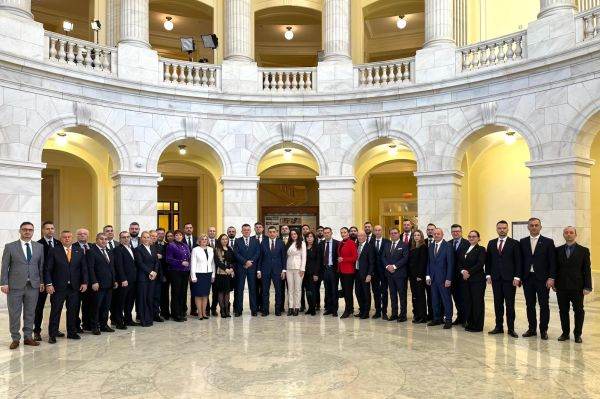
The visit of the AUR delegation to the United States, triumphantly presented by its members as a high-ranking diplomatic incursion, looks, on closer inspection, more like a guided tour through the showcase of American MAGA (Make America Great Again) populism, with strategic stops at organizations marginal to the Washington establishment, with carefully staged photos and a geopolitical symbolism treated at the level of a festive cake. To be precise, a cake with Greenland.
George Simion smiled and cut a cake in the shape of Greenland, decorated with the US flag, at an event organized at the Trump Kennedy Art Center, at a moment that, beyond online folklore, sparked harsh reactions including from within European institutions. The Vice President of the European Parliament, Nicu Ştefănuţă, reacted bluntly: "George Simion, I have a message for you: let that cake stick in your throat! When you cut that cake, think that maybe it was Dobrogea instead of Greenland and someone would have asked you for that territory. We are part of a family and when you are part of a family you take care of the needs of your family. If one of the family members is attacked, don't laugh at serious things. Because, next time, maybe it's your turn.”
The context in which the cake appeared is essential. The event was organized by Republicans for National Renewal, an organization categorized by the American press as right-wing, national-populist and pro-Trump, but almost completely absent from the respectable institutional landscape of Washington. It is not a structure of the Republican Party, it is not a government institution and it has no formal role in American political decision-making. In the American press, the organization is rather invisible, and when it appears, it is mentioned in controversial contexts, described by critics as part of the radicalized ecosystem of the Trumpist right. However, AUR presented the award received by George Simion from this organization as a major international validation, omitting to explain who they are, what they represent and what real weight those who offered the distinction have.
In parallel, the AUR delegation announced meetings with the America First Policy Institute (AFPI), a conservative think tank well known in the American press, but not in the sense suggested by the party's press releases. The Washington Post describes AFPI as a "holding house for former Trump officials", Politico characterizes it as explicitly aligned with Donald Trump, and the Associated Press places it unequivocally in the "America First" movement. It is not a neutral institution, it is not a bipartisan forum and it is not an official channel of the American state, but an ideological laboratory of Trumpism, used to prepare the cadres and policies of a possible maintenance of Trump in power.
The AUR leaders also boasted about their meetings with Republican congressmen, Andy Ogles, Abe Hamadeh and Anna Paulina Luna. Here too, the labels in the American press are relevant. Andy Ogles is described by the Associated Press as "far-right”, and Reuters presents him as a combative Republican, known for radical initiatives and open conflicts with institutions. Anna Paulina Luna is classified by Time magazine as a figure of "MAGA-aligned populism”, a symbol of the new generation of radicalized Republican politicians, more ideological influencers than consensus legislators. In the American press, Abe Hamadeh appears as a tough Republican politician, aligned with the Trumpist current, known more for controversy than for legislative results. The organization US Term Limits notes that "he promised to support term limits in Congress, but broke his commitment”, signaling an inconsistency frequently invoked by critics. Hamadeh is cited for alarmist statements, claiming that some publications and media collaborations "represent direct threats to democratic stability and national security.” In his appearances on Fox News, he presents himself as a victim of "censorship” and the "federal government,” stating that "it doesn't surprise me at all how far the state can go.” None of the three is a central figure in American foreign policy, none represents the US diplomatic or strategic establishment.
All this time, the mainstream American press - the New York Times, CNN, Washington Post, Reuters - has not treated the AUR visit as a relevant diplomatic event. There are no extensive reports, no geopolitical analyses, no institutional echoes. However, there are critical reactions, including from the American Jewish Committee, which explicitly warned of the extremist and anti-Semitic character attributed to the AUR and demanded that the delegation not be legitimized through official meetings.
In this setting, the AUR rhetoric about "defending democracy" and "cancelling the elections" presented to American congressmen takes on an involuntarily ironic note. The party that complains about democratic slippages in Romania is looking for allies precisely in a merican politicians known for relativizing the rule of law and constant attacks on institutions. An export of selective indignation, packaged in selfies, viral videos and a cake with Greenland.
AUR's visit to the US was not, in essence, a diplomatic success, but an internal branding exercise, aimed at the Romanian public. A visit that did not open doors, but confirmed ideological affiliation. A trip that did not bring Romania closer to Washington, but AUR closer to the basements of American populism. And the cake, cut with a smile on its face, remains the perfect symbol: lots of sugar, lots of form, zero strategic substance.





















 Euro
Euro Dolar SUA
 Franc elveţian
 Liră sterlină
 Gram de aur