English


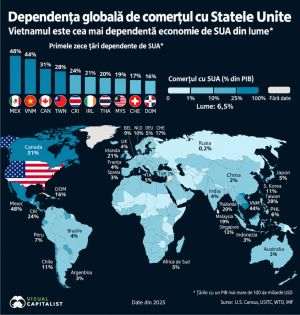
• Structural decline in the degree of globalization
The news regarding China's tightening of regulations on revenues obtained from overseas listings - which, in principle, requires the repatriation of these funds to the mainland - is a fundamental strategic move that confirms the most important trend of this decade: the structural fragmentation of global financial markets.
(read "China mandates the repatriation of funds from overseas listings”)
To understand the structural impact, we must view this Chinese action not as an isolated event, but as a key element in a global context of risk minimization and economic securitization, as also reflected in parallel initiatives in the US (OISP) and the EU (ACI).
• The great Chinese repatriation: capital fragmentation
The decision by the People's Bank of China (PBOC) and the State Administration of Foreign Exchange (SAFE) to mandate the repatriation of funds obtained from IPOs or offshore share sales (such as those in Hong Kong or New York) effectively ends an era of relatively free capital arbitrage.
What does this mean?
Frictional Control:
Forced repatriation introduces friction and bureaucracy (the need for pre-approval to keep funds offshore) precisely where globalization promised maximum fluidity. Capital can no longer travel freely in search of the best global return; it is required to return "home,” under central regulatory supervision.
National Priority:
Beijing sends a clear message: the foreign capital attracted must primarily serve domestic economic development objectives and macro-financial stability (e.g., stabilizing the RMB exchange rate and preventing speculative capital outflows).
Accelerated Financial Decoupling:
Until now, Chinese companies listed abroad (often using VIE structures) functioned as a bridge between global markets and the Chinese economy.
VIE (Variable Interest Entity) structures allow Chinese companies to list abroad without formally transferring ownership to foreign investors, who hold only contractual rights over cash flows, not the assets in China. Their functioning depends on the political tolerance of the Chinese state, not on guaranteed property rights.
By forcing repatriation, China isolates domestic and external financial transactions, accelerating financial decoupling from the West.
This policy is a defensive instrument, reflecting China's lack of confidence in the stability of the global financial system and its desire to strengthen its monetary and financial sovereignty.
• Convergence of restrictions: the US and the EU align with the fragmentation movement
Contextual analysis shows that all major economic blocs are institutionalizing geopolitically based controls, reinforcing the fragmentation trend:
US (Outbound Investment Security Program - OISP):
The OISP program is the mirror image of Chinese control, but applied to the outflow of American capital.
By banning or requiring notifications for US investments in critical technologies (AI, semiconductors) in China, Washington uses national security to block capital flows to the strategic sectors of its rival. This is capital allocation control based on geopolitical, not economic, criteria.
EU (Anti-Coercion Instrument - ACI):
Although defensive, the European instrument allows the EU to impose restrictions on financial markets and direct investment in response to external economic pressures. Therefore, cross-border investment decisions will no longer be governed solely by market rules, but also by risks of political or commercial retaliation.
EU (Internal Integration):
The request of the European Central Bank (ECB) supervisor, Claudia Buch, to remove national barriers (trapped capital) within the Eurozone indicates intensified "regional” integration.
This is essential: as fragmentation increases, blocs seek to strengthen their regional integration, becoming more resilient financial fortresses.
• Structural impact: divergent interest rates and the value of capital
When the degree of globalization declines and capital flows become managed, the immediate structural result is the disappearance of global convergence in the cost of capital (interest rates).
For decades, globalized capital acted like communicating vessels: excess savings in China could finance deficits and investments in the US or Europe, keeping the global borrowing cost relatively uniform.
When capital is closed (repatriated or blocked):
Divergence of Interest Rates:
Managed capital flows can no longer offset differences between markets.
In China, interest rates may remain low (or even need to be lowered) to stimulate the absorption of the surplus of repatriated capital domestically.
In the West, the cost of capital for technology investments (those affected by OISP, for example) could rise, as external funding sources are restricted or considered politically risky.
Dual Valuation:
Chinese companies will depend increasingly on the onshore market for financing.
This creates a dual valuation: the same company could have significantly different valuations on the onshore market (dominated by domestic capital and PBOC/SAFE regulations) compared with the offshore market, where geopolitical risk and lack of capital freedom are penalized by foreign investors.
Financing Structures:
Financial managers must prioritize geopolitical compliance over efficiency. Financing structures will be reorganized to align with economic "security zones” (either China or the Western bloc), sacrificing global financial optimization in favor of political resilience.
China's repatriation rules are an essential pivot in the new era of "geofinance.”
We are rapidly heading toward a world where interest rate policy and capital allocation are instruments of national power.
The decline in globalization is not merely a metaphor; it translates directly into tangible barriers that make capital more expensive and less mobile transnationally, forcing each economic bloc to build its own financial ecosystem, with its own interest rates and its own fragmentation risks.























 Euro
Euro Dolar SUA
 Franc elveţian
 Liră sterlină
 Gram de aur