English


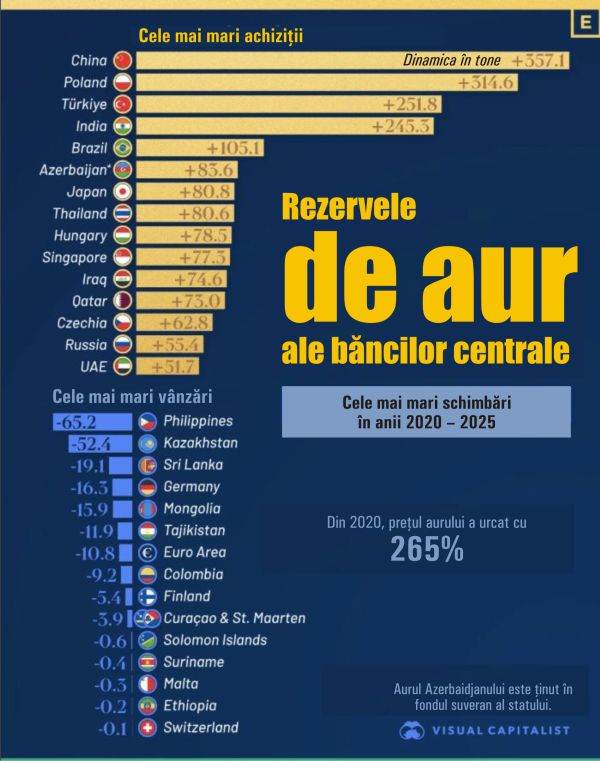
With the price of gold increasing by over 230% since 2020, central banks around the world have launched one of the largest gold buying waves in modern history.
For many countries, bullion has become more than a simple hedge, respectively a strategic reserve asset amid rising geopolitical tensions, currency volatility and increasing efforts to diversify away from the US dollar, according to www.visualcapitalist.com.
However, not all countries have followed the same strategy: some have massively accumulated gold, while others have reduced their reserves.
The cited source presents a ranking of the countries that have recorded the largest net purchases, respectively the largest reductions in gold reserves in the last five years, according to data from the World Gold Council (WGC).
• China and Eastern Europe lead gold purchases
Together, the top 15 buyers increased their reserves by almost 2,000 net tonnes of gold between 2020 and 2025, highlighting a major shift in official sector strategy.
China recorded the largest increase in gold reserves during this period, adding more than 350 tonnes. The move aligns with Beijing's long-standing efforts to diversify reserves away from the US dollar and reduce exposure to Western financial systems, reinforcing gold's role as a politically neutral anchor in global reserves.
Poland closely follows China in the rankings, increasing its gold reserves by more than 300 tonnes as part of a long-term effort to bolster monetary security. Turkey and India also rank among the top buyers, with additions of 251.8 tonnes and 245.3 tonnes respectively. Both countries face persistent inflationary pressures and currency volatility, making gold an attractive hedge within official reserves.
• Emerging markets step up purchases
Beyond the biggest buyers, several emerging markets made notable purchases. Brazil added over 100 tonnes and Azerbaijan, through its sovereign wealth fund, over 83 tonnes.
Japan, Thailand, Hungary and Singapore also expanded their reserves, signaling broader global interest in gold as a safe haven asset during times of economic uncertainty.
• Who has been reducing their gold holdings?
While many central banks built up large gold holdings, a smaller group reduced their exposure to the precious metal, highlighting different priorities for reserves.
The Philippines saw the largest reduction, by over 65 tonnes. Kazakhstan and Sri Lanka also saw significant declines (-52 tonnes and -19 tonnes respectively), often reflecting domestic liquidity pressures or active rebalancing of reserves during times of economic stress.
Several European countries, including Germany and Finland, saw modest reductions. The move in Switzerland was marginal (-0.1), underscoring its generally stable approach to gold management compared to other more active buyers.
Overall, the data shows how gold has reasserted itself as a cornerstone of global reserves, even as countries take starkly different paths in preparing for an uncertain monetary future.
Last year, gold demand hit a record high as concerns about instability and trade tensions sparked a surge in investment, even as a string of record prices kept jewellery buyers away.
Global gold demand rose 1% in 2025 to 5,002 tonnes, the highest ever, the WGC said recently.
The WGC expects another year of strong inflows from gold-backed exchange-traded funds (ETFs) and robust demand for bars and coins. ETFs saw inflows of 801 tonnes of gold in 2025, while bar and coin demand rose 16% to 1,374 tonnes, the highest level in 12 years.
Total investment demand for gold increased by 84%, reaching a record high of 2,175.3 tonnes in 2025, from 1,185.4 tonnes in 2024.

























 Euro
Euro Dolar SUA
 Franc elveţian
 Liră sterlină
 Gram de aur