English

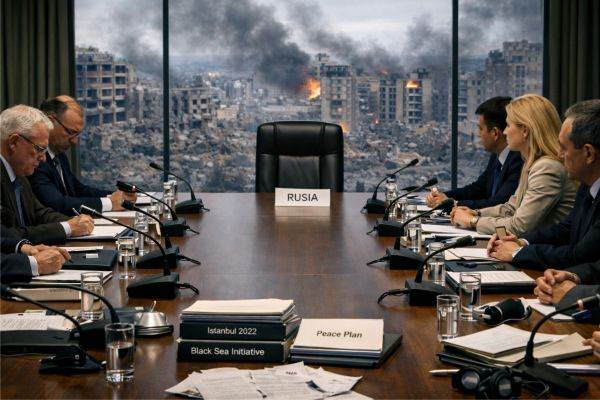
On the morning of February 24, 2022, when Russia moved to a full-scale invasion of Ukraine, the world entered a diplomatic paradox: the more total the war became, the more often peace was invoked. From that moment until today, attempts at negotiation have followed a harsh, almost mechanical logic: each round of talks was essentially a snapshot of the balance of power at that moment, not a real move towards compromise. When Russia thought it could win quickly, it demanded Ukraine's surrender in political-military terms; when Ukraine resisted and began to recover territory, it refused any peace treaty that would sanctify the aggression; when the allies felt the pressure of costs, the temptation to freeze the conflict resurfaced; when the Global South sought economic stability, it called for dialogue without naming the aggressor. All the while, the negotiations became a secondary but permanent front: a war of peace projects.
The first stage was the most direct. Just four days after the invasion, Russian and Ukrainian delegations met on the border with Belarus, followed by additional rounds in early March and subsequent discussions by videoconference, without result. The facts show why: Ukraine demanded the withdrawal of troops; Russia conditioned peace on Ukraine's strategic neutrality.
Then came the Istanbul moment, March 29, 2022, when the Ukrainian delegation put on the negotiating table a formula of neutrality in exchange for NATO-style security guarantees, with concrete elements such as a 15-year consultation period on the status of Crimea, and the condition for entry into force was linked to an armistice or a complete ceasefire. In the following weeks, the parties continued to negotiate until mid-April, but the talks collapsed because the Russian Federation did not agree to many of the Ukrainian demands. Reuters summarized that, after Istanbul, there were exchanges of drafts until mid-April, before the talks broke down, and these texts were subsequently periodically invoked in Russian discourse. More recently, the Kremlin itself communicated that it sees the 2022 draft as a "possible basis” for an agreement, amid talks about American mediation, but Ukraine rejected the idea as a request for a disguised "surrender.” There is something much more serious in the subtext than a dispute over texts: Russia demands that the results of the aggression be recognized or at least tolerated, and that would mean an unacceptable global precedent.
Since then, the negotiations have not been direct between the two states in conflict, but a network of fragmented mediations. The most famous example remains the Black Sea Grain Initiative: signed in Istanbul on July 22, 2022, through a "mirror” mechanism (Ukraine with the UN and Turkey, Russia with the UN and Turkey), it created a maritime corridor for food exports, then operated until Russia announced its withdrawal from the agreement in July 2023.
The initiative reduced the pressure on global food prices and showed that Moscow accepts agreements only when they serve its interests and can be suspended when they become inconvenient. In parallel, the Kremlin has tried to permanently revive the idea that "peace was missed in 2022”, using the Istanbul projects as a propaganda reference and, sometimes, as a point of diplomatic pressure.
Since 2023, the scene has gradually shifted from peace negotiated between the belligerents to peace formulated by coalitions. Ukraine launched its own "Peace Formula,” and the strategy was clear: if Russia does not credibly come to the table, then Ukraine builds its international legitimacy for a peace framework that starts from international law, not from the balance of power. This is how the meetings of security advisors and diplomats in an expanded format emerged: Copenhagen (June 24, 2023), Jeddah (August 5-6, 2023), Malta (October 28-29, 2023), followed by meetings that prepared a high-level summit. Jeddah was a relevant moment: Reuters noted the participation of officials from "nearly 40 countries,” including the US, China, and India, on August 5, 2023, precisely as part of Kiev's effort to broaden support beyond the Western core. Symbolically, the fact that Russia was not invited (or, more precisely, that the process was built without it) was, at the same time, the strength and the limit of the format: you can define principles, you can gather signatures, but you cannot stop a war without the aggressor accepting real constraints. However, this stage created a diplomatic infrastructure: working groups, lists of issues (from nuclear security to food and deportations), a common language that could be recycled in any future negotiation.
In the same interval, China entered with its own document, a 12-point position published on February 24, 2023, in which it insists that "dialogue and negotiation” are the only viable solution, while avoiding, however, qualifying Russia as an aggressor and putting accent on the opposition to "unilateral” sanctions. For Ukraine and its allies, the problem was not that Beijing was talking about peace, but that the proposed "peace” risked meaning a ceasefire without retreat, i.e., freezing the conquests.
In 2024, Ukraine pushed the process to a high point: the Peace Summit in Ukraine, organized in Switzerland, in Burgenstock, on June 15-16, 2024, with the participation of dozens of states and organizations (public sources indicate 92 participating countries). The communique and the message of the hosts insisted on three "less controversial” themes to maximize signatures: nuclear safety, freedom of navigation and food security, as well as the humanitarian dimension. The inevitable criticism was that the summit could not deliver peace without Russia.
And yet, as the war entered its fourth year, the temptation of a "grand bargain” has returned, especially around the idea that a strong mediator can force a compromise. This is where Donald Trump's meetings with Volodymyr Zelensky and then with Vladimir Putin, the US-mediated Geneva talks, with Russia and Ukraine at the table, entered the picture. The Kremlin confirmed that "big issues” were on the agenda, including territory, and Reuters reported that Russia insisted that Ukraine cede all of Donbas, while Kiev rejected territorial cessions and demanded security guarantees.
What is clear, taken as a whole, is that each camp is negotiating a different definition of peace. For Ukraine, peace is the restoration of sovereignty and the international legal order; for Russia, peace is the securing of gains and the strategic containment of Ukraine; for part of the West, peace is the cessation of a geopolitical and budgetary hemorrhage; for many states in the Global South, peace is a return to economic predictability, even if that means moral ambiguity.


















 Euro
Euro Dolar SUA
 Franc elveţian
 Liră sterlină
 Gram de aur