English


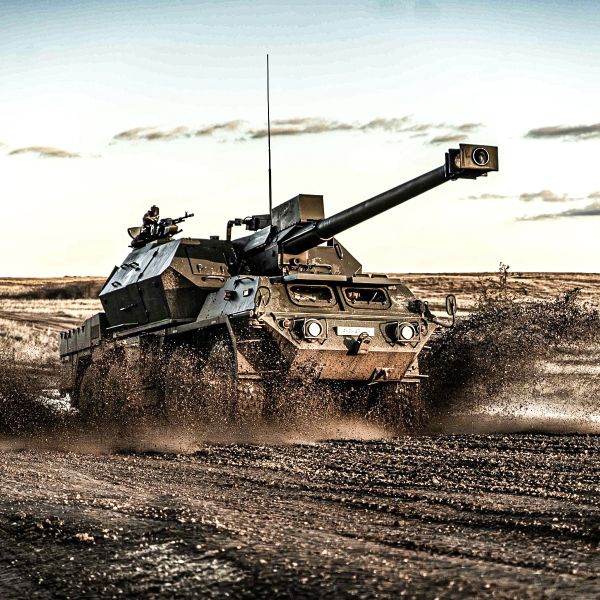
In a context of global stress, the dollar is strengthening as a safe-haven asset, while the euro remains high not through performance, but through constraint. For those who follow the exchange rate, the stakes are no longer strictly the leu-euro parity, but the role that the European currency plays in a new architecture of security and strategic autonomy. The euro no longer reflects only the productivity of the European economy, but the cost of maintaining this architecture.
This is the regime change that must be understood.
• The euro is no longer a currency of growth, but one of defense
In the current phase of global reconfiguration, the euro functions as a defensive currency.
It no longer signals competitiveness, convergence or economic dynamism, but Europe's capacity to finance its independence from external resources, technologies and guarantees.
When the euro remains at high levels despite structural productivity problems, the message is clear: the currency no longer measures efficiency, but the financial effort required to support a new model of economic and strategic protection.
• How a defensive euro translates into concrete terms
A currency that serves a defensive Europe inevitably produces a forced redistribution of resources, between sectors considered critical and those left outside the protection of the state.
1. Expensive money finances new priorities
High interest rates no longer have only an anti-inflationary role. They function as a mechanism to attract capital within Europe, directing financing to strategic industries: energy, microchips, defense, critical infrastructure. This "capital tax" is paid diffusely, through the cost of credit borne by the population and companies.
(Source: Draghi Report on the Future of European Competitiveness, European Commission, 2024)
2. Sectoral Sacrifice Asymmetry
To secure access to essential raw materials and technologies, Europe accepts trade compromises that deliberately expose certain traditional sectors. Agriculture is the most visible example: openness to cheaper imports is not an accident, but the price paid for facilitating access to strategic resources that benefit the continent's technological core.
(Source: DG AGRI analyses on the impact of trade agreements on sensitive agricultural products, 2024-2025)
3. Importing costs from the centre to the periphery
States on the periphery of the European architecture, such as Romania, absorb the tensions of the entire system. Domestic interest rates reflect not only local risks but also the pressure to contribute to the stability of the common currency in a hostile geopolitical environment.
(Source: NBR, Financial Stability Report - External Risks and Monetary Policy Transmission)
• The Price of Membership in a Fortified Economic Area
A defensive euro offers stability, but not freebies. It is the price of membership in a fortified economic area, in which costs are distributed politically, not uniformly. Not all actors benefit from protection, and those who remain outside the new priorities pay the price.
Understanding the euro today means understanding who is protected, who is exposed and who finances this difference.
Post Scriptum
I offer a helping hand here for beginners in investment and speculation, but everything that follows should not be understood as a "recipe for success", because there is no such thing. Instead, the Decision Matrix displayed here illustrates (in principle) how the problems arise.
• Decision Matrix - Direct Check for 2026
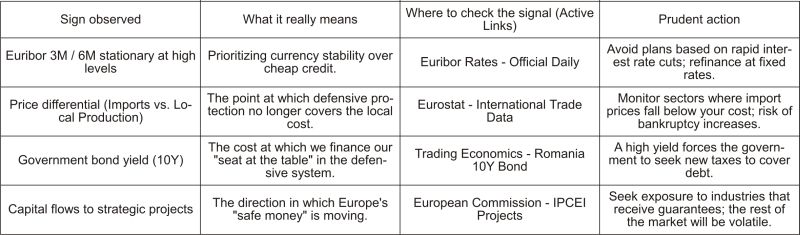
List of active links in the Matrix:
Euribor Rates - Official Daily
Eurostat - International Trade Data
Trading Economics - Romania 10Y Bond
European Commission - IPCEI Projects
If we want to understand the direction of our money, we need to watch where barriers are being raised and where they are being removed:
1. If we see increasingly tougher rules for small sectors (road freight, small-scale food processing, residential construction), it means that these players are left to bear the costs of the transition alone.
2. If industries high-end (semiconductor production, green hydrogen, military aerospace technology) receives subsidies, but agriculture receives foreign competition, we have a new map of priorities ahead.
3. Recommended reaction for investors: In times of stress, liquidity is more important than yield.
The prudent investor should reduce his exposure to assets that do not benefit from direct subsidies and seek refuge in government bonds or shares of companies integrated into the new logistics and energy corridors of Europe.
Disclaimer: This article is for informational and analytical purposes. It does not constitute investment advice and does not replace a professional assessment adapted to the risk profile of each reader.














 Euro
Euro Dolar SUA
 Franc elveţian
 Liră sterlină
 Gram de aur