English


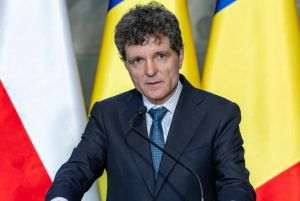
Nicolae Ştefănuţă, Vice-President of the European Parliament, announced last week in Strasbourg that he had asked the European Commission to ban the use of fireworks in enclosed spaces.
During a press briefing held in front of Romanian journalists, the MEP from the Greens political group stated: "The tragedy at the beginning of the year in the Swiss resort of Crans Montana reminded me of the fire at Colectiv, the victims, the families, the survivors, and I believe that Europe must not allow itself to have such incidents again. We already have three fires in which at least 50 people died and hundreds were affected for life. It is about Colectiv Romania in 2015, it is about North Macedonia, the Puls Club in 2025 and Crans Montana 2026, in which young people are dying alive from the stupidity of using fireworks indoors. So we asked the European Commission and collected signatures this week among parliamentarians to stop this weak practice once and for all. We are directly requesting a legislative initiative from the European Commission to ban pyrotechnic instruments in closed spaces, such as clubs. We have dozens of signatures collected so far from MEPs and we will put pressure on the European Commission on this issue. I am doing this out of respect for the victims of Colectiv and for their families. We know that the world has bigger problems now, but at least no one should suffer from such nonsense.”
We recall that on New Year's Eve, inside the La Constellation club in the Swiss resort of Crans Montana, a fire broke out due to the use of fireworks, an event that resulted in the deaths of 40 people (including a Romanian citizen) and the injuries of 117. The tragedy was strikingly similar to the one that occurred at the Colectiv Club in Bucharest at the end of October 2015, resulting in the deaths of 68 people and the injuries of 186 people.
• Nicolae Ştefănuţă: Mandatory reimbursement of mental health services
During the press briefing, the Vice President of the European Parliament also referred to the amendment of the psychologists' law in Romania, in the sense of direct reimbursement by the state of mental health services.
Nicolae Ştefănuţă said: "Mental health is a very important subject for me. In my opinion, we need a new mental health law, one that is written properly and one that includes reimbursement of mental health services, going to therapy. Let's have a package like any civilized country in which 10, 20, 30 - my proposal is 30 - sessions are reimbursed for going to a psychologist. I have a campaign called "Therapy 30". It is important because in Romania mental health is considered a kind of luxury only for those who can afford it, when in fact it is an enormous necessity. And with 300 or 400 lei as the cost of an hour to see a psychologist, most people cannot afford it. However, the law on psychologists and psychotherapists has major flaws. It is proposed through the back door by the College of Psychologists, which in reality does not really represent the industry, because those who should be represented are making massive opposition to this law through parliamentary channels and it includes a kind of control of the profession, meaning some extra testing so that the respective testing companies can pass through it. Basically, it would be about a strangulation of the profession and a control as exists in other guilds and I fear not only for psychotherapists, but also for the prices for patients. Anyway, the prices for patients in Romania are very high. Everyone knows that if you don't have money to go to a psychologist, you go for free to the classes that psychologists also offer for free because otherwise you have no chance. The reason I mentioned the settlement is that what exists now, in rare cases (autism, oncological relatives), is done exclusively with the psychiatrist and or primary doctor who have their share of each session. Which is abnormal. It's like when you receive a referral from the primary doctor, but you receive it once. There is no reason for the primary doctor to take part in each psychotherapist's bill. And then yes, psychologists want direct settlement because instead of, say, 200 lei per hour in the best case, they only receive 70 lei from the state and it doesn't suit them".
He specified that psychology means a lot of prevention, in the current conditions in which many employees in our country enter burnout, a disease that does not exist in the current legislation, and that is why they invent other diseases to be able to enter sick leave.
"Ask the emergency room how many patients arrive for psychosomatic causes instead of burnout and load the emergency rooms. Doctors face very high burnout rates because they can't cope, they have non-stop shifts, there have even been deaths on duty. I did an event in Cluj about burnout in the medical system and I understood that it's not just from the need to earn more , but it is also from this overload”, stated Nicolae Ştefănuţă.
Mr. Ştefănuţă also referred to the need to protect minors with regard to content in the online environment.
"We are far behind in Romania. Luckily we have the revenge porn law, meaning when they are sent intimate pictures of them, when they are emotionally abused online, they have a legal way through this law to defend themselves. Because there are many dramas at the moment that we, as adults, may consider details, but which for them destroy their lives. In fact, I have also had minors commit suicide because of pictures distributed online. I am a parent and I am terrified to think that it could happen in my family too. So on the online side, we are far behind with grooming, with the sexualization there, with the facilitation of pornography, pedophilia and all these variants. I believe that European legislation must be applied without any shame or modesty. We have legislation, we have penalties. The Romanian state should do more, obviously”, said Nicolae Ştefănuţă.
The Vice President of the European Parliament mentioned that there is a classification of crimes in the online environment in EU legislation, in which issues such as online harassment and online trafficking of intimate photos are qualified as crimes, crimes that should also be severely punished by the Romanian state.















 Euro
Euro Dolar SUA
 Franc elveţian
 Liră sterlină
 Gram de aur