English

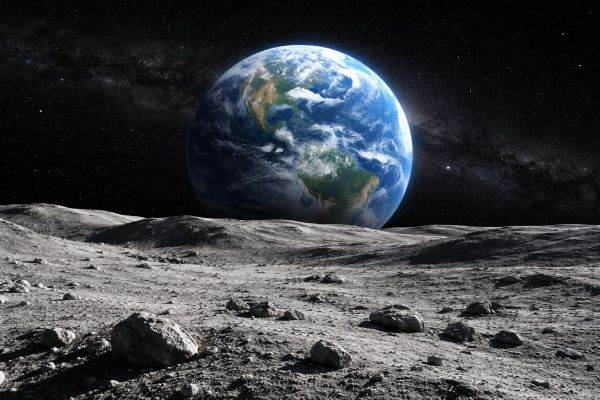
Observing the Earth from the Moon could become one of the most effective methods for analyzing global climate, a new scientific study published recently shows. The research indicates that this unique perspective allows eliminating the "noise" generated by local weather phenomena and highlighting the planet's real radiative signature, essential for understanding climate change, reports Xinhua news agency.
Earth's radiation balance, the balance between the energy received from the Sun and the energy reflected back into space, is a key element in the functioning of the climate system. Changes in this balance influence global temperatures, atmospheric circulation and the frequency of extreme events. Until now, satellites have played a crucial role in measuring this balance, but each type of orbit comes with important limitations. Low-orbit satellites observe different regions of the planet at different times, while geostationary satellites monitor only one hemisphere. This fragmentation makes it difficult to obtain a coherent, continuous, and truly global picture of the radiation reflected by the Earth.
• Ideal platform for global observation
The study, published in the Journal of Geophysical Research: Atmospheres, shows that an observing platform located on the Moon could overcome these limitations. From the distance of the Moon, the Earth appears as a complete and stable disk, providing a permanent perspective of the entire planet. "From the Moon, the Earth appears as a single and complete disk,” explained Ye Hanlin, a researcher at the Institute of Atmospheric Physics of the Chinese Academy of Sciences (CAS) and the study's lead author. "This allows us to extract the dominant radiation signals of the planet while suppressing interference caused by local and small-scale weather events,” he added.
• Earth's Radiation Footprint
The Chinese team's analysis shows that about 90 percent of the variations in radiation emitted by the Earth, as observed from the Moon, can be described by simple planetary-scale mathematical models known as spherical harmonics. These models function as a true global "radiative footprint” of the planet, effectively reducing noise in the energy data and highlighting major climate features. In essence, the lunar perspective allows for the separation of climate-relevant signals from short-term fluctuations generated by weather. The study also identified clear rhythmic cycles in the radiation data, associated with the phases of the Moon, its orbital motion, and the Earth's daily rotation, each leaving distinct signatures in the observations.
• A Strategic Tool for Climate Monitoring
"A platform placed on the Moon provides a new, sustainable and holistic view of the Earth, which is completely unique,” said Guo Huadong, an academician of CAS and corresponding author of the study. According to the researchers, this approach could become an essential tool for precisely measuring the radiation emitted by the Earth and for long-term monitoring of global climate change. Such a "big picture” perspective would complement the data provided by current satellites and contribute to a deeper understanding of the planet's climate dynamics.


























 Euro
Euro Dolar SUA
 Franc elveţian
 Liră sterlină
 Gram de aur