 English

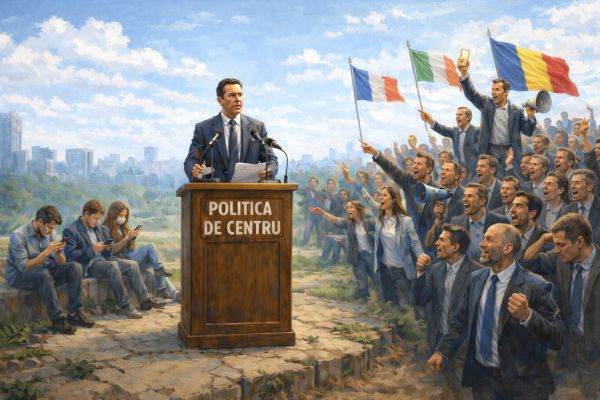
Centre parties and mainstream political groups are fundamentally wrong when they believe that the rise of the new right can be stopped by calls for responsibility, by invoking the complexity of governance or by warnings about the "danger of populism", says Mark Leonard, director of the European Council of Foreign Relations (ECFR) in an analysis published yesterday on the website of the institution he leads.
In an era marked by disorder, polarization and permanent crisis, the strategy of posing as sober administrators of the status quo is a sure recipe for failure, argues Mark Leonard, who explicitly warns that "the greatest danger, in this era of disorder, is that centrists appear to be representatives of the existing order", at a time when a growing part of the electorate perceives this very order as the cause of economic, cultural and political insecurity. Fighting the new right through moral superiority, through tactical imitation or through successive denial of reality only strengthens its position.
The cited source identifies three directions without which mainstream parties cannot hope to regain the political ground lost in the last six years. The first is the honest assumption of the disorder of the contemporary world and the abandonment of the illusion that global interdependence can be presented as a uniformly beneficial process. Center politicians must speak directly about fear, insecurity and loss of status, not minimize them or explain them away in technocratic terms, the cited source states.
The second direction refers to rebuilding a government that no longer leaves the working class behind, after decades in which economic policies have treated globalization as a good in itself, ignoring its deeply unequal impact. The third direction concerns the articulation of an alternative collective identity, capable of competing with the emotional and majoritarian offer of the new right. Without its own story of belonging and meaning, the political center remains disarmed in a struggle that is no longer fought on numbers and expertise, but on identity, emotion and the perception of legitimacy.
These solutions offered by the cited source are not theoretical, but represent the result of a broad analysis of how the new right has become the political force best adapted to the present. Mark Leonard shows that we are not dealing with a nostalgic movement, but with a "hyper-modern, even post-modern” one, which understood better than the old parties the nature of the successive crises that have hit the West since 2007. The financial crisis, the eurozone crisis, the 2015 migration crisis, the Covid-19 pandemic and the war in Ukraine did not simply follow one another, but overlapped and intensified, producing what Benedikt Kaiser calls a "convergence of crises” in a hyper-interdependent society, where no one seems to be in control anymore.
• The rise of the new right, favored by the crises of the last six years
The ECFR data confirms this profound fragmentation of European society. In 2023, 73.7 million EU voters were primarily concerned with the Covid-19 pandemic, 73.6 million with climate change, 70.9 million with global economic turmoil, 58 million with immigration, and 49.6 million with Russia's war on Ukraine, out of an adult population of around 372 million. Instead of creating solidarity, these crises have produced "crisis tribes,” groups with different, often incompatible, priorities in a context where the old left-right divide is disintegrating. The new right has understood that, in such a context, the promise of stability is less compelling than the promise of rule-breaking. According to the cited source, at the 2025 National Conservatism conference, one participant brutally formulated this logic: "breaking things is the goal.” Donald Trump has transformed this strategy into a style of governance, ignoring norms, procedures and even laws to demonstrate his political will, from closing borders to spectacular threats such as capturing Nicolas Maduro or suggesting the annexation of Greenland. In Europe, Marine Le Pen speaks openly about ignoring European law to give priority to "French citizens” in access to housing, jobs and social benefits.
But this policy of rupture would not have succeeded without a profound social mutation. ECFR director Mark Leonard shows that the new right has built a solid electoral coalition among those who see themselves as the losers of globalization. "The left has abandoned the social question in favor of minority policies,” says Benedikt Kaiser, one of the AfD leaders, adding bluntly: "the welfare state exists for its own people, not as an attraction factor for multicultural elements.”
This rhetoric translated into spectacular electoral results. In the United States, Donald Trump won the 2024 election with 66% of the vote among white voters without a university degree and 56% of the vote among the working class, regardless of race. In Germany, workers' support for the Social Democrats fell from 48% in 1998 to just 12% in 2025, while the AfD won 38% of the vote in this segment. In France, the Rassemblement National won 59% of the working-class vote in the first round of the 2024 legislative elections.
• Dominating the online information space - the greatest power of the new right
The political agenda of the new right is coherent and articulated around the idea of "national preference”. Immigration is the central theme, symbolically and emotionally charged. Viktor Orban speaks of "civilizational suicide”, and US Vice President JD Vance states that "America is not just an idea. It is a group of people with a common history and a common future”. Tom Homan boasts that, through ICE actions, he has reduced illegal immigration by 96% in just seven weeks and that he will deport 400,000 people in a single year, the cited source shows.
On the economic front, tariffs and protectionism are presented as instruments of moral and cultural regeneration, not just industrial. In foreign policy, the new right rejects liberal internationalism and promotes a vision of national sovereignty embedded in a vaguely defined Western civilization, in which the European Union should not be abandoned, but reshaped "from within.”
Finally, perhaps the greatest advantage of the new right is its mastery of the fragmented information space. According to the cited source, Nigel Farage unequivocally admits: "I wouldn't exist if it weren't for the internet.” Politico's analysis shows that although only about a quarter of MEPs belong to the radical right, they generate the most interactions on TikTok, with almost 39 million likes, while the largest parliamentary group, the European People's Party, barely reaches 3% of the total.
From this perspective, Mark Leonard's final warning takes on strategic weight. Without a deep understanding of the new right, without a direct confrontation with the real fears of voters and without an alternative collective identity, centrist parties not only risk losing elections. The real risk is to lose the ability to define the political meaning of the era we live in.


















 Euro
Euro Dolar SUA
 Franc elveţian
 Liră sterlină
 Gram de aur





























