English

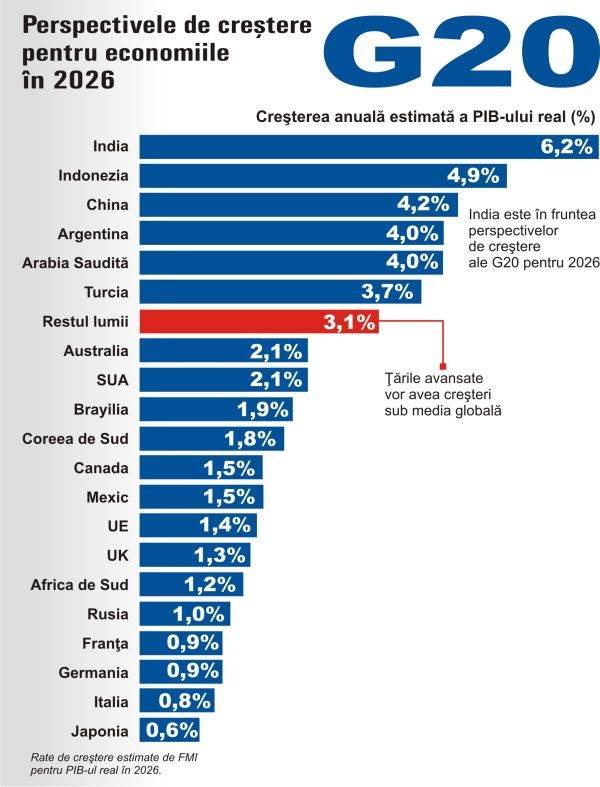
Emerging markets appear poised to drive global economic growth this year, while many advanced countries are expected to underperform the global average, according to the World Economic Outlook report published in October 2025 by the International Monetary Fund (IMF), which provides updated forecasts for real GDP growth through 2026.
These projections provide a snapshot of where the G20 economies are headed and how they compare to each other, and visualcapitalist.com presents a ranking of real GDP growth across all G20 nations in 2026, based on IMF data.
• India - the engine of global growth
According to the cited source, India leads the group of countries analyzed with an estimated economic expansion of 6.2% in 2026, followed by Indonesia (+4.9%) and China (+4.2%). In positions 4-10 in the ranking we find Argentina (+4%), Saudi Arabia (+4%), Turkey (+3.7%), Australia (+2.1%), USA (+2.1%), Brazil (+1.9%), South Korea (+1.8%).
In contrast, major advanced economies, such as Japan (+0.6%), Italy (+0.8%) and Germany (+0.9%), are significantly behind the ranking.
India's remarkable performance is part of a broader macroeconomic shift. The country's expanding middle class, demographic advantage and growing role in global supply chains position it as a key player in realigning global economic trends.
This is also reflected in the long-term shift in global economic power, where countries such as India and China have steadily increased their share of global GDP.
• Advanced economies lag behind
While global real GDP growth is projected at 3.1%, many advanced economies in the G20 are expected to underperform, the source notes. The US and Australia are each expected to grow by 2.1%. Modest, but still above much of Europe.
The EU as a whole is expected to grow by just 1.4%, according to the IMF, with the bloc's main economies, such as France and Germany, set to grow by less than 1%.
Japan, which is struggling with demographic challenges and weak domestic demand, is expected to grow by just 0.6%.
These projections highlight the growing divergence in global growth, with emerging markets taking a larger share of the economic momentum in 2026, the source said.
• Global GDP of $123.6 trillion in 2026
The global economy is expected to reach $123.6 trillion in 2026 as countries recover from recent shocks and adjust to high interest rates.
According to the IMF, the United States (US) will retain its position as the world's largest economy this year, with an estimated GDP of $31.8 trillion, more than the next two countries combined. The US economy has grown by about 70% over the past 25 years, in inflation-adjusted terms.
China ranks second with $20.7 trillion, reflecting slower but still substantial growth as it moves towards advanced manufacturing.
In Europe, Germany ($5.328 trillion) remains the largest economy, with the UK ($4.266 trillion), France ($3.559 trillion) and Italy ($2.702 trillion) all among the world's top ten economies. These countries are also among the world's richest economies by GDP per capita.
Many emerging markets continue to gain economic weight in 2026. India's economy is projected to reach $4.5 trillion, making it the world's fourth-largest economy by GDP.
Meanwhile, countries like Vietnam, Bangladesh, and the Philippines are expected to surpass the $500 billion mark in GDP as they become increasingly integrated into global supply chains.

























 Euro
Euro Dolar SUA
 Franc elveţian
 Liră sterlină
 Gram de aur