English


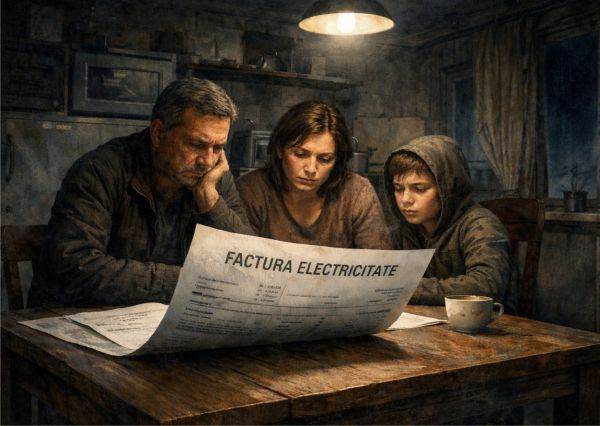
The energy market in our country recorded, in the first month of this year, an anomaly related more to the standard of living: for household consumers, the price of electricity looks relatively good in euros, but becomes the most difficult to bear in Europe when it is reported in purchasing power parity (PPP), according to the Household Energy Price Index (HEPI), published yesterday for January 2026.
According to the cited source, Bucharest climbs from 11th place in nominal terms (euro) directly to 1st place in terms of PPS (purchasing power), that is, exactly the indicator that shows the impact of the electricity bill reported in relation to income and the cost of living. And the figure is sharp: in PPS, electricity in Bucharest reaches 49 eurocents/kilowatt-hour (kWh), the highest value among the capitals analyzed, while the lowest price is in Oslo (Norway), with 10.9 eurocents/kWh. In other words, the problem here is not just the price, but the explosive combination of price and purchasing power: a bill that, on paper, may seem comparable, becomes a budget shock in reality. Nominally, in eurocents/kWh, the EU average for electricity used by household consumers is 25.8 eurocents/kWh at the beginning of January 2026, but Europe looks like a two-speed continent. At the top, according to HEPI, are the expensive capitals: Bern (38.5 eurocents/kWh), Berlin (38.4 eurocents), Brussels (36.5 eurocents), Dublin (36.5 eurocents), London (36.4 eurocents) and Prague (36.4 eurocents). At the opposite end, HEPI shows the lowest tariffs in Kiev (8.8 eurocents/kWh), Budapest (9.6 eurocents), Podgorica (11.1 eurocents) and Belgrade (11.6 eurocents). This is the picture "in euros”, which can induce a convenient conclusion: the East seems cheap, the West seems expensive.
However, the reality for households is seen in PPS (energy purchasing power standard), and there the ranking is different: Bern falls from first place in euros to 22nd place in PPS, Luxembourg drops from 17th to 26th, while Bucharest jumps from 11th to 1st, and Riga climbs from 14th to 5th. The message is stark and simple: even when nominal prices are lower in the East, they weigh harder on people's budgets, because incomes and purchasing power do not keep up.
For natural gas, the picture is just as telling and just as inconvenient, according to HEPI. In January 2026, the EU average is 10.6 eurocents/kWh, but the range is huge: from 1.6 eurocents/kWh in Kiev to 35 eurocents/kWh in Stockholm. Within the EU, the difference between Stockholm and Budapest is over 13 times, because Budapest is at 2.6 eurocents/kWh, with the mention that Hungary is still supplied from gas pipelines in the Russian Federation.
The price of natural gas in Stockholm is almost double that of the second place, Amsterdam, with 17.4 eurocents/kWh. In the area of prices above the EU average, a list of capitals that normally dictate the standard of living also enters: Bern (15.8 eurocents), Lisbon (13.8 eurocents), Rome (13.6 eurocents), Paris (12.8 eurocents), Vienna (12.7 eurocents), Dublin (11.7 eurocents), Prague (10.7 eurocents).
HEPI links these differences to a number of factors that, in practice, translate into bills: purchasing and pricing strategies, weather and temperatures, storage levels, market interconnections, cross-subsidies and the tariff mix. In the case of Sweden, the explanation in the report is even more straightforward: a small market, with around 77,000 household customers nationwide, of which around 50,000 are connected to an isolated network in Stockholm, which can amplify costs.
Where does Romania fit into this equation? Bucharest is only 23rd in gas prices (i.e. it has a low price of 5.6 eurocents/kWh), but it climbs to 17th in the energy purchasing power standard. That is, again cheap on paper, more expensive when it really matters: in relation to purchasing power.
In the PPS, household gas varies from 3.6 eurocents in Budapest to 28.5 eurocents in Stockholm, and the Swedish capital remains the most expensive even after adjustment, a sign that the price there is simply high, regardless of income. In contrast, the fact that Bucharest climbs the ranking after adjustment shows exactly that the problem is not just the bill, but how much of the salary covers this bill. And here, Romania is losing ground to a Europe that can pay, even when it pays a lot.
What makes this explosive picture for Romania is the contrast between two competing narratives. The nominal narrative tells us that Eastern European states often have lower energy prices, with exceptions such as Prague for electricity. The real narrative, in the PPS, however, shows us that the burden is shifting precisely to these countries, and Romania reaches the very top of the electricity burden: 1st place in the PPS.
We are not talking about a statistic, but rather a diagnosis: when a state is at an average level in terms of the European base of energy prices for household consumers, but becomes the European champion in the burden in PPS, means that energy is no longer just a consumer good, but an accelerator of poverty and social polarization.
Eurostat estimates that, on average, electricity, gas and other fuels represent 4.6% of total household expenses in the EU, but the average hides precisely the countries where this share jumps much higher for those with low incomes, where each increase or each harsher winter moves entire budgets from the "living" zone to the "survival" zone.
Therefore, the authorities in our country must not only consider energy prices, because they can be reassuring, but also look at the purchasing power standard of energy, which shows us that the bill is a function of price and income, not just price. When the price of electricity in Bucharest reaches 49 eurocents/kWh for household consumers, and in other capitals the apparently expensive electricity prices become relatively cheaper after adjustment, it means that the discussion about energy inevitably turns into a discussion about wages, productivity, social protection and economic competitiveness. In simple terms, our country may have tariffs that are not eye-catching in euros, but if purchasing power remains weak, energy becomes an invisible tax on poverty, paid month after month, precisely by those who have the least room to maneuver.
And the impact is a chain reaction: households reduce consumption, postpone investments, go into debt, energy vulnerability deepens, and the economy loses domestic demand. In parallel, political pressure explodes, because people do not live by graphs, they live by bills.
And that is precisely why, at the beginning of 2026, our country appears in the mirror of Europe as the state where electricity weighs the most heavily in relation to purchasing power, a position that, if it remains unchanged, represents a major social and economic risk, with a direct impact on welfare, consumption and public stability.





















 Euro
Euro Dolar SUA
 Franc elveţian
 Liră sterlină
 Gram de aur