English


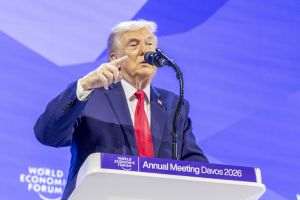
The ramblings that battered Donald Trump's discourse (available on the website www.bursa.ro as an attachment to this article) during his Wednesday appearance in Davos exert a certain attraction both on the public and on the journalist called upon to analyze them.
I did that.
I analyzed each of them, through a process of confronting the triumphalist figures issued by Trump with the official data.

Read Data vs. Rhetoric
Then I analyzed the obvious cognitive problems presented by the American president.
But this type of analysis is somewhat frivolous.
It is within easy reach of media outlets that display a certain degree of editorial independence.
I thought that BURSA should offer its readers a different kind of analysis: what are the consequences of Trump's discourse (if we take it seriously) for the entire world.
That is what you will find out by reading on.
------------------------
The speech delivered by U.S. President Donald Trump at the World Economic Forum in Davos in January 2026 is not merely what Trump intended it to be-a celebration of an internal economic comeback he claims is more than remarkable-but also functions as a structural declaration of the end of the global order based on consensus and efficiency.
The speech confirms a trend of accelerated decoupling and a transition toward an era of economic and geopolitical fragmentation.
The immediate conclusion is that the political agenda described-based on tariffs, energy sovereignty, and geopolitical transactionalism-represents, in the logic of the speech, a concerted effort to prioritize national resilience and control at the expense of cost arbitrage and the integration of value chains.
• I. Structural Impact: The Decoupling of Production and Trade
President Trump claims a 77% decline in the monthly trade deficit and an explosion of domestic investment (with factory construction cited as having grown by 41%), a phenomenon supported, according to the speech, by 100% tax deductions and accelerated depreciation.
If these claims are taken at face value, they constitute the strongest signal yet of the fragmentation of global supply chains.
• The Mechanism of Fragmentation
1. Tariffs as a Tax on Globalization
Tariffs are no longer presented as mere negotiating tools, but as pillars of fiscal policy and industrial development. They force the relocation (reshoring) of production back to the United States, even at marginally higher operational costs.
2. "Sovereignty Premium”
The claimed economic success (5.4% growth, 1.6% inflation) suggests, in the narrative of the speech, that the American market is willing to absorb the cost of a "sovereignty premium”-the price paid for having production localized domestically and protected from geopolitical or logistical shocks.
3. Impact on the Rest of the World
A sudden decline in the U.S. trade deficit implies, by definition, an equivalent reduction in the net exports of trading partners (especially China, Mexico, but also Europe).
This commercial decoupling forces the rest of the world to seek alternative markets or to re-regionalize, intensifying competition and reducing the degree of globalization.
• II. Divergent Interest Rates: The Dominant National Currency
Interest rates tend to cease converging internationally, reflecting different risks and credit conditions.
The interventions announced by President Trump-capping credit card interest rates at 10%, injecting USD 200 billion into mortgage-backed securities, and announcing a new Fed chair-signal a subordination of monetary policy to social policy and domestic growth objectives.
• Implications of Divergent Interest Rates
1. Prioritization of Domestic Credit
By aggressively controlling the cost of mortgage credit and consumer debt, the U.S. isolates its economy from the impact of tightening global financial conditions.
If other central banks (ECB, BoE) are constrained to maintain high interest rates due to persistent inflation-driven by energy costs and supply chain fragmentation-the divergence becomes structural.
2. Sovereign Monetary Policy
The speech suggests the possibility of high growth without inflation, a declarative denial of the traditional Phillips curve ("in a normal economy, strong growth comes at a price: inflation”).
If this dynamic is achieved through massive capital repatriation, attracted by generous fiscal policies, and through reduced external demand induced by tariffs, the result is a U.S. monetary policy that is more relaxed than that of other G7 economies, even as the U.S. remains the engine of global growth.
This monetary divergence is a classic symptom of economic fragmentation.
3. Europe's Vulnerability
In contrast, Europe is portrayed in the speech as being trapped in a combination of economic stagnation and high energy costs, suggesting a fundamentally different cost structure from that of the United States.
Under these conditions, European interest rates cannot follow the American trajectory without exerting severe pressure on local economies.
• III. The Erosion of the Global Security Architecture
Perhaps the strongest signal of fragmentation appears in the geopolitical realm, where global security-an essential facilitator of globalization-is redefined as an economic transaction.
✓The Case of Greenland and NATO
The territorial claim over Greenland, justified by strategic security needs vis-à-vis Russia and China, and the implicit threat directed at Denmark, transform security alliances into transactional arrangements.
1. From Alliance to Ownership
The demand to acquire Greenland in exchange for protection ("the golden dome”) indicates an externalization of the cost of global security, by demanding explicit territorial or financial compensation. NATO thus appears as a security cartel, not an alliance based on shared values.
2. Fragmentation of Risk
The explicit distancing of the U.S. from the war in Ukraine forces Europe to assume the full costs and risks of regional security.
This forced regionalization of risk reduces strategic interdependence and compels regional blocs to develop autonomous military and financial capabilities.
When security alliances become bilateral transactions, long-term stability-essential for cross-border global investment-erodes. Capital tends to retreat toward jurisdictions perceived as safest and most controllable, foremost among them the United States.
✓The Future of De-Globalization
The Davos 2026 speech can be read as a manifesto for a form of "selective national autarky.”
The economic success claimed by the U.S. is not presented as a validation of globalization, but as proof of America's capacity to extract value from a global system in retreat, by:
Taxing external competition, using tariffs to finance deficit reduction and domestic investment;
Capturing value chains, by forcing reshoring under the pretext of resilience;
Dictating security terms, transforming military protection into an economic lever.
✓Fragmentation, the New Order
A lower degree of globalization does not imply an immediate economic collapse.
It does, however, entail higher transaction costs, increased redundancy in supply chains-with a sacrifice of efficiency-and a persistent divergence of interest rates between economic blocs, as central banks prioritize national objectives over global monetary synchronization.
The global structure is evolving from an interconnected network into a system of regional blocs locked in intensified competition-a more volatile world, but one with a more self-sufficient America.
























 Euro
Euro Dolar SUA
 Franc elveţian
 Liră sterlină
 Gram de aur