 English


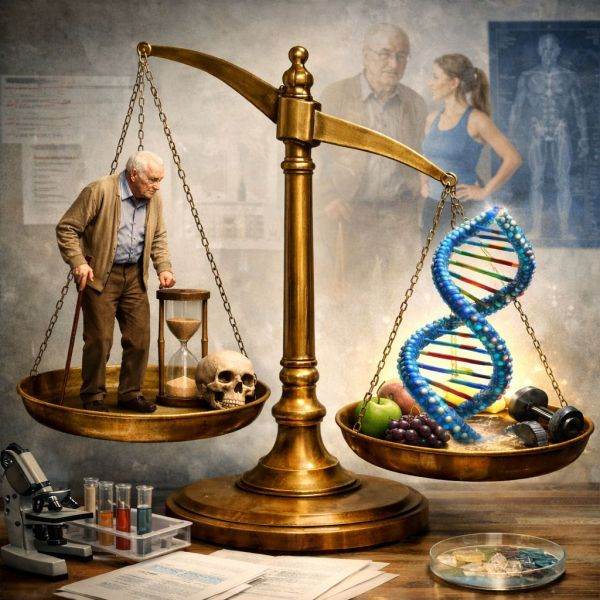
Questions about lifespan, DNA, and whether it's down to choice, environment, or pure chance have been and will continue to be asked. A new study published in the journal Science suggests that genes play a much larger role in determining human longevity than previously thought, explaining about 50 percent of the variation in lifespan, according to an analysis by researchers at the Weizmann Institute of Science in Israel. The estimate is almost double the conclusions of previous studies and is close to the results obtained in experiments on laboratory animals, Reuters reports.
Lifespan is influenced by numerous factors: diet, physical activity, smoking, alcohol consumption, living environment, and access to medical services. But there is also a dose of hazard, including accidents. The role of genetics in this complex mix has been hotly debated for decades, with most studies suggesting that genes explain only 20-30 percent of longevity. But the new study challenges that view.
• Why previous studies underestimated genetics
The classic studies relied primarily on data on Swedish and Danish twins, many of which date back to the 19th century. The major problem: these databases did not include cause of death, only the age at which the individuals died. "If one twin died at 90 of natural causes and the other at 30 due to an infectious disease or an accident, the raw data suggests a large difference that is not related to genetics,” explains Ben Shenhar, a doctoral student in physics at the Weizmann Institute and lead author of the study.
These factors-accidents, violence, infectious diseases-are defined as extrinsic mortality, meaning deaths caused by factors outside the body.
• Extrinsic mortality, the "noise” that masked genes
According to the researchers, extrinsic mortality was much higher in the period analyzed by the old studies, especially before the advent of antibiotics. "Extrinsic mortality was about ten times higher than it is today, mainly due to infectious diseases that are now easily treated,” Shenhar explained.
To correct for this distortion, the team developed a mathematical model that separates the influence of genetics from deaths caused by external factors, thereby recalculating the true share of heredity. The researchers validated the model using more recent data from Sweden, which includes both twins raised together and twins raised apart. "Identical twins raised separately share genes but not environment. This allows for a clear separation of genetic and environmental influences,” explained Uri Alon, a systems biologist and co-author of the study. The analysis showed that as extrinsic mortality decreases, the genetic influence on lifespan becomes more and more visible. Previous twin studies have worked well for traits such as height, blood pressure, and certain personality traits. "Life span, however, is a special trait that is deeply affected by extrinsic mortality,” Uri Alon emphasizes. "This component has not been corrected for in classic studies, which has led to an underestimation of the role of heredity.”
• Implications for aging research
The new findings could have a major impact on how aging is scientifically approached. "Low estimates of the role of genetics may have discouraged funding and research in the field of aging genetics,” says Ben Shenhar. "Our study shows that the genetic signal is strong, but it has previously been hidden by noise in the data.” Genetics influence longevity in both directions. Some genetic mutations can predispose to serious diseases, while others appear to provide protection. "Many centenarians reach 100 years without major medical conditions. It is clear that they have protective genes,” Shenhar explained. These genes exist, but longevity remains an extremely complex trait, likely influenced by hundreds or even thousands of genes.

























 Euro
Euro Dolar SUA
 Franc elveţian
 Liră sterlină
 Gram de aur





























