English

Geopolitical tensions are putting global trade in the spotlight, as many countries seek, in the current context, to diversify their imports.
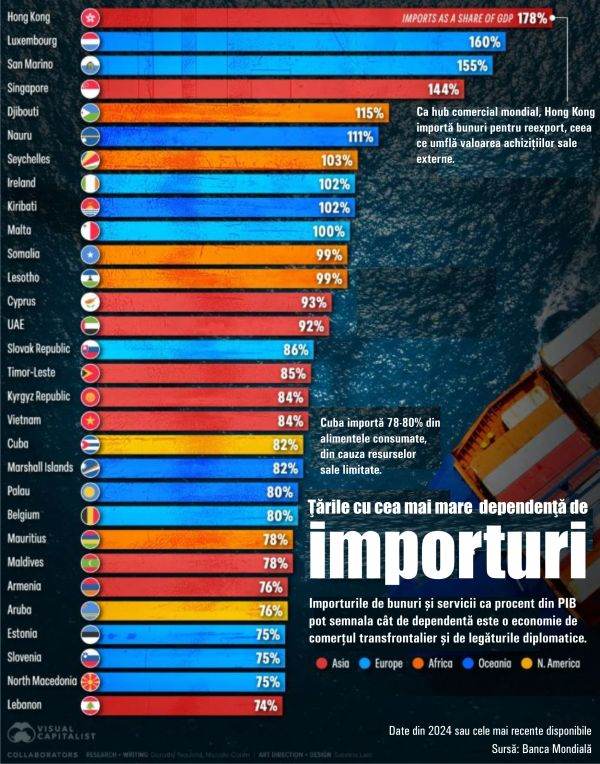
The economies most dependent on imports are often small islands or landlocked countries. A visualcapitalist.com analysis presents the countries with the highest imports as a share of GDP, based on data provided by the World Bank. According to the source, in Hong Kong, for example, 99% of fossil fuels are imported to cover energy needs. At the same time, Cuba imports up to 80% of its food, due to low domestic production.
The ranking of countries with the highest imports relative to Gross Domestic Product places Hong Kong in first place, with imports equal to 178% of GDP. Being one of the busiest shipping centers in the world, many goods enter Hong Kong and are then re-exported elsewhere. Because imports are counted at full value, this inflates the import-to-GDP ratio. Other commercial and financial hubs-including Luxembourg (160% of GDP), San Marino (155%) and Singapore (144%)-have similar import shares for the same reason.
Beyond these hubs, several small island nations, such as Nauru, Seychelles and Kiribati, have import values above 100% of GDP. Moreover, 26 of the 30 most import-dependent countries have populations under 10 million, according to the source.
The United Arab Emirates also relies heavily on imports-especially food-which makes it more vulnerable to supply chain disruptions. Notably, up to 90% of the Emirates' food is imported.
In Europe, landlocked Slovakia is among the most import-dependent countries (86% of GDP). It was also one of the few European countries exempted from Russia's oil embargo to ease the deficit, with Russia supplying 87% of its crude.
• WTO chief urges trade war escalation avoided
All parties must find solutions to defuse the dispute over US claims to take control of Greenland so that it does not escalate into a full-scale trade war, World Trade Organization (WTO) Director-General Ngozi Okonjo-Iweala warned in January, according to Reuters.
"We need to find a solution to ensure that it does not result in a trade war, because a trade war does not only hurt those involved, it has negative effects on others. I think what we are seeing and hearing in Davos is a kind of tempering: "let's have a dialogue, let's discuss'," the WTO chief said on the sidelines of the World Economic Forum in Switzerland, Agerpres notes.
At the time, President Donald Trump was threatening to raise tariffs on eight European countries if a deal was not reached to allow the United States to buy Greenland from Denmark.
The World Trade Organization recently revised its estimates for world trade in 2026, citing the delayed impact of tariffs imposed by President Donald Trump. According to new forecasts by WTO economists, global merchandise trade is expected to grow by just 0.5% this year, compared with a previously estimated 1.8% increase.
• Norway: "WTO reform is a matter of life and death for the organization”
Last week, Petter Olberg, Norway's ambassador to the WTO and the facilitator of the talks on the organization's reform, told AFP that WTO reform is a matter of life and death for the organization. "We are preparing a reform plan that we will submit to ministers for approval. It will be a reform plan for the future, which will define the direction in which the WTO must go. We must reform. We reform or we die,” said Petter Olberg.
The WTO reform, which has been facing structural and geopolitical obstacles for several years, will be at the center of discussions at the organization's upcoming ministerial conference, which will take place from March 26 to 29 in Yaounde, Cameroon.
Petter Olberg's view is shared by other parties, including the EU, which, in a document published at the end of January, warned that "the WTO is at a turning point, which is, in fact, existential".
The aim of the Yaounde conference is not to finalize the reform, but to establish a work program with objectives and deadlines, notes Agerpres.
"The chances of this plan being successful are quite good, even if some changes may be necessary", said Petter Olberg.
The need for WTO reform has been discussed for many years. But the paralysis of the dispute settlement mechanism's appellate body since 2019, when the US blocked the appointment of judges, has made the reform more urgent. The need for WTO reform was recognized in 2022 at a ministerial conference held in Geneva. But the talks have really intensified in recent months, amid trade tensions with the return of Donald Trump to the White House.
"Everyone realizes that there is a sense of urgency that was not there before. This time, we have to act. Many, if not all countries are affected by this situation, whether they are small or large,” Olberg stressed.
As WTO Director-General Ngozi Okonjo-Iweala said at the Davos forum, trade agreements announced by the Trump administration are not notified to the organization. However, WTO member states are required to do so to allow other members to see whether the agreements comply with WTO rules.
This uncertainty raises concerns that the agreements could violate a fundamental principle of the WTO, that of "most-favoured nation”, which aims to extend any trade advantage granted to one trading partner to all its other partners, in order to avoid discrimination.
However, on December 15, 2025, the United States notified the WTO that this principle "is no longer appropriate at this time,” especially given the "reluctance of some countries to promote and defend fair, market-oriented competition” and the "insistence of some countries to maintain economic systems that are fundamentally incompatible with WTO principles.”
"This is a real turning point. The United States is fed up, and many other countries are fed up. We cannot continue like this,” Olberg said.
Most WTO agreements are working, especially those on customs valuation procedures, intellectual property, and sanitary and phytosanitary measures. And 72 percent of global trade still operates under WTO rules. But the organization's effectiveness is increasingly being questioned.
"We cannot adopt new rules and we cannot change old ones because of the consensus rule,” Olberg noted.
This rule allows, for example, the United States to block the appointment of judges to the Court of Appeals or India to block the adoption of multilateral trade agreements in accordance with WTO rules.
"There is enormous frustration, growing in the context of the need to do something to modernize and reform the WTO. Now, more than ever, people understand that we must reform. Otherwise, we will become irrelevant. Therefore, the status quo is not an option,” Olberg concluded.















 Euro
Euro Dolar SUA
 Franc elveţian
 Liră sterlină
 Gram de aur