English


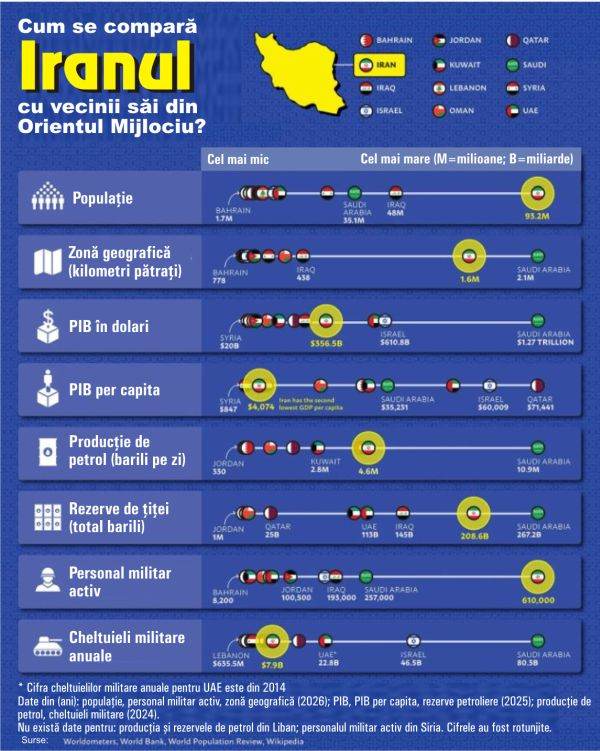
Iran is often seen as a major power in the Middle East, but how does it compare to its neighbors? By population, energy resources and military size, it is among the largest players in the region, but it lags behind richer states in terms of per capita economic output and defense spending, according to visualcapitalist.com. The cited source presents the figures on several dimensions, showing where Iran leads, where it lags, and how its overall size shapes its regional influence.
• Low GDP per capita
Iran stands out with its population of 93.2 million, much larger than its neighbors, but its GDP per capita remains among the lowest. While its total GDP is sizeable at over $356 billion, it lags behind regional leaders such as Saudi Arabia ($1.27 trillion) and Israel ($610.75 trillion), highlighting the gap between size and prosperity.
While population size can boost economic potential, Iran's relatively low GDP per capita, just over $4,000, suggests that productivity per capita lags behind smaller, wealthier nations such as Qatar ($71,441) and Israel ($60,009).
This contrast highlights the regional pattern: smaller Gulf states tend to have higher per capita wealth, while larger countries like Iran and Iraq have more modest income levels.
• Energy Power
Energy remains one of Iran's defining strengths, with the country near the top of the rankings in both production and oil reserves. Iran ranks second after Saudi Arabia, with an estimated 208.6 billion barrels in reserves and a daily production of about 4.6 million barrels, making it one of the region's major energy players.
Despite this, sanctions against Iran have restricted exports and investment, limiting production growth relative to Gulf players like Saudi Arabia and the United Arab Emirates. Much of the oil exports that leave the country's borders end up in China.
• Largest active military force in the region
In terms of defense, Iran has the largest active force in the region, with 610,000 troops, more than double Saudi Arabia's (257,000). Despite this, its annual military spending of $7.9 billion is much lower than that of Saudi Arabia ($80.3 billion) or Israel ($46.5 billion). This reflects a different strategic approach: Iran emphasizes manpower and asymmetric capabilities (significant differences in power, tactics, or resources between the parties); while its rivals invest heavily in advanced technology and defense systems.
Although Israel is often considered more technologically advanced, Iran's size and regional influence remain significant factors in the balance of power.
• Iran issues 10 million rial note amid record inflation
In the midst of its war with Israel and the United States, Iran has issued a new banknote, the highest value in its history - with seven zeros - of ten million rials, which is worth almost nothing, 6.56 euros, after the value of the rial fell by 97% against both the dollar and the euro.
This new banknote - light burgundy in color, which has a drawing of the Isfahan Mosque on the front, and a drawing of the Bam citadel on the back - began to be put into circulation by banks in mid-March, writes the Financial Times (FT), according to news.ro. The banknote represents a response to a growing demand for liquidity from the population, affected by exponential annual inflation (47.5% in February), as Iran plunges into war.
The economic crisis is not exactly new in Iran, a country undermined by years of US sanctions, especially on oil. One million rial banknotes have been in circulation since the summer of 2025. The demonstrations in December, which were brutally suppressed by the authorities, were originally triggered by the high cost of living. They turned into protests against the regime in January. On March 15, the Iranian Ministry of Labor announced a 60% increase in the minimum wage, from 103 million rials to 166 million rials per month (109 euros). The government has announced a similar increase in family allowances. In order to simplify transactions and display prices, the government obtained, a few months ago, a law on the deletion of the last four zeros. The ten million rial note thus reads "1,000" in capital letters on both sides. However, the full number is displayed on the reverse, where the last four zeros are printed in a lighter shade.



















 Euro
Euro Dolar SUA
 Franc elveţian
 Liră sterlină
 Gram de aur