English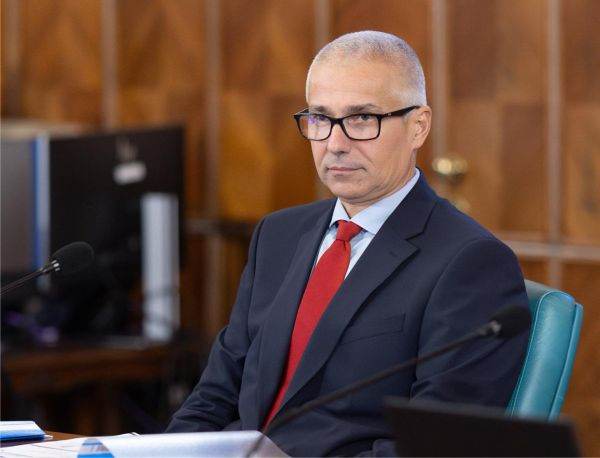
The Bolojan government is facing a new scandal related to one of its members, after yesterday Radu Marinescu, the Minister of Justice, was accused in a press article of plagiarizing in the preparation of his doctoral thesis. The Marinescu case comes after Ionuţ Moşteanu was forced to resign on November 28 from the position of Minister of National Defense, following controversies related to his bachelor's degree.
The controversy regarding Radu Marinescu's doctoral thesis comes just a month after the case of Lia Savonea, the president of the High Court of Cassation and Justice and the Bucharest Court of Appeal, revealed by Recorder in the documentary "Corrupted Justice" and a few days after the Minister of Justice launched the selection procedure for the new heads of the DNA, the General Prosecutor's Office and DIICOT.
According to the analysis carried out by Emilia Şercan and published by Pressone, Radu Marinescu allegedly copied approximately 140 pages out of the total of 247 of his doctoral thesis, defended in 2009 at the Faculty of Law and Administrative Sciences of the University of Craiova, under the coordination of Professor Ion Dogaru. The investigation indicates extensive copying, including from the "Foreword of the thesis”, without quotation marks and without indicating the source, some text segments extending over up to 25 consecutive pages. Most of the content considered plagiarized comes from three previously published works, one of which was not cited at all or included in the bibliography.
In response, the Minister of Justice rejected the accusations. In a statement to PressOne, Radu Marinescu stated: "I do not consider that I plagiarized. That much I can tell you.” He claimed that the thesis was developed "in accordance with the norms of the time and under the coordination of a reputable academic professor”. Later, in a large post on his Facebook page, Minister Radu Marinescu questioned the timing of the investigation, asking rhetorically: "Why now? Why me?” He described the article as "defamatory and full of contradictions” and stated that it did not violate the academic standards in force at the time of writing the paper. The Minister of Justice highlighted his professional career, showing that he graduated from the Faculty of Law in Craiova as the head of his class, practiced as a lawyer for 30 years and also worked in international structures of the profession. Regarding the doctorate, Radu Marinescu claimed that it was evaluated by the doctoral committee and the CNATDCU, "without any non-compliance being reported to me”. He also stated that the doctorate did not benefit his career and specified that he does not hold a university chair, being only an associate professor.
However, PressOne shows that, in 2009, academic norms and legislation explicitly required the marking of texts taken from other works with quotation marks and the indication of the author, contrary to the claims regarding an alleged "lack of norms”. The investigation also mentions that certain passages were allegedly copied including from works signed by the doctoral coordinator and other professors who held leadership positions within the faculty.
Amid this scandal, the Social Democratic Party publicly announced its support for the Minister of Justice. In a press release issued yesterday, the PSD states that it "unreservedly supports the Minister of Justice Radu Marinescu” and denounces "the attempt to undermine the legal procedures regarding the appointment of heads of prosecutors' offices”. According to the party, the accusations represent "a political attack aimed at determining the removal of the minister”, the timing of their appearance being directly linked to the initiation of procedures for the appointment of chief prosecutors.
PSD also claims that the minister "is not at all in the situation of other dignitaries targeted by similar accusations”, pointing out that his doctoral thesis "has already been validated by the Doctoral Commission and CNATDCU, who considered that the text respected academic norms and the legislation in force at that time”. The statement also states that "you cannot accuse someone of violating a law that was not in force at that time” and that the verdict on academic integrity cannot be given by an individual or the press, but by the competent state institutions.
The Radu Marinescu case reopens a recurring theme in the Romanian public space: the relationship between politics, academia and justice, as well as the way in which allegations of high-level plagiarism are handled. After the recent scandal involving the leadership of the High Court, the new controversy amplifies the pressure on the judiciary and raises again questions about the standards of integrity of those who occupy key positions in the state, at a decisive moment for appointments at the top of the prosecutor's offices.

























 Euro
Euro Dolar SUA
 Franc elveţian
 Liră sterlină
 Gram de aur