English

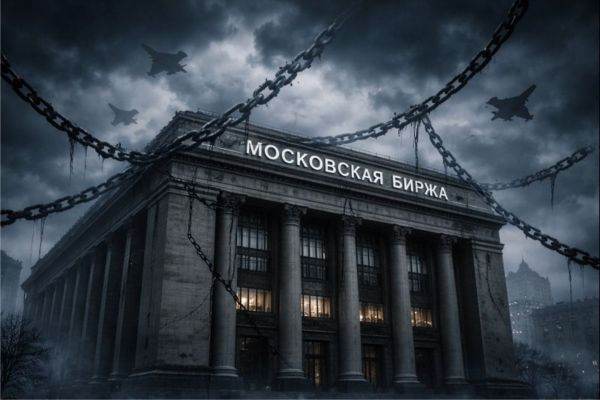
The capital market in the Russian Federation ends 2025 in a state of collective frustration, with a mixture of dashed hopes, postponed promises and a reality that refuted almost all the optimistic scenarios built at the beginning of the year, according to two extensive analyses recently published by the Russian daily Kommersant.
After the current year was presented as the starting point of Vladimir Putin's grand political ambition of doubling the capitalization of the stock market by 2030, the source cited claims that Russian investors are now looking at charts that show a Moscow Stock Exchange index lower than in January 2025, a market that is thin, extremely volatile and deeply dependent on geopolitical factors it cannot control. The target has never seemed easy either: the Central Bank called it "superambitious”, almost impossible to achieve, and the Moscow Stock Exchange has said, with the lucid cynicism of those who do the calculations, that to get there we would have to "find somewhere and bring thirty more Sberbanks to the market”, according to experts quoted by Kommersant.
The cited analyses show that, at the end of November 2025, the IMOEX index on the Moscow Stock Exchange was over 14% below the level at the beginning of the year, in painful contrast to the forecasts circulating in the fall of 2024. At that time, Donald Trump's return to the White House, promises of geopolitical de-escalation and an end to wars, as well as expectations of a rapid decrease in the key interest rate in Russia had fueled a wave of enthusiasm. Slogans that sounded like a caricature, but which, in the logic of investments, can move billions, were circulating in the market: "Make IMOEX Great Again". On the day Trump became the 47th president of the USA and promised that he would "not start, but stop wars", a "Trump-rally" took place on the Russian stock exchange, and the index jumped, "heated by the "geopolitical hopes' of investors", by almost 4%. Some analysts were talking without reservation about 5,000 points for the Moscow index, a new historical high that would have meant a massive revaluation of Russian assets; it was even said that the inauguration on January 20 "may become a turning point in investors' attitude towards the Russian market” and may trigger a "significant positive revaluation” of Russian financial instruments.
• Geopolitical uncertainties - a major obstacle for investors in the Russian capital market
However, as Kommersant journalists show, the reality in 2025 was exactly the opposite: the rally at the beginning of the year quickly faded, and the market entered a combination of steep declines and sideways movements, dominated by news about sanctions, peace negotiations without concrete results, and an economy that suddenly slowed down.
Although the Central Bank of Russia has begun to reduce the key interest rate from a record 21%, cutting it by a total of 4.5 percentage points to the current level of 16.5%, the pace has been far below market expectations. Russian monetary policy has remained restrictive, and the message has been one of emergency braking: too rapid easing could "accelerate inflation,” which would require "a new cycle of increases.”
In this context, stocks continued to be eclipsed by conservative instruments: deposits, money market funds, and, above all, bonds. The market still remembers the diagnosis made bluntly by brokers: "The main reason for the index's decline in 2024 was high interest rates in rubles. Bonds, money market funds, and deposits attracted investors' money that could have gone to stocks.” And the promise at the beginning of the year, uttered in an almost advertising form, sounds like irony today: "In short: we believe that 2025 will be better than the previous year.”
Instead of getting better, 2025 became more complicated for the capital market in the Russian Federation. An investment manager summarized for the cited source the main reason for the disappointment: "Yes, monetary policy easing took place, but not at the pace the market expected.” In addition, the strengthening of the ruble, tax changes and sanctions, including secondary sanctions against partners, settled on the stock market like tectonic plates, against the backdrop of "geopolitical uncertainty” that continued to weigh. For equity analysts, the conclusion expressed for the cited source was even harsher: "Geopolitics remains the dominant factor: the strengthening of the sanctions regime and the increasing military rhetoric from Europe are canceling out the effect of monetary policy easing.” And with that, the market has become "extremely is dependent on news about peace negotiations,” news that, most of the time, had "a limited influence” on reality.
Overlaying this picture was another toxic factor for the Russian Federation's stock market: an unusually strong ruble. For an economy heavily dependent on raw material exports, the appreciation of the national currency has reduced the profits of exporting companies, which have a large share in the IMOEX index. In parallel, lower oil prices and a slowdown in economic growth, from 4.3% in 2024 to almost "virtually zero values” in 2025, have further eroded investor confidence. According to Kommersant, one strategist described the ruble as being "at abnormally high levels for a number of reasons, including those hidden from most analysts,” and this anomaly has cut into the potential of exporters and, implicitly, the traction weight of the entire index.
• Open-end funds and ETFs, only 1% of GDP
However, the problems of the Russian capital market are not only external, the analysis carried out by the cited source shows. From within, the Moscow Stock Exchange suffers from the same chronic structural weaknesses: a narrow base of real investors, the absence of foreign capital, the lack of large institutional investors and an excessive concentration of liquidity in a few dominant names. "The market is still not capacious enough, it does not stand out either in the number or in the diversity of participants,” said the experts consulted by Kommersant, who added that although it is considered "retail”, with 60-70% of turnover coming from individuals, "real private investors” are "no more than 7 million”, while open-end funds and ETFs amount to only "about 1% of GDP”, pension funds are "in no hurry” to increase the share of shares, and foreign investors are "practically non-existent”.
That is why, one of the experts told the cited source that, on such a terrain, it is difficult to make IPOs that change the game: "Companies are increasingly turning to the debt market, but they still do not look at the stock market as a source of investment. For years, there have been about 200 issuers, and the top ten companies concentrate over 60% of the capitalization and liquidity". This structural fragility also explains the failure of the IPO market in 2025. After the effervescence of 2023-2024, the current year brought only three listings, all followed by decreases in quotations below the offer price, fueling a rejection reflex. The cold explanation came from the professionals' area: at a high interest rate, investors receive attractive returns in low-risk instruments, and this "reduces the appetite for risky shares", especially for new issuers. And there was also a second effect, also explicitly recognized: high interest rates hit "twice”, as an alternative for investors (fixed income) and as a "cost of capital” for companies, which is exactly what reduces their valuations and makes their IPO unattractive. And above all, an almost accounting but decisive argument was placed: if "market valuations are low”, the costs and transformations required by the status of a public company "simply do not pay off”.
Thus, in 2025, the Moscow stock exchange once again became a place of high volatility and sensitivity to sanctions, "the best time for speculators”, but a bad time for long-term ideas. At the same time, the participants admit that the 2030 reform program, proposed to move the market towards the political target, did not produce "systemic changes” in 2025. At the end of the year, the total capitalization of shares traded in Moscow was about 50.8 trillion rubles, lower than at the end of last year, and to keep up with the goal would require a huge domestic financing effort, called the "minimum necessary volume” in order not to completely miss the trajectory.
• The wave of financing for the first ten months barely reached 6 trillion rubles, most of it in bonds
Kommersant notes that if there is a clear lesson from 2025, it is that money has not disappeared from the market, it has just moved from shares to instruments perceived as "safer”. The verdict was unequivocally pronounced by the specialists consulted by the cited source: "2025 can be called, without a doubt, the year of bonds.” Over 200 issuers, over 450 issues, approximately 6 trillion rubles in the first ten months of this year alone represent a wave of debt financing that has pushed stocks into the background. Flows to bonds and funds have exploded, while inflows to stocks have been almost symbolic. Basically, the market has admitted failure: incomparably less money has flowed into stocks than in 2024, while bonds and funds have become the main investment channel for the public.
In this landscape dominated by pessimism, the few rays of light have come from specific sectors. Gold has offered a refuge, food retail has performed above average, and some companies have benefited from the status of the "dividend stock of the season”. Even the SPB Exchange has become a magnet for speculative transactions, and the explanation is that the demand is "predominantly speculative in nature”, but this has not prevented traders from maintaining huge daily turnovers.
Looking towards the end of 2025, the Russian market remains in a state of tense expectation. In this context, the estimates for 2026 are formulated cautiously, but not without hope, but they depend on the same common thread: interest rates. Some experts have stated to the cited source that the market does not "value” enough the possibility of more substantial decreases next year and that "many do not see the forest for the trees”. The idea is simple and brutal: lowering interest rates would widen the refinancing space, increase the ability to pay dividends and could weaken the ruble, giving exporters a new impetus. But for the IPO market, the psychological threshold is even clearer: an activation could only take place when the key interest rate drops "to 12% and below”.
Kommersant also notes that there are many companies that would like to list on the Moscow Stock Exchange, but are waiting for a window of opportunity. Russian capital market experts told the cited source that "in our current pipeline there are over 50 issuers, of which over 25 companies are ready for placement”, including many from the technology sector. In practice, however, the conditions are tough: even a reference interest rate of 13% is high, and for appetite to return, monetary easing is not enough; volatility must decrease and a growth trend must form that makes shares, in general, attractive again.
And yet, beyond all the calculations of interest rates, prices and multiples, there remains the variable that decides, in Russia, more than anything else: geopolitics. In a scenario of easing tensions, which would at least allow for hope of lifting economic sanctions, the return of foreign investors and the resumption of economic growth, the market "will quickly recover its values”, say industry representatives.
Until then, the capital market in the Russian Federation remains a barometer of economic isolation and the limits of its financial model. 2025 was not the year of the promised revival, but another episode of survival in a hostile environment. 2026 is shaping up to be a second attempt, one in which there is no longer room for grandiose illusions, but only for calculated scenarios, strictly conditioned by interest rates, geopolitics and the internal capacity of the market to reform itself.













 Euro
Euro Dolar SUA
 Franc elveţian
 Liră sterlină
 Gram de aur