 English


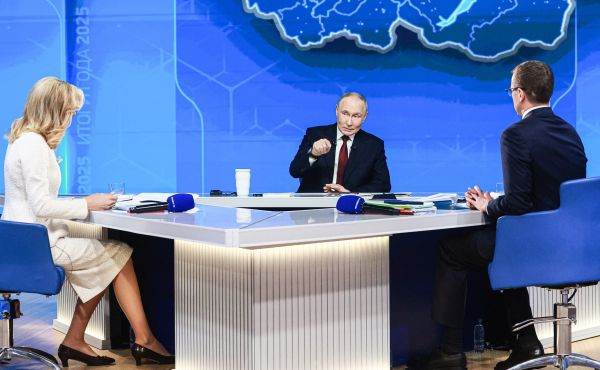
According to Vladimir Putin's recent statements, it seems that the liberation of Russia's "historical territories” has officially become the explicit justification for a war of conquest, rhetorically packaged as a defensive reaction. The respective statement was made by the President of the Russian Federation both on December 17, at the headquarters of the Ministry of Defense in Moscow, and on December 19, at the annual press conference that the leader from the Kremlin held. The two statements together constitute one of the clearest radiographs of the political and military reality of the Russian Federation in recent years. Beyond the carefully chosen formulations and the constant attempt to shift responsibility onto others, Vladimir Putin's two public interventions dismantle, through the Kremlin leader's own words, the narrative of a defensive, peaceful Russia constrained by a hysterical West.
"Today we see that the geopolitical situation remains tense throughout the world and even critical in some regions,” Putin said on December 17, claiming that "NATO countries are actively building and modernizing their offensive forces” and that, in Europe, "people are being instilled with fears of an inevitable confrontation with Russia.” This idea was repeated obsessively on December 19, when he stated that "in Europe, people are being instilled with fears of a major war” and that claims that Russia poses a threat are "a lie, nonsense, simply delirium.” However, at the same time, Putin proudly describes a reality that directly contradicts this denial: "The Russian army occupied over 300 localities in 2025” (ed. - in Ukraine), and "the expansion of the security buffer zone will be carried out consistently.”
As can be seen from the Russian leader's speech, it is not about defense, but about occupation, not about prevention, but about expansion. Vladimir Putin insists that Russia tried "until the last moment” to find diplomatic solutions and that the blame for their failure lies with those who "believe they can speak to us in the language of force”. But, in the same speech from the Ministry of Defense of the Russian Federation, he announced unequivocally that "the objectives of the special military operation will undoubtedly be achieved” and that, if the dialogue does not produce the results desired by Moscow, "Russia will liberate its historical territories by military means”. This formulation, repeated almost identically in the annual press conference held last Friday, is not conditional, but programmatic. "Liberation of historical territories” thus becomes the explicit justification for a war of conquest, rhetorically packaged as a defensive reaction.
In an attempt to legitimize the conflict, Putin claims that Russia, with the outbreak of the war, "has regained its status as a fully sovereign country.” It is a statement that redefines sovereignty not as respect for international law, but as the freedom to use military force without constraints. The same logic appears in his attacks on the statehood of Ukraine, which he says is "collapsing,” appealing to propaganda images and symbolic contempt, while the reality described by the Kremlin itself is that of a total war of attrition, involving hundreds of occupied localities, thousands of drone strikes per month, and the continuous testing of new weapons.
• 3,700 drones sent monthly to Ukraine
The military component of the speeches is, in fact, the most sincere. Vladimir Putin not only does not hide, but proclaims the massive acceleration of armaments. He talks about the rapid continuation of the modernization of the army under the new State Equipment Program for the period 2027-2036, about the priority given to air and missile defense, about command and control systems, electronic warfare and the use of drones "in all environments”.
On December 19, the Kremlin leader detailed this program with figures and results: "the intensity of drone attacks has increased from 1,500 to 3,700 drones per month”, "the efficiency of air defense is 97%”, and Russia has allegedly achieved "a twofold superiority over Ukraine in the combat use of drones”.
The emphasis on technology and the future of warfare is constant. Putin talks about the accelerated introduction of robotics, artificial intelligence and new materials into the army, about the expansion of the use of autonomous systems and about the formation, in the first half of next year, of troops dedicated to unmanned systems.
"It is necessary to attract young people under 35 to work with drone systems,” Vladimir Putin said, essentially describing a process of militarizing society and adapting new generations to a long-term conflict.
The strategic dimension is even more revealing. "Improving strategic nuclear forces remains a priority,” the Kremlin leader said, stressing that they will played a "decisive role in deterring aggression and maintaining the global balance of power.”
At a press conference last Friday, Vladimir Putin even announced the operationalization, by the end of this year, of the "Oreshnik” complex and boasted of the successful tests of the "Burevestnik” strategic missile and the "Poseidon” unmanned underwater system, as well as the entry into service of the first regiment equipped with the S-500 system, capable of destroying targets "in the vicinity of outer space.”
These statements are not compatible with the idea of a besieged Russia that reacts defensively, but describe a state that is investing heavily in strategic escalation capabilities.
At the same time, Vladimir Putin spoke of the "inevitable collapse” of Ukrainian defense, the occupation of key cities, the expansion of operations in the Kharkiv and Sumy regions, and the maintenance and acceleration of the offensive pace in the coming year. The statement that "the policy of Ukraine and European countries creates real premises for the continuation of hostilities in 2026” again shifts responsibility, although his own speech describes an offensive strategy planned for years.
Although the Russian president claims that everything that European states say is not true, his statements last week do nothing but confirm the fears of European Union leaders. When the president of the Russian Federation declares that he has occupied hundreds of localities, that he will expand security zones on the territory of another state, that he will continue the offensive, that he will develop weapons capable of striking from the air, sea, land and space, and that nuclear forces are the key to "global balance”, this is no longer a matter of induced fears or hysteria. This is a policy of force assumed, articulated and justified by the very words of the one who leads it.
Practically, all of Vladimir Putin's statements from the second half of last week are not a call for peace, but the act of accusation through which the Kremlin reveals its own strategy: war as a legitimate instrument, expansion as a goal and militarization as a permanent state.












 Euro
Euro Dolar SUA
 Franc elveţian
 Liră sterlină
 Gram de aur





























