English


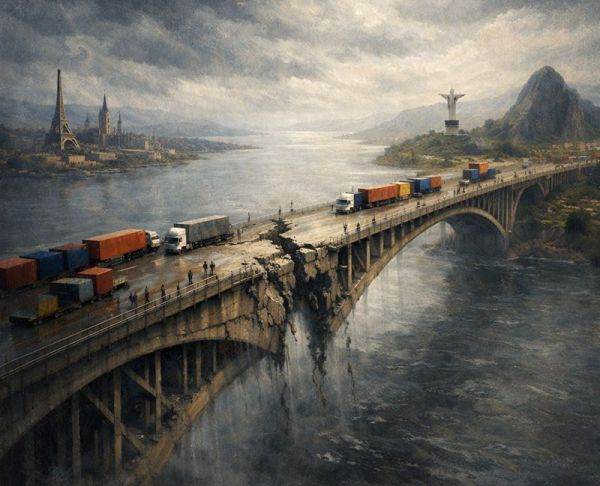

The signing of the EU-Mercosur Partnership Agreement and the almost simultaneous political and legal paralysis are not a procedural accident. The rapid succession of events points to a regime shift: trade rules no longer operate within a stable framework, and economic decision-making is increasingly subordinated to political arbitration.
On paper, the creation of a free trade area of approximately 700 million consumers should have boosted integration, investment, and predictability. In practice, the agreement has become a case study in how domestic interests and geopolitical pressures push efficiency aside in favor of control.
• 1. From Integration to Political Arbitration
The original objective of the agreement was clear: the elimination of significant annual tariffs and the securing of access to critical raw materials. These premises belong to the classic logic of globalization, based on reducing frictions and ensuring stable rules. Subsequent developments, however, have revealed the fragility of this framework.
The veto of sectoral interests.
The firm opposition of European farmers, particularly concentrated in France, has blocked ratification and pushed the agreement into legal scrutiny. This is not merely a bureaucratic delay, but the expression of a choice: local protection and immediate social costs prevail over diffuse macroeconomic benefits.
Legal uncertainty.
Referring the text to the Court of Justice introduces a horizon of uncertainty of up to two years. When the trade framework becomes contingent and reversible, long-term investments and contracts are postponed, and capital reacts with caution or withdrawal. At this point, the agreement ceases to function as a liberalization instrument and becomes a field of political arbitration.
• 2. The Transatlantic Rift and "Secured Trade”
The blockages surrounding Mercosur cannot be separated from the broader geopolitical context. Transatlantic trade tensions and tariff threats from the U.S. administration have reduced confidence in access to traditional markets.
In this environment, trade decisions are no longer assessed through the lens of efficiency, but through criteria of security and political alignment. The concept of "free trade” is replaced by "secured trade,” while friend-shoring and near-shoring become dominant criteria.
The insistence on the provisional application of the Mercosur agreement is not an ideological gesture, but a defensive reaction: market diversification becomes necessary in a world where old trade axes no longer offer guarantees of stability.
• 3. Financial Transmission: Why Fragmentation Produces Different Interest Rates
Here the concrete, measurable effect of fragmentation becomes visible. Political and legal decisions do not remain confined to the sphere of trade, but are translated by markets into different financial costs.
The cost of resilience
Production reshoring, agricultural subsidies, and protectionist policies increase the structural costs of economies. These costs are reflected differently in inflation and public financing needs, forcing central banks to react according to local, not global, conditions.
The political risk premium
Uncertainty over the ratification of agreements, the possibility of their legal annulment, and tariff volatility increase the risk perceived by investors. This risk is directly embedded in the cost of capital: exposed companies and states pay higher interest rates, even when economic fundamentals are comparable.
In this context, markets begin to treat monetary policy not as a neutral instrument, but as an extension of political and fiscal constraints.
Divergences within the euro area
The need to finance national protection schemes and compensatory measures amplifies fiscal differences between states. Markets increasingly distinguish between national risks, leading to wider sovereign bond spreads and divergent financing conditions, even under a common monetary policy.
Trade fragmentation thus turns into financial fragmentation, and interest rates become an early indicator of this rupture.
• Globalization in Quarantine
The Mercosur case shows that classic multilateralism functions only under conditions of geopolitical consensus and a relatively balanced distribution of benefits. When these conditions erode, trade agreements become contestable, and the economy enters a regime of fragmented adaptation.
Globalization does not disappear, but it ceases to be a coherent system. In this framework, differences in financing and in the cost of capital are not accidents, but early signals of an economic order in which stability is harder to achieve and convergence becomes the exception, not the rule.



















 Euro
Euro Dolar SUA
 Franc elveţian
 Liră sterlină
 Gram de aur