 English

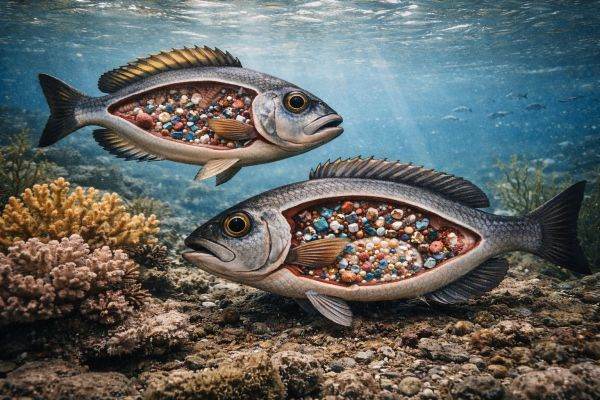
Microplastics were found in about a third of fish sampled in the territorial waters of several Pacific island states, a proportion lower than the global average but marked by significant discrepancies from one country to another, according to a study published in the scientific journal PLOS One, AFP reports. The research was carried out by an international team of 19 specialists from the Pacific region, Germany and Japan, who analyzed more than 900 fish belonging to 138 species, caught for human consumption in Fiji, Tonga, Tuvalu and Vanuatu.
• Levels below global average, but extreme differences between territories
According to the study authors, about 33% of the fish analyzed contained at least one microplastic particle, a level lower than the estimated global average of 49% for freshwater fish, according to data cited by Jasha Dehm, a researcher at the University of the South Pacific in Suva (Fiji). However, the disparities between the analyzed countries were considerable. In the waters off Fiji, microplastics were identified in 75% of the fish, while in Vanuatu the percentage was only 5%, according to the results published in PLOS One.
Amanda Ford, co-author of the study and associate professor of marine sciences at the University of the South Pacific, said that the extremely low levels found in Vanuatu were "surprising.” According to her, possible explanations include more efficient waste management practices, but also peculiarities of ocean currents, which can influence the distribution of plastic in the marine environment. At the same time, the researcher warned of the risk of exaggerating the conclusions: "It is important not to give in to alarmist discourse,” she stressed.
• Plastic, present almost everywhere in the food chain
Amanda Ford drew attention to the fact that the presence of microplastics is no longer an isolated phenomenon. "We have to accept that, in almost everything - whether it is table salt or drinks - people find plastic,” she explained. The results of the study confirm that plastic that reaches the ocean fragments into microscopic particles, which can be ingested by marine organisms and can subsequently enter the human food chain. Although the presence of microplastics is increasingly documented, the direct consequences on human health are not yet well understood, especially in the context of the relatively low levels identified in many samples. "We cannot yet draw clear conclusions about the risks,” Amanda Ford stated, emphasizing the need for further studies.
According to the United Nations Environment Programme (UNEP), the total amount of plastic present in the world's oceans is estimated to be between 75 and 199 million tonnes, and the lack of effective waste management systems makes certain regions, including Pacific island states, particularly vulnerable to this type of pollution.
























 Euro
Euro Dolar SUA
 Franc elveţian
 Liră sterlină
 Gram de aur





























