English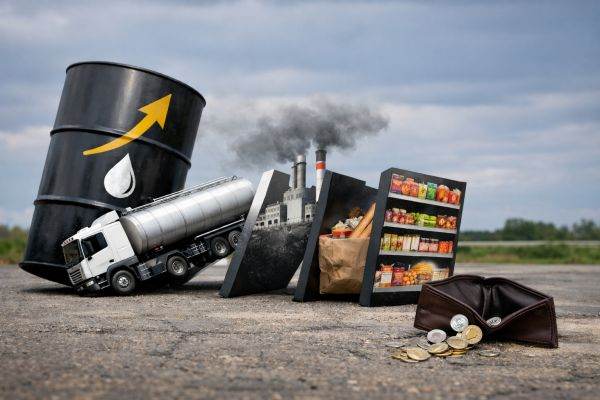
The accelerated increase in oil prices, amid the conflict in the Middle East, has brought the vulnerabilities of the Romanian economy to global energy shocks back to the forefront. In just a few days, oil prices rose from approximately 70-72 dollars per barrel (the level before the outbreak of the conflict) to over 110 dollars, with peaks reaching as high as 115-116 dollars. The jump is one of the fastest in recent years and was caused by disruptions in the Persian Gulf, in particular the blocking of maritime traffic through the Strait of Hormuz and the temporary halt of production in some refineries in the region. As an essential part of global oil flows transit through this strait, the markets reacted instantly, and the effects have already begun to be seen in the Romanian economy.
Especially since Romania's economy remains dependent on oil imports, even though our country still produces crude oil. According to data from the National Institute of Statistics for 2025, cited by Agerpres, our country produced approximately 2.472 million tons of oil equivalent, while imports reached approximately 8.894 million tons of oil equivalent. This means that domestic production covers only approximately one fifth of the country's oil needs, the rest being provided by imports. In other words, approximately 20-25% of the oil used in Romania comes from domestic production, and approximately 75-80% is imported. Under these conditions, the Romanian economy remains directly connected to developments in the global energy market, and the increase in the price of oil on international markets is inevitably reflected in domestic costs.
The first sign of this energy shock immediately appeared in gas stations in our country, where fuel prices exceeded the threshold of 9 lei per liter, and premium diesel reached approximately 9.35 lei in some stations.
However, the increase in price is not just a one-time phenomenon at the pump. It triggers a broad economic mechanism, which starts with transportation, continues with logistics and distribution, and ultimately reaches the prices of goods and services. The chief economist of the Concordia Confederation, Iulian Lolea, stated for Pro TV that a 10 dollar increase in the price of oil can translate into an increase of approximately 0.4-0.5 lei per liter at the pump in Romania. This means that, as oil rises, the costs of transporters increase rapidly, and these costs are subsequently transferred to the distribution chain.
• Increasing transport prices lead to increases in production and commercial chains
Transport is one of the most sensitive links in the economy to rising energy prices. Fuel is a major component of logistics costs, and in the distribution of goods, according to representatives of the Association of Goods Distribution Companies in Romania, fuels can reach 9-15% of the total costs of companies in the field. Once these costs increase, transport and logistics companies increase tariffs, and product prices gradually increase.
The link between oil and food prices is stronger than it seems at first glance, as Nicu Vasile, former president of LAPAR, recently reported for the BURSA newspaper. The transport of agricultural products, agricultural machinery, processing and packaging all depend on fuel and energy prices.
Trade specialists estimate that transportation represents approximately 15% of the final cost of food products such as bread, milk or vegetables, which explains why the increase in fuel prices reaches supermarket shelves relatively quickly. Estimates by traders, including representatives of the National Association of Small and Medium-Sized Traders in Romania, show that, if oil remains above $100 per barrel, the prices of basic foods could increase in the coming days or weeks by approximately 7-12%, and in the case of vegetables, the price increases could even reach 15%.
At the same time, production costs are also increasing in other sectors of the economy. Oil is an essential raw material for the chemical industry, for the production of plastics and for packaging, and its price increase inevitably propagates throughout the economic chain. Therefore, oil shocks rarely remain limited to the energy sector: they gradually reach almost all branches of the economy.
• Measures taken by the Government to limit the macroeconomic impact of the increase in fuel prices
Economists warn that the macroeconomic impact of this development could be significant. According to studies carried out by specialists from Coface Romania and CFA Romania, the national economy could enter a period of very modest growth, in which inflation remains high and consumption weakens. According to assessments to the cited sources, inflation could reach 6-7%, and Romania's economic growth in 2026 could be only about 0.5%. At the same time, the increase in energy costs will erode the purchasing power of the population, as salaries fail to keep up with price increases.
Another alarm signal comes from the National Bank of Romania. The Deputy Governor of the National Bank of Romania, Cosmin Marinescu, warned, according to several articles published in the media yesterday, that the evolution of oil prices could have direct effects on inflation. According to the NBR official, "a permanent 10% increase in oil prices could add about 0.3 percentage points per year to the inflation rate".
The calculation becomes relevant in the current context, in which the price of oil has increased by over 50% compared to the level before the conflict.
In order to limit the impact on the economy, the Romanian authorities have adopted several measures. The government has increased the subsidy for diesel used by transporters to 0.85 lei per liter, a measure intended to reduce the pressure on transport costs and avoid the immediate transfer of price increases to goods. In parallel, the state maintains the cap on the price of natural gas for household consumers at 0.31 lei per kilowatt-hour, in order to prevent an increase in energy inflation. The Minister of Energy also announced measures to increase domestic fuel production, including the resumption of production at the Petrotel-Lukoil refinery and the acceleration of the completion of the technical overhaul at the Petromidia refinery. In addition, Romania has fuel stocks for at least 90 days, which reduces the risk of a short-term supply crisis.
• Two scenarios outlined for the coming period
Based on current developments, two scenarios can be outlined for the Romanian economy. The first scenario is one in which oil remains in the current area of approximately 110-115 dollars per barrel. Compared to the pre-conflict level of around $70-72 per barrel, this represents an increase of around 55-65%. Applying the formula presented by the Deputy Governor of the National Bank of Romania, Cosmin Marinescu, such an increase could add around 1.6-2 percentage points to annual inflation. In this scenario, the Romanian economy would experience a period of persistent inflation and modest economic growth, but the effects would remain manageable if geopolitical tensions stabilize relatively quickly. The second, much more severe scenario involves an escalation of the conflict and a prolonged disruption of oil flows from the Persian Gulf. In this case, some analyses cited by Reuters, including that carried out by Wood Mackenzie, show that the price of oil could rise to around $150 per barrel. Compared to the pre-conflict level, this would represent an increase of over 110%. Applying the same formula of the National Bank of Romania, the impact on inflation could exceed 3 percentage points. In such a scenario, fuel prices could exceed the threshold of 10 lei per liter, transportation costs would increase significantly, and price increases would be transmitted to almost all sectors of the economy, from food and consumer goods to services and industry.
We would like to point out that these are only scenarios, which do not take into account other developments and measures that can be taken at a global level, nor any intervention measures that the European Union and the Romanian government can take, in support of citizens.
From the above, it is clear that the conflict in the Middle East is not only a geopolitical crisis, but also a factor that directly influences the Romanian economy. Oil is not only fuel for cars, but one of the fundamental raw materials of the modern economy. When its price increases, the effects propagate from refineries and logistics chains to prices in stores and household budgets. The evolution of the conflict and the stabilization of global energy markets will decide whether our country will only go through a period of higher inflation or whether it will face a new major energy shock, with much deeper consequences on the economy.






















 Euro
Euro Dolar SUA
 Franc elveţian
 Liră sterlină
 Gram de aur