English

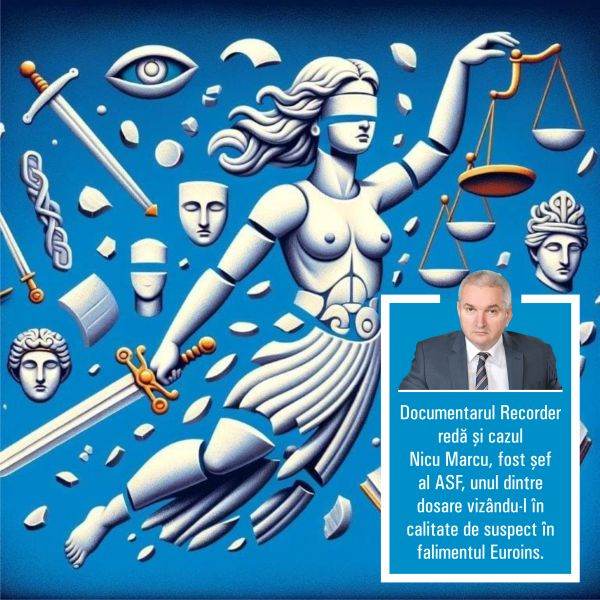
The documentary Recorder - Captured Justice - represents only a small fragment of what the leaders of the Romanian judiciary are trying to hide under the rug, to cover up. An embarrassing attempt to hide under the rug the garbage that has already invaded the judicial system took place yesterday at the Bucharest Court of Appeal. Flanked by some of the court's judges, just as Adrian Năstase and Liviu Dragnea were once accompanied to the DNA by party colleagues, Liana Arsenie, president of the Bucharest Court of Appeal, tried to explain that everything stated in the documentary Recorder is false, manipulated and does not correspond to reality.
We would have expected a magistrate with years of experience, who has gone through all the professional steps, from the court, through the tribunal, to the Bucharest Court of Appeal, where he has now also become president of the judicial institution, to have a free, coherent, concise speech, with an impartial tone, which would denote confidence and enjoy the respect of his interlocutors. This was not the case at all. Liana Arsenie read her entire speech from a sheet of paper probably scattered last night in the presidential office of the Court of Appeal and struggled to give coherence to what she read, reminding us of the way in which former Prime Minister Viorica Dăncilă struggled to read.
Although she tried throughout her speech to give the impression that her position was correct, without unfounded accusations, her attitude during the press conference changed, and Liana Arsenie transformed from judge into accuser. Maybe she made a mistake in her vocation and should be a prosecutor and not a judge who decides the fate of the people before her.
Because the accusations made by Liana Arsenie, during the press conference, against judge Laurenţiu Beşu - who appeared in the documentary Recorder - and against judge Daniela Panioglu, who was invited on Wednesday evening to a show on Euronews Romania, cannot be explained otherwise than through the role assumed by the prosecutor.
• Personal attack to awaken the moral court
Ignoring the professional ethics and respect she emphatically claimed in the courtroom of the Bucharest Court of Appeal, Liana Arsenie directly carried out a personal attack and presented to the journalists in front of her, from a laptop, a recording of a court session in which Ms. Panioglu had a heated discussion with the lawyers of one of the parties in the file she had submitted to the court. Moreover, in the face of the accusations brought by Daniela Panioglu the night before on Euronews, Liana Arsenie came up with evidence that the judge in question had violated the law, following the collection of public money for the rent settlement in Bucharest, although she owned a personally owned apartment in the same locality.
After rejecting all the accusations in the documentary Recorder, regarding the favoritism of the defendants Marian Vanghelie and Niculae Bădălău, Liana Arsenie said: "The events seem coordinated in order to seize the judicial power. We draw attention to the seriousness of the situation and (...) we publicly ask all authorized bodies to proceed with the investigation of the accusations made and to publicly present the conclusions. The law does not change in the street through lies and manipulation. (...) Unfortunately, through messages that exceed constitutional limits, justice has moved from a tactical field to an arena in which arbitrariness and dilettantism have the value of law, the only concern being that of destructuring the judicial power and replacing it with genuine moral courts. As such, we are witnessing a media lynching campaign of the judicial system, with a demonization of the magistracy by discretizing any form of judicial organization, by ridiculing and anathematizing the leadership of the judicial system, by manipulation and lies, using as so-called representative voices of the judicial system people who act out of the impulse of personal professional failure”.
The irony of fate is that the person who accuses that the judiciary is being replaced with genuine moral courts did exactly the same thing yesterday, from the courtroom lectern of the Bucharest Court of Appeal. When you publicly present, during a press conference, a recording of a hearing led by a judge undesirable to you and then come and wave the contract regarding the apartment that he owned when you were paying his rent, aren't you replacing justice with the moral court? Or does Ms. Liana Arsenie have double standards? For her close associates, only justice needs to rule, and for her undesirables, there is the burning on TV, in the middle of a press conference, to attract the opprobrium of the moral courts on the judges who challenge her way of leading the Bucharest Court of Appeal?
• Liana Arsenie, as a film critic
But let's continue to analyze the hallucinatory speech read by the president of the Bucharest Court of Appeal.
"Who benefits from the simultaneous delegitimization of the DNA and the Bucharest Court of Appeal? We see actions aimed at creating controlled chaos. The synchronization is not accidental. The attacks launched through the statements of Judge Beşu, the anonymous statements of a prosecutor, appear when the DNA finalizes and sends to trial difficult files, which will reach the Bucharest Court of Appeal. An ideal environment is created for the moral challenge of any solution in these files, so that the verdict is perceived as illegitimate, no matter what it is. The actions are part of an organized mechanism of destabilization. (...) The attack of institutionalized politics results even from the presentation on the national public television (ed. - TVR 1) of a very artistic film, with documentary claims, being obvious public instigation against the constitutional order. We categorically reject any attempt to denigrate the professional body, to polarize, antagonize and weaken the independence of the judiciary. We, the CAB leadership, will never abdicate from the values of the rule of law. We we claim that there are no problems in the justice system, but these can only be solved through dialogue within the institutional framework. The hostile takeover of judicial power through the streets, through public instigation, are mechanisms that can never substantiate a democracy”, stated Liana Arsenie.
From all this lucubration above, it is important to remember this paragraph: "The actions are part of an organized mechanism of destabilization. (...) The attack of institutionalized politics results from the presentation on the national public television (ed. - TVR 1) of a very artistic film, with documentary claims, the public instigation against the constitutional order being obvious”.
Where have we heard of destabilization actions? The first time, in 1990 when Ion Iliescu called on the miners in Bucharest to restore order and public peace, that is, to clear University Square of those who challenged the legitimacy of his power.
Regarding the irony of the Recorder's production with the expression "a very artistic film, with documentary pretensions", we are curious what qualifications the president of the Bucharest Court of Appeal has to claim that a documentary is not what it is said to be, but only a very artistic film. From Ms. Liana Arsenie's CV, we note that she is a graduate of a law school and in no way a graduate of UNATC. The use of such expressions by the head of the Bucharest Court of Appeal demonstrates that she does not differ in thinking from the street corner sluts or the saleswomen in Obor, who have the impression that they know everything and are good at everything. From a head of court, we expect the expression to be clear, unequivocal, free of irony or inappropriate labeling. It seems that Liana Arsenie failed the exam in this regard.
• Criticizing the Justice System, incitement against the constitutional order?
The President of the Bucharest Court of Appeal also states that the presentation of the documentary Recorder on TVR 1 represents a "public incitement against the constitutional order”. That is, exactly one of the crimes with which Călin Georgescu is accused. What should we understand from Liana Arsenie? That when the press, in the exercise of its function, does its duty and presents a situation through the prism of statements by people who are part of a certain system, and that presentation is not to the liking of those who run the system, then journalists turn into instigators against the constitutional order? Should we understand that all those who disagree with the opinions of the President of the Bucharest Court of Appeal are potential criminals and should be faced with criminal cases?
This is not an attitude worthy of a court leader in a democratic state, but rather in an autocratic, dictatorial state. Unfortunately, we notice that in recent years Romania tends to transform into such a state, with the mention that it is an autocracy that those who lead the judicial system in our country want. If they had wanted an autocracy of law and justice, we would not have opposed it. But when autocracy concerns the imposition of privileges, the system of thought, the occult practices established at the level of the courts that were revealed in the documentary Recorder, then the press has every right to oppose it.
• Raluca Moroşanu, judge: "We are simply being terrorized with disciplinary actions; it is a toxic and tense atmosphere and situation”
The press representatives and some of the magistrates of the Bucharest Court of Appeal applauded yesterday, at the beginning of the press conference, the statement of Ms. Raluca Moroşanu, who declared: "I am a judge at the Criminal Section I of the Bucharest Court of Appeal, I have been in the judiciary for 26 years, of which 19 at the Bucharest Court of Appeal, Criminal Section. I am here to support my colleague Laurenţiu Beşu and to say that everything he said is true. If he is contradicted, it is a lie. The management does not help us in any way, we are simply terrorized with disciplinary actions. I do not want to tell you what it is like to atmosphere and what a toxic and tense situation we are in. Some of my colleagues agree with me. I was neither an undercover officer, nor at two and a quarter, anywhere; I have been a magistrate all my life. My colleagues in the country know me because I was also a trainer at the National Institute of Magistracy and the National School of Clerks for almost 15 years. And they will know that I am not lying. If they don't believe Laurentiu, at least they should believe me”.
What did we notice after this moment, when Liana Arsenie was also present? That the president of the CAB had nothing to comment on judge Raluca Moroşanu, he did not criticize her position, but only referred to Laurenţiu Beşu - who appeared in the documentary Recorder - and to Daniela Panioglu. From this attitude of the head of the Bucharest Court of Appeal towards what her colleague said, we remember only one fact: yesterday the truth was told by Raluca Moroşanu and not by Liana Arsenie.
The magistrates' associations stand alongside the judges and prosecutors in the documentary Recorder, whom they consider whistleblowers and ask the authorities not to take measures that would reduce their right to free expression.
In a joint press release, the Romanian Judges' Forum Association, the Association for the Defense of the Prosecutors' Statute and the Justice Initiative Association, consistent with the principles by which they have operated since their establishment, reaffirm their solidarity with the magistrates who understand how to publicly denounce all situations in which their independence is put at risk.
"The Organization for Economic Cooperation and Development (OECD) has repeatedly and firmly called on Romania to introduce clear rules that would allow judges and prosecutors to be whistleblowers without fear of reprisals, and this recommendation cannot be ignored. We call on the competent authorities to refrain from any action that would target disciplinary investigations or institutional pressure on magistrates who exercise their right to free expression. Any attempt to silence critical voices in the judiciary, by abusively invoking the "reserve”, represents a direct attack on the rule of law because when a judge or prosecutor publicly signals irregularities that affect the administration of justice, whether it is political interference, hierarchical pressure or systemic deficiencies, he or she does not break the law, but defends it. However, sanctioning these magistrates means discouraging the expression of critical opinions within the system and, instead, reinforcing the culture of silence and complicity. Any disciplinary procedure initiated solely on the grounds of publicly expressed critical opinions is contrary to the independence of magistrates, who do not request immunity for themselves, but independence for justice. We ask the Superior Council of Magistracy to fulfill its constitutional role as guarantor of the independence of justice and to unequivocally defend magistrates against any form of pressure or reprisals. Society has the right to know the truth about dysfunctions in the justice system, and magistrates who dare to speak out should not be turned into targets, but recognized as defenders of the public interest. Any other approach means returning to the practices of a closed, opaque and vulnerable system to external influences. We ask the Romanian Government and the Romanian Parliament to adopt a specific legal framework that would grant judges and prosecutors the status and full protection of whistleblowers, because magistrates who report, in the public interest, violations of the independence of justice or the rule of law must benefit from protection against any form of reprisals, be they disciplinary, administrative, professional or other”, is stated in the press release issued by the representatives of judges and prosecutors in our country.





















 Euro
Euro Dolar SUA
 Franc elveţian
 Liră sterlină
 Gram de aur