English


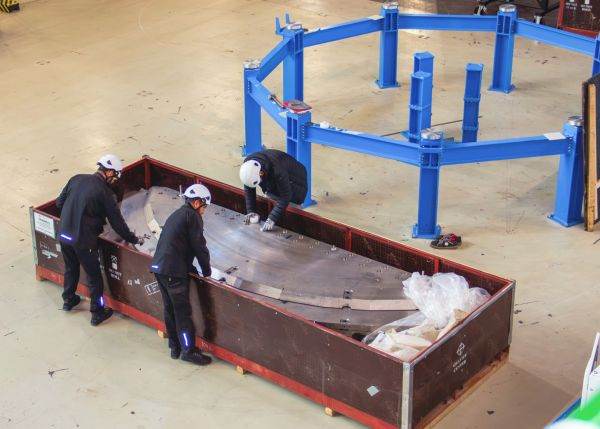
For the first time in the history of the European Organization for Nuclear Research (CERN), donors from the private sector have pledged to contribute financially to the construction of the world's largest particle accelerator, with a total amount of 860 million euros, the Geneva-based institution announced, according to AFP. If the project receives the approval of CERN's member states, these contributions, "worth 860 million euros (about one billion dollars), would represent a major investment by the private sector in the service of fundamental physics research," the organization said in an official statement.
• Global-caliber donors
Among the private supporters of the project are: Breakthrough Prize Foundation, founded by Silicon Valley billionaire Iouri Milner; Eric and Wendy Schmidt Strategic Innovation Fund, coordinated by former Google CEO Eric Schmidt; John Elkann, heir to the Agnelli family and chairman of the Stellantis group; Xavier Niel, founder of the telecommunications company Iliad.
CERN said that these financial commitments are conditional on the approval of the project by the member states, which remain the organization's main financiers.
CERN plans to build a new particle accelerator, called the Future Circular Collider (FCC), by 2040. It would be located in an underground tunnel with a circumference of 91 kilometers, at an average depth of about 200 meters, far exceeding the current Large Hadron Collider (LHC), which has a tunnel of 27 kilometers. The FCC's major scientific objective is to provide explanations for the nature of about 95% of the energy and matter of the observable universe, including the mystery of the asymmetry between matter and antimatter - one of the most important open questions in modern physics. The total estimated cost of the project exceeds 15 billion euros, making it one of the most ambitious and expensive scientific initiatives in history.
• A historic moment for CERN
CERN Director-General Fabiola Gianotti welcomed the opening of the private sector to a project of such magnitude. "This is the first time in history that private sector donors have come together with CERN to build an extraordinary research instrument that will allow humanity to make major advances in understanding fundamental physics and the Universe,” Gianotti said in a statement. Pete Worden, president of the Breakthrough Prize Foundation, said that supporting this project reflects a shared mission: "Understanding the fundamental nature of our universe is everyone's responsibility. We are proud to support the creation of an instrument that can shed new light on some of humanity's most fundamental questions.” The current Large Hadron Collider (LHC), the world's largest particle accelerator, made history in 2012 when it allowed the discovery of the Higgs boson, a particle essential for explaining the fundamental mass of matter. The discovery represented one of the most important scientific achievements of the 21st century. The future of the FCC, however, remains uncertain. The CERN Council, made up of representatives of the 25 member states, is due to make a final decision on the construction of the accelerator in 2028, after scientific, financial and political assessments. Until then, the unprecedented commitment of the private sector marks a significant change in the way fundamental research is financed and could redefine the relationship between science, the state and private capital.



















 Euro
Euro Dolar SUA
 Franc elveţian
 Liră sterlină
 Gram de aur