English

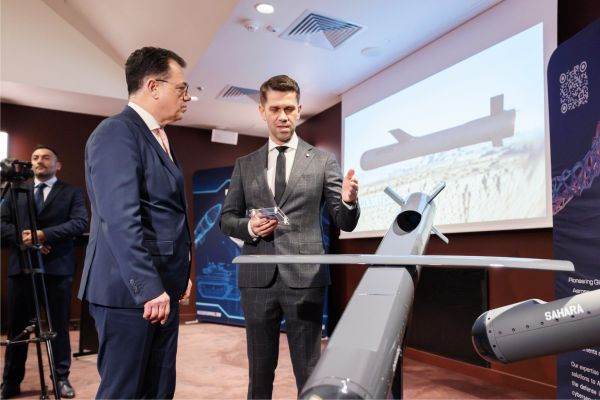
Cluj-based company OVES Enterprise officially presented, in Bucharest, Sahara Autonomous System - the first cruise missile developed in Romania by a private actor, a project that combines locally designed hardware, critical software and natively integrated artificial intelligence. The OVES project may represent the beginning of a new stage in the national defense industry, traditionally dependent on imports, foreign licenses and delayed programs.
The company's CEO, Mihai Filip, described Sahara as the result of a natural evolution of the expertise accumulated in complex software and artificial intelligence, following collaborations with military institutions and governments.
"Strategic partnerships developed internationally have provided us with the necessary framework to understand the standards, rigors and level of integration that such a system requires. Through this project, we are taking forward the skills that we have already validated in previous collaborations and integrating them into a complete, locally developed architecture. Our objective is to build a robust system, aligned with international standards, that will demonstrate that Romanian expertise can support highly complex projects in strategic fields. Everything is made in Romania, including the AI processing board; practically, the brain of the Sahara missile is built by us 100% in Romania. We built this project as a complete system, because real autonomy cannot be achieved otherwise. The way Nemesis AI works is closely linked to the hardware architecture that we fully control: the electronics, the processing units, the flight controller and the structure on which the algorithms run. This level of integration is essential in scenarios where satellite navigation is disrupted by jamming (intentional interference) or spoofing. (sending false signals). In such situations, the missile must maintain its stability, direction and ability to fulfill the mission. The first tests show us that this approach is correct, and the demonstrations in 2026 will highlight the maturity of the technology”, stated Mihai Filip, CEO of OVES Enterprise.
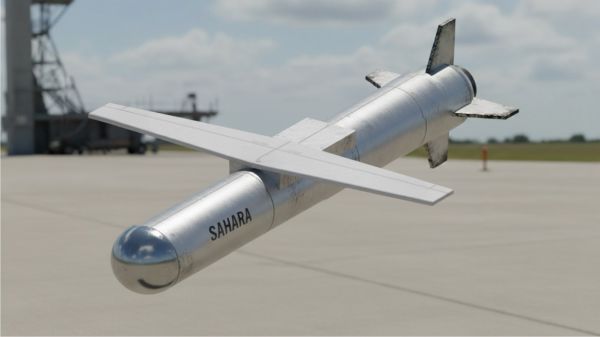
The Sahara missile is positioned as an autonomous system capable of operating at low altitude, approximately 50 meters, following the terrain to reduce radar detection and maintain mission stability in hostile environments, including in conditions of jamming or compromising GNSS signals. The architecture is built around Nemesis AI, its own artificial intelligence platform, which allows for rapid configuration of AI models and operational parameters directly in the operator's facilities. The company's claimed concept is that of vertical integration: hardware, processing units, electronic boards and control system designed together with AI algorithms, in a technological framework developed entirely in Romania, with the exception of the turbojet engine and optical sensors.
In a geopolitical context in which electronic warfare, spoofing and jamming have become standard tools, the emphasis on navigation resilience is essential. The Super Sensor Fusion system, presented as the central element of the platform, correlates data from multiple satellite sources and on-board sensors, verifying the integrity of the signals at intervals of approximately 200 milliseconds. In the scenario of total degradation of GNSS navigation, the rocket automatically switches to data provided by the internal motion and orientation measurement unit (IMU). Technically, the promise is mission continuity in the absence of external references, a critical desideratum for any modern autonomous system.
Mihai Filip also said: "Sahara has the ability to be situational aware before hitting a target, understanding the entire context, adapting and reacting based on the knowledge available in the system, which is an element of absolute novelty. Through our platform, a mission can be configured on a laptop in just 30 seconds, after which 1,000 missiles can execute the mission at high speed, without any intervention or additional costs".
The technical data communicated by the company's representatives show that it is a missile with a total mass of approximately 50-55 kg, of which 10 kg is the payload. The turbojet engine provides a thrust of 310 newtons, and the approximately 20 kg of fuel allow an estimated autonomy of approximately 200-250 km in the current version. The designed speed can reach approximately 0.85 Mach. OVES Enterprise says the program is designed as a family of products, with planned variants for medium range (500-600 km) and long range (900-1,100 km). In parallel, the company mentions the possibility of integrating additional technologies, such as synthetic aperture radar (SAR), which would expand the capabilities of operating in difficult weather conditions and reconnaissance scenarios.
The company estimates a price of between 150,000 and 350,000 euros per unit, significantly below the levels associated with conventional cruise missiles. If these values are confirmed in the testing phases and eventual certification processes, the implications are major: the classic ratio between the cost of the vector and the value of the target could be modified, and the accessibility of autonomous strike capabilities would enter a new economic paradigm. In the same logic, OVES Enterprise is relying on rapid manufacturing technologies, including extensive 3D printing, with the declared objective of producing a missile in its entirety within approximately 24 hours.
Mihai Filip stated: "We are working on a technology that will allow the 3D printing of the entire cruise missile. Currently, we are printing certain components, but in a few months we will be able to 3D print an entire missile in 24 hours. Imagine a war zone where you can deploy 100 printers to produce 100 missiles in 24 hours; all this technology is already approved in combat conditions. A major advantage is the price: while a conventional missile can cost $2 million, our small missile costs $150,000. The system is extremely scalable; we could build a million missiles per night if we had enough printers and resources, without the need for many operators. The missile is impossible to shoot down by laser guidance, having anti-laser technology. We can also integrate technologies such as SAR, which will make the difference between a technologically advanced country and one that does not have such systems. We present the future: a system smart, easy to manufacture and efficient”.
The investment made to date exceeds one million euros, and an additional budget of approximately two million euros is foreseen for the optimization and testing phases. The program is being developed by a team of approximately 25 engineers and researchers specialized in artificial intelligence, avionics, hardware and flight systems. The announced calendar indicates an initial demonstration scheduled for May 2026. In a field where real validation is not done through renderings or statements, but in the polygon, under strict standards, this stage will represent the moment of truth for the project.
The presentation event was attended by the Minister of Economy, Digitalization, Entrepreneurship and Tourism, Secretary General of the Government, the Director General of Romarm, officials of the Ministry of National Defense and representatives of foreign armament companies.
Ştefan-Radu Oprea, Secretary General of the Government, said: "I believe in the potential of Romanian companies to develop in the area of advanced technologies. The presented project confirms the maturation of a Romanian innovation ecosystem that combines expertise in IT, artificial intelligence and the aerospace industry, generating locally developed strategic capabilities. Supporting these initiatives is essential both for economic competitiveness and for strengthening Romania's technological autonomy and industrial profile in European and Euro-Atlantic partnerships. I congratulate the OVES Enterprise team for their performance and for their ambition to take Romanian innovation to the next level. I want the project to progress and to see it industrialized in companies in Romania."
Irineu Darău, Minister of Economy, said: "I believe that any investment and any collaboration must be achieved through deeds, not necessarily through words. It is good to be very open and see which subsidiary or state-owned company is the right fit."
Răzvan Pîrcălăbescu, the general director of Romarm, said: "It is a very good project, which we have been waiting for a long time in the national defense industry. We have discussed with OVES regarding its development. Romarm is ready to make our facilities available to them for this product. We have very good missile specialists in the Braşov area. Therefore, we can offer them a space in Tohani for the development of this type of missile or at Electromecanica Ploieşti".
Sahara Autonomous System is not just about an AI cruise missile, but about the maturation of an industrial segment that could reposition Romania on the map of critical technologies. If the performances are validated in official tests, the OVES Enterprise project could become a significant precedent for the integration of IT, hardware and artificial intelligence skills in locally developed defense products.


























 Euro
Euro Dolar SUA
 Franc elveţian
 Liră sterlină
 Gram de aur