English


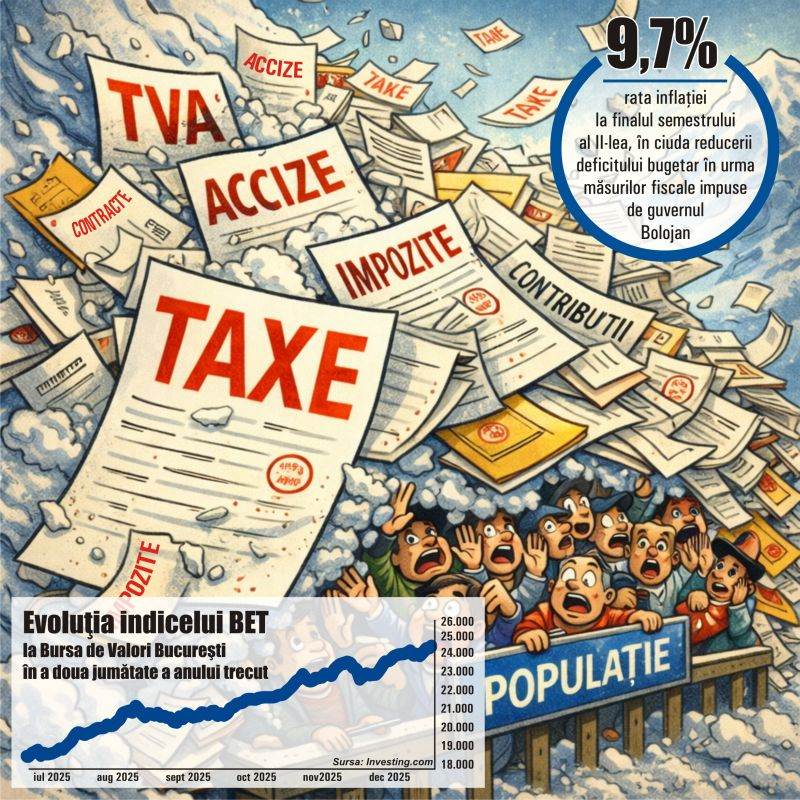
The second semester of last year marked our country's entry into a fiscal-budgetary consolidation phase forced by reality, after a first semester that pushed the deficit to 3.68% of Gross Domestic Product (GDP) and amplified the risk of a sovereign rating downgrade and a loss of momentum in the absorption of European funds. Practically, everything that happened in the last six months of 2025 meant the transition from the diagnosis of structural financial instability to the administration of shock therapy, in which the Government led by Prime Minister Ilie Bolojan tried to re-anchor the budget through two successive packages of fiscal and structural measures, two budget adjustments and stricter execution discipline, in a tense social climate and under permanent market pressure. In July, assuming responsibility for the first fiscal package instantly reconfigured the fiscal architecture: increasing VAT to 21%, the single reduced rate of 11% for basic products, increasing excise taxes, additional taxation of dividends and large profits, introducing health contributions for pensions over 3,000 lei, plus announcements of salary and hiring freezes for 2026 and a review of school scholarships. In August and September, the Government pushed forward the reform agenda, including in the area of special pensions and corporate governance in public enterprises, assuming a second package that produced a new wave of institutional and social frictions, but maintained the consolidation direction.
At the macro level, pressure remained high. The budget execution for nine months indicated a deficit of 102.47 billion lei (5.39% of GDP), while the budget revision prepared at the end of September confirmed an estimated deficit target of 8.4% of GDP for the whole year and additional expenditures of approximately 27 billion lei. In parallel, interest costs rose sharply, reflecting the increased cost of financing public debt. In this context, the National Bank of Romania has repeatedly maintained the key interest rate at 6.5%, citing supply shocks (energy liberalization, VAT and excise tax increases) and persistent inflationary pressures, which pushed the annual inflation rate to 9.7% in December.
However, the second semester also produced an accounting result that tempered the most pessimistic scenarios: the budget deficit at the end of 2025 was 7.65% of GDP, below the 8.4% level negotiated with the European Commission, signaling that the mix of measures and execution discipline have started to work, even if structural vulnerabilities - collection, expenditure rigidity, debt cost and fund absorption - remained defining for the state's fiscal vulnerability.
• July: First fiscal package, assumption in Parliament and massive financing on foreign markets
The first month of the second semester began with a change of register in fiscal policy. The Bolojan government launched the first fiscal package as an emergency tool to stop the erosion of confidence and the slide towards "junk”. The measures were adopted in Parliament on 7 July and promulgated on 25 July, after the Constitutional Court rejected the opposition's appeals.
The package included increasing the standard VAT rate to 21% and establishing a single reduced rate of 11% for basic food and medicines, increasing excise duties on alcohol, tobacco and fuel, taxing pensions above 3,000 lei, freezing public sector salaries and pensions for 2026, and reorganizing the school scholarship system around the criteria of merit and need. In budgetary terms, the measures were presented with an additional impact estimated at 9.5 billion lei for 2025 and 35 billion lei in 2026, doubled by spending cuts of over 57 billion lei in 2026, in an attempt to reduce the pressure on the deficit in the medium term.

In parallel, the Government made sectoral decisions with strategic stakes: environmental agreement for the refurbishment of Unit 1 at the Cernavodă NPP, the launch of the first stage of the electronic road pricing system based on the "polluter pays" principle, legislative amendments to the Fiscal Procedure Code to prepare for OECD accession and infrastructure projects aimed at unblocking economic corridors.
On the financing front, the Ministry of Finance combined domestic issuances (FIDELIS) with substantial external outflows, attracting approximately EUR 4.7 billion in three tranches in July, while the state's first green bonds channeled RON 10.85 billion to water, sustainable transport and climate adaptation projects, in an effort to strengthen credibility through allocation reporting. In this context, the NBR decided on July 8 to maintain the key interest rate at 6.50%, warning of accelerating inflation with the liberalization of energy and the application of new indirect taxes.
July was also marked by episodes of institutional integrity: the resignation of Deputy Prime Minister Dragoş Anastasiu, amid the appearance in public space of information from a DNA file, and the placement under judicial control of the president of ANPC, Cristian Popescu Piedone, followed by the rapid decision to withdraw from office.
• August: The deficit rises, Fitch reconfirms the rating, and the E.On-MVM file enters the security zone
In August, fiscal consolidation remained under pressure from rigid costs. The budget deficit at the end of July had risen to 4.04% of GDP, despite increases in tax, excise and VAT revenues, being pushed by the recalculation of pensions, energy compensations and rising interest rates. The Ministry of Finance continued financing through FIDELIS - including with ten-year euro-denominated securities - and in parallel ran the TEZAUR program with high yields, signaling the structural dependence on domestic saving.
Regarding the rating, Fitch reconfirmed BBB-/F3 with a negative outlook, keeping Romania in the investment grade window, but implicitly conditioning stability on the effective delivery of consolidation. The BNR, in turn, maintained its line of caution on August 8, maintaining the key interest rate and anticipating the peak of inflation in the fall. The INS recorded an inflation of 9.9% in August, which confirmed the materialization of price shocks.
In strategic and geopolitical terms, the transaction through which the Hungarian company MVM would have taken over part of the assets of E.On Romania received a negative opinion from the Foreign Direct Investment Evaluation Committee, the file being pushed to the CSAT against the backdrop of energy sensitivities and the regional context. Also in August, the death of former President Ion Iliescu and the declaration of August 7 as a day of national mourning reopened historical issues with social significance, at a time when the state was trying to simultaneously manage austerity and maintain cohesion.
On the reform agenda, the Government sent to Parliament a project on the payment of private pensions, introducing options for scheduled withdrawal and lifelong pension, with access and information rules intended to stabilize trust in a crucial pillar for demographic pressures.
• September: Fragile balance between austerity and social pressure
In the first month of autumn, the Government assumed its second package of reforms, after the approval of August 29 and subsequent adjustments, going through a wave of political challenges. Four motions of censure were rejected, and the appeals to the Constitutional Court were largely rejected, leaving the issue of special pensions as a sensitive one, which would turn into an institutional knot in the following months.
The second package aimed at capping service pensions at 70% of the last salary and increasing the retirement age to 65 for magistrates, staff cuts and allowances in autonomous authorities, resetting corporate governance in public enterprises, anti-evasion measures and against aggressive optimizations, as well as introducing an increased tax on large fortunes for expensive properties and luxury cars. On the business side, the package introduced new rules on the share capital for LLCs, raising thresholds and establishing exceptions for startups and business angel investors, in an attempt to reduce the proliferation of vehicles without economic substance. At the same time, the Government extended the cap on the commercial mark-up on basic foods until March 2026, citing consumer protection in a climate of high food inflation, while the business environment complained about competitive distortions. In the social area, the start of the school year on September 8 was accompanied by teacher protests and the adoption of the new scholarship methodology, worth over 4 billion lei, a sign that austerity was calibrated with compensation measures aimed at avoiding social rupture.
The budget execution at the end of August showed a deficit of 4.54% of GDP, and the Ministry of Finance prepared the budget rectification published on September 29, with additional revenues estimated at 3.23 billion lei and expenses increased by 27.8 billion lei, pressured by interest, social assistance and PNRR projects. In September, Moody's maintained the Baa3 rating with a negative outlook, maintaining access to capital, but emphasizing the conditionality of consolidation.
In terms of security, the CSAT established at the end of September the chains of command for shooting down hostile drones and aircraft violating airspace, an institutional signal of adaptation to the risks in the Black Sea.
• October: Budget rectification and institutional conflict on special pensions
The middle of the calendar autumn brought the budget rectification adopted by the Government in the meeting of October 1, on a revised macro foundation: economic growth of 0.6%, GDP of 1,902 billion lei, average annual inflation of 7.1% and a deficit targeted at 8.4%. The revision confirmed the pressure on spending, with significant increases especially in interest and social obligations, reflecting a correction in pace rather than level.
On the external financing front, the Ministry of Finance attracted approximately 4 billion euros on 2 October through a three-tranche Eurobond issue, with high demand from investors. In parallel, debt management operations aimed to reduce the refinancing risk through early redemptions and maturity extensions. On the domestic market, the FIDELIS program attracted approximately 2.2 billion lei in October, including through tranches in euros and the tranche dedicated to blood donors, consolidating the role of the population as the financier of the state.
The NBR maintained the key interest rate at 6.50% on 8 October, in the context of inflation remaining high and price pressures being transferred from energy and indirect taxes to current consumption.
October was, however, the month in which the institutional conflict over the reform of special pensions became explicit. On October 20, the CCR ruled that the law on the reform of special pensions for magistrates was unconstitutional, citing the absence of the CSM opinion, even if negative, and the failure to comply with the mandatory stages, which reconfirmed the procedural fragility of reforms conditioned by European milestones.
Symbolically, the consecration of the painting in the Cathedral of the Salvation of the Nation on October 26 brought to the forefront the issue of public spending and mixed financing, at a time when the state was trying to reduce any budgetary slippage.
• November: The second budget revision and the revival of the Euroins scandal
The last month of autumn began in the context of a ten-month budget execution showing a deficit of 108.87 billion lei (5.72% of GDP), down compared to the same period in 2024 as a share of GDP, but maintaining high pressure in absolute values. The government adopted the second budget revision on November 28, trying to keep the deficit target within the parameters negotiated with Brussels and to correlate allocations with actual execution and absorption of funds.
Before the revision, the Fiscal Council warned that public debt, close to 59% of GDP, is pushing Romania towards a systemic risk area if reforms are postponed, highlighting structural vulnerabilities: reduced tax collection as a share of GDP and absorption below potential both in the 2021-2027 financial framework and in the PNRR.
The NBR kept the key interest rate at 6.50% on November 12, indicating a deterioration in the short-term inflation outlook and a postponement of the return to target. Data on the current account, direct investment and external debt outlined, during this period, a constant external pressure, even if foreign exchange reserves provided a stability buffer.
The population remained a relevant creditor of the state: the FIDELIS program exceeded 60.62 billion lei attracted since its launch, and the November edition brought significant additional subscriptions, confirming that domestic financing has become a structural component of debt management.
On the political-institutional level, the month was marked by the resignation of the Minister of Defense, Ionuţ Moşteanu, and the rekindling of the Euroins scandal, with searches and serious accusations surrounding financial reporting, payments and transfers, which brought the issue of governance and control in sectors with systemic risk back to the forefront. Also in November, the CSAT approved the National Defense Strategy 2025-2030 and the projects financed through the SAFE program, marking an acceleration of the security agenda in parallel with fiscal consolidation.
• December: "The Little Train Ordinance”, inflation of 9.7% and budget deficit of 7.65%
December closed the year under the simultaneous pressure of budgetary discipline and an inflationary shock fueled by energy and indirect taxes. In accounting terms, the Government managed to close 2025 with a cash deficit of 146.03 billion lei, respectively 7.65% of GDP, below the 8.4% target negotiated with the European Commission. General budget revenues amounted to 662.70 billion lei, up 15.3% compared to 2024, boosted by a high level of European funds, while expenditures totaled 808.73 billion lei, being managed more rigorously in the second semester, especially at the end of the year.
In terms of domestic financing, the last FIDELIS edition in 2025 attracted subscriptions of almost 1.5 billion lei, and throughout the year, Romanians invested over 21.1 billion lei in the 11 editions, consolidating the role of domestic savings as a pillar of deficit financing.
In terms of external stability, foreign exchange reserves at the end of December were maintained at a high level, while external debt and the current account deficit remained components of vulnerability.
Inflation, however, remained the major pressure indicator: in December 2025, the annual rate rose to 9.7%, with significant increases in energy and services, which confirmed the difficulty the calibration of monetary policy in an environment with supply shocks and accelerated price transmission.
At the institutional level, the special pensions file remained pivotal. The Government maintained the central benchmarks of the reform (capping, seniority and retirement age), and assumed its project in Parliament, the opposition unsuccessfully trying to overthrow the Executive through a motion of censure. The dispute moved to the CCR area, with successive postponements and procedural tensions, which showed once again that the reform conditioned by European milestones is vulnerable not only politically, but also procedurally.
At the same time, the Government pressed on the reform of state-owned companies and administrative discipline, through an ordinance on corporate governance aimed at reducing the blockages generated by prolonged provisional appointments and introducing deadlines and sanctions. In the area of local taxation, the Executive strengthened the constraints on the approval of taxes and duties for 2026, including through mechanisms for conditioning budget supplies.
The closing point of the month was the "little train ordinance”, which established the parameters of the fiscal transition for 2026: brakes on spending, adjustments to taxes (including the reduction of the minimum turnover tax in 2026 and its elimination in 2027), clarifications and extensions for fiscal digitalization (RO e-Invoice, RO e-TVA simplifications), targeted measures for the minimum wage and for vulnerable energy consumers, plus strengthening control over excise products through authorizations and financial guarantees. Also in December, the public scene was dominated by the "Captured Justice” investigation, which amplified tensions between institutions, and by partial local elections that quickly redrawn the political map in key centers.
Overall, the second semester of 2025 showed what the fiscal consolidation imposed by the pressure of debt, interest rates and European conditionalities looks like: two packages of politically assumed fiscal measures, two budget adjustments to maintain control, massive domestic and external financing, monetary prudence in the face of an inflationary wave and a permanent institutional struggle on sensitive reforms. Between deficit, inflation, debt and social pressure, the direction remains dependent on the same equation: fiscal discipline, accelerated absorption of European funds, a leaner state, real governance in public enterprises and a budget execution that transforms the reform packages from legislative text into accounting results.






















 Euro
Euro Dolar SUA
 Franc elveţian
 Liră sterlină
 Gram de aur