English


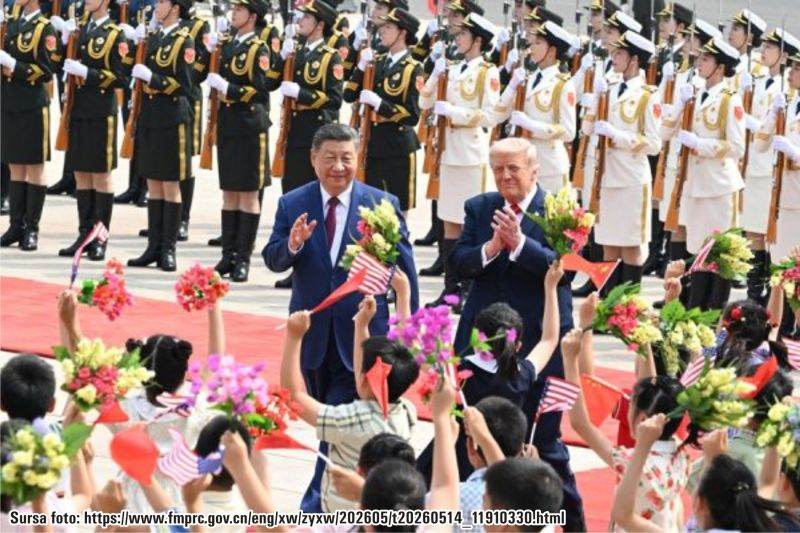
The first day of Donald Trump's official visit to China, which will end today, showed that the detente in Sino-American relations is blocked when the discussion reaches "Taiwan independence”. However, the presence of the American president has transformed Beijing into the scene of the most important diplomatic exercise of the moment, in an international context tense by the war with Iran, the global energy crisis, technological competition, trade pressures and the explosive file of Taiwan.
Donald Trump was received with pomp by his Chinese counterpart, Xi Jinping, in the Great Hall of the People, in a ceremony carefully directed by the Chinese authorities, with a guard of honor, military fanfare, cannon salutes, children waving the flags of the two states and an obvious political message: China wants to be treated as an equal power with the United States. Donald Trump seemed to accept this logic of the moment, at least publicly. After the welcoming ceremony, the American leader declared that it was "an honor like few I have ever seen,” adding that he was "especially impressed by the children.”
The conciliatory tone continued at the beginning of the official talks, where Trump directly praised Xi Jinping: "You have great regard for China, for what you have done. You are a great leader. I tell everyone: you are a great leader. Sometimes people don't like it when I say this, but I say it anyway, because it is true. I always tell the truth.”
The bilateral meeting between the two leaders, held in the Great Hall of the People, lasted over two hours, according to the Foreign Ministry in Beijing, and covered the most sensitive topics of the relationship between the US and China: trade, access for American companies to the Chinese market, purchases of American agricultural products by China, investment, energy, oil, fentanyl, the war in Iran, the Strait of Hormuz, Ukraine, the Korean Peninsula and Taiwan.
• Taiwan, the apple of discord between the US and China
The White House administration reported, according to CNN, Fox News and ABC News, that the talks were "good" and highlighted the convergences on energy and Iran. The two leaders, Donald Trump and Xi Jinping, agreed that the Strait of Hormuz must remain open for global energy flows and that Iran must never obtain a nuclear weapon. Xi Jinping expressed, according to the American press, his opposition to the militarization of the strait and to any attempt to tax its use, while also signaling China's interest in increased purchases of American oil, in an attempt to reduce energy dependence on this strategic route.
But the major difference between the American and Chinese communication appeared in the Taiwan file. The White House did not mention the subject in the information sent to the media after the meeting between the two leaders, while Beijing placed it at the center of its message. Mao Ning, a spokeswoman for the Chinese Foreign Ministry, said that Xi Jinping told Donald Trump that "the issue of "Taiwan independence' is the most important issue in China-US relations.”
The warning was sharp: "If it is properly handled, the bilateral relationship will enjoy overall stability. Otherwise, the two countries will have clashes and even conflicts, putting the entire relationship in great danger.” China insisted that "Taiwan independence” and peace in the Taiwan Strait are "as irreconcilable as fire and water,” and the American side must exercise "extra caution.”
• Elon Musk, in the delegation of businessmen accompanying Trump
On the economic front, the first day of the visit was built as a show of commercial strength. Trump traveled to Beijing with a large delegation of American business leaders, including Tim Cook, Elon Musk, Jensen Huang, Larry Fink, Stephen Schwarzman, Kelly Ortberg, David Solomon and Cristiano Amon. The US president said they had come "to pay their respects” to Xi and China. "I asked the top 30 businessmen in the world. Every one of them said "yes' and I didn't want number two or number three in the company. I just wanted the top guys. And I'm here today to pay my respects to you and to China and look forward to trade and business, and it's going to be completely reciprocal from our side,” Trump told Xi Jinping. In turn, the Chinese leader responded with a strategic message, not just a commercial one. Xi Jinping said that "one side's success is an opportunity for the other” and that "a stable bilateral relationship is good for the whole world.” He formulated the goal of a constructive relationship of "strategic stability,” explaining that the United States and China must "be partners, not rivals,” help each other to each other to succeed and find "the right way for major powers to coexist in the new era.” In Beijing's parlance, this "strategic stability” means cooperation as the core, competition kept within controllable limits, differences manageable, and a predictable peace.
According to CNN, Chinese Premier Li Qiang encouraged Elon Musk, Tim Cook, Jensen Huang and other top American businessmen to increase their presence in China and serve as a bridge between the world's two largest economies. Li expressed hope that American companies would "further strengthen the ties of mutually beneficial cooperation between China and the United States and continue to serve as bridges for communication and dialogue between the two countries.”
He also asked them to "help various sectors in the United States view China's development in a more objective and rational way and promote mutual trust and friendship,” according to a statement by the state-run Xinhua news agency.
Li's meeting with US executives, including Apple's Tim Cook, Nvidia's Jensen Huang and Tesla's Elon Musk, followed talks between Chinese leader Xi Jinping and President Donald Trump.
• Xi Jinping: "China-US relationship is the most important bilateral relationship in the world”
The tone at the state banquet in the evening became almost solemn. Xi Jinping declared that "the people of China and the United States are two great nations” and symbolically bridged his national slogan with Trump's political slogan: "Achieving the rejuvenation of the Chinese nation and MAGA can go hand in hand.” He continued: "Today, President Trump and I had in-depth exchanges on China-US relations and international and regional dynamics. We both believe that the China-US relationship is the most important bilateral relationship in the world. We must make it work and never break it.” Xi Jinping added that both countries "have something to gain from cooperation and something to lose from confrontation,” and that the relationship between them concerns the well-being of more than 1.7 billion people in the two countries and the interests of more than 8 billion people around the world.
Trump responded with a toast in the same historical vein, calling the U.S.-China relationship "one of the most important relationships in the history of the world.” He cited 250-year-old ties, from Benjamin Franklin and Confucius to Chinese railroad workers on the U.S. railroads and the popularity of basketball, jeans, and Chinese restaurants. "Chinese restaurants in America now outnumber the five largest fast-food chains in the United States combined. This 250-year-old bond of trade and respect is the foundation for a future that benefits both our nations. The American people and the Chinese people have much in common. We value hard work. We value courage and achievement. We love our families and we love our countries,” said Donald Trump.
The first day ended with a symbolic invitation: Donald Trump invited Xi Jinping to the White House on September 24, marking the declared desire of both sides to continue the dialogue at the highest level.
Beyond the pomp, compliments and diplomatic formulas, the meeting of the two great world leaders reveals a more complicated reality: the US and China are trying to stabilize the most important global rivalry without giving up their own red lines. On trade, energy and Iran, the two presidential administrations have shown convergence. On the subject of Taiwan, the gulf remains deep. And behind the smiles, toasts and promises of a "fantastic future”, the first day of Trump's visit to China confirmed that the Washington-Beijing relationship is simultaneously indispensable, explosive and decisive for the world order.


















 Euro
Euro Dolar SUA
 Franc elveţian
 Liră sterlină
 Gram de aur