English


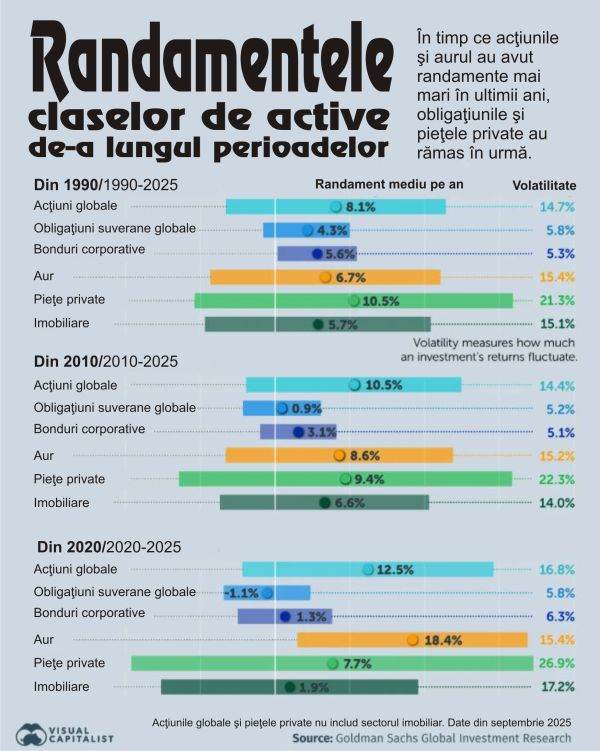
Investment performance can vary greatly depending on the time period in which they are held. While stocks and gold have delivered solid returns in recent years, bonds and some alternative assets have lagged, especially in the post-pandemic era of rising interest rates, according to an analysis by visualcapitalist.com, which presents annualized returns and volatility across major asset classes over three distinct periods: long-term (1990-2025), medium-term (2010-2025) and the most recent cycle (2020-2025), using data from US bank Goldman Sachs. Global equities and private markets exclude real estate, and the data is updated as of September 2025.
• Long-term returns by asset class
Over the past 35 years, risky assets have significantly outperformed safer alternatives, according to the source cited. Private markets posted the strongest annualized returns, at 10.5%, although this was accompanied by substantial volatility of over 21%. Global equities also performed well, averaging just over 8% annually.
Bonds offered more modest but stable returns, while gold provided diversification benefits, with average returns and high volatility.
• Performance in the post-global financial crisis era
The period following the global financial crisis was marked by low interest rates and strong equity performance. According to the cited source, global equities posted an increase in annualized returns to 10.5%, while private markets continued to outperform public assets.
In contrast, sovereign bonds struggled as yields fell, generating annualized returns of less than 1%. Gold has remained resilient during this period, with the yellow metal's price rising sharply between 2009 and 2012, then declining and stabilizing.
• Returns in the post-pandemic era
The most recent five-year period highlights a sharp divergence across asset classes.
Global equities have delivered solid returns since the 2020 crisis, despite market volatility. Gold, meanwhile, has been the best-performing asset amid rising inflation, geopolitical risks and high interest rates, with prices hitting record highs twice since 2020.
Bonds have underperformed in real and nominal terms as rapid interest rate hikes have eroded prices. Rising inflation and high levels of sovereign debt have put downward pressure on sovereign bond prices.
In addition, the real estate sector has posted relatively low returns over the medium to long term, with high mortgage rates dampening demand for housing in many major markets.

























 Euro
Euro Dolar SUA
 Franc elveţian
 Liră sterlină
 Gram de aur