 English

• 1. Starting point: what the polls show
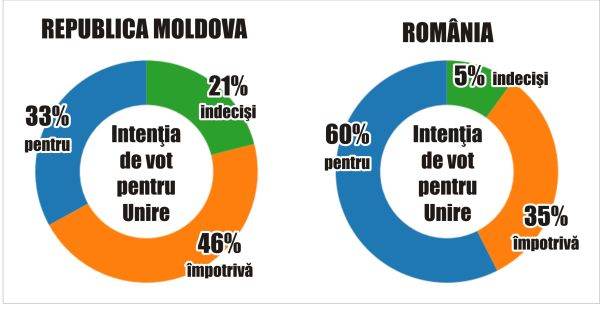
According to the Public Opinion Barometer conducted in September 2025, approximately 46% of citizens of the Republic of Moldova state that they would vote against unification with Romania, 33% would vote in favor, while the rest are undecided. These data were publicly cited by President Maia Sandu, who pointed out that, at present, there is no majority in favor of unification.
National surveys conducted in Romania between 2024 and 2026 by CURS and INSCOP indicate support for unification of 55-60%, with 30-35% opposed.
• 2. Causes of opposition in the Republic of Moldova
a) Post-Soviet identity inertia
A significant part of the population, particularly older cohorts, prefers maintaining the state status quo. This option is correlated with socialization within a Soviet and post-Soviet institutional framework distinct from Romania, according to the Institute for Public Policy.
b) Russian information warfare
The Republic of Moldova is identified as one of the most exposed targets of Russian disinformation on the EU's eastern flank.
Dominant narratives associate unification with the loss of statehood, military conflict, and economic deterioration, as shown by the European External Action Service and OSCE reports on the information environment in the Republic of Moldova.
c) Immediate economic fears
Low-income respondents point to uncertainties related to pensions, wages, taxes, and prices in a unification scenario.
According to the Institute for Public Policy, Romania is perceived as a more developed economy, but with a higher cost of living.
d) The Transnistrian issue
The association of unification with the risk of military escalation and direct involvement in a major geopolitical conflict represents a deterrent even for pro-European segments of the population, according to OSCE data and NATO assessments.
e) Regional fragmentation
Regional distributions show massive opposition in Gagauzia, southern Moldova, and predominantly Russophone communities, where support for unification frequently falls below 10% (IMAS - Socio-political Barometers 2023-2025).
f) Absence of an official unification project
The lack of a phased plan, a clear timeline, and institutionally guaranteed social safeguards amplifies opposition to a scenario perceived as uncertain, as shown by a comparative analysis of the Republic of Moldova's administrative capacity.
• 3. Causes of reservations in Romania
According to surveys, the 30-35% opposition in Romania is mainly associated with:
fiscal concerns (deficit, public debt),
imported geopolitical risk,
lack of confidence in the administrative capacity to manage integration.
• 4. Unification as a process: costs and measurable effects
a) Transitional fiscal costs
Convergent estimates indicate net budgetary transfers of 1.5-2.5% of Romania's GDP per year, equivalent to euro5-9 billion annually, over a period of 5-7 years.
(sources: European Commission - convergence reports and macro-financial assistance; World Bank - sectoral assessments of the Republic of Moldova).
b) Impact on financing costs (short term)
A probable increase in Romania's sovereign yields of +30-70 basis points, without an automatic loss of investment-grade status, according to Standard & Poor's, Moody's, and Fitch Ratings.
c) Interest rates and volatility - current situation
Republic of Moldova: 2-3 year government bonds at 8.1-8.4%
Romania: 2-3 year government bonds at 6.2-6.5%
Difference: approximately 2 percentage points, explained mainly by political risk
(sources: Ministry of Finance of the Republic of Moldova; Trading Economics).
Leu/Moldovan leu volatility against the euro (~7.5% annually) is about 80% higher than that of the Romanian leu/euro (~4.2%), according to data from the National Bank of Moldova and the National Bank of Romania.
Public opposition to unification stems from risk perception
Surveys in both states, correlated with market data and institutional assessments, show that unification is perceived as a process with certain upfront costs and delayed benefits.
Opposition is not ideological per se, but derives from measurable economic, informational, and institutional risks.























 Euro
Euro Dolar SUA
 Franc elveţian
 Liră sterlină
 Gram de aur





























