 English


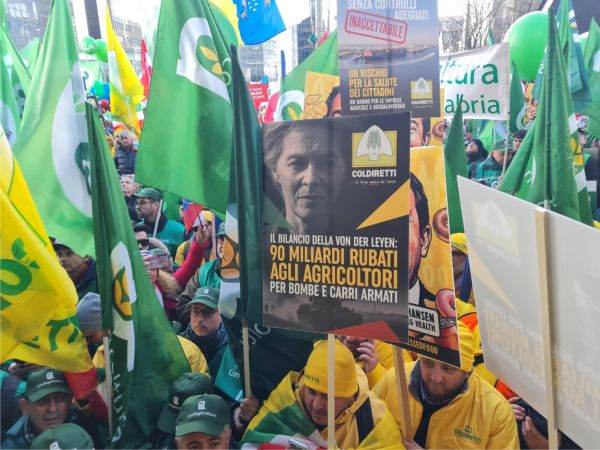
Last Thursday's violent protest in Brussels, presented by the organizers as a revolt "for the survival of farmers" and against the "Brussels dictatorship", in reality looked like a siege with hidden objectives broader than the slogans pasted on the fences of the European Parliament: behind the fury in the Place du Luxembourg, with black smoke from tires, thrown potatoes, projectiles and clashes with the police, the stakes quickly shifted from specific agricultural demands to raw political pressure on the EU institutions.
According to the Belgian press, representatives of the Belgian capital's police force said that around 8,000 people and almost 1,000 tractors arrived in the European quarter, although a much smaller protest had been initially authorized, and that they used water cannons and tear gas after some protesters threw stones, potatoes and broke windows, threw fireworks and set fire to "two bins" of tires, with a cloud of smoke visible in the city. But this is precisely where the major logical flaw that the farmers covered up with noise and spectacle is visible: they tried to induce the idea that "Brussels" is monolithic, that "Parliament" and "Commission" are a bloc that cuts their subsidies and opens the gates to imports, so the only solution is street force.
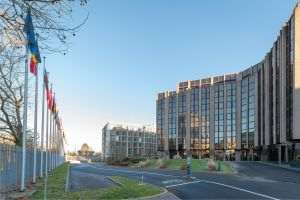
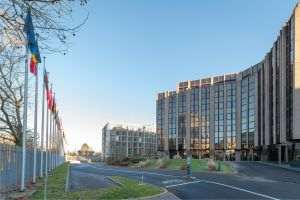
In reality, the very institution demonized by farmers on Thursday, the European Parliament, is one of the main political brakes already placed on the architecture of the 2028-2034 budget proposed by the Commission, and the opposition does not come from the "margins”, but from the core of the majorities: MEPs explicitly contested the Commission's idea of mixing funding for agriculture and cohesion in a single "package”, demanding the preservation of distinct flows and clear European guarantees for the Common Agricultural Policy (CAP), precisely in order to avoid the "nationalization” of support and competitive differences between states. The European Parliament's chief negotiator on the future multiannual financial framework, Siegfried Mureşan (VP of the EPP), warned that the European Commission's proposal would be rejected if it was not amended in the sense proposed by MEPs. In other words: instead of "defending democracy” by besieging Parliament, the protesters attacked exactly the place where political pressure is building to correct the Commission's plan.
• European Commission proposal, disavowed by the European Parliament
What exactly is the Commission proposing for the future Common Agricultural Policy and what ignited the revolt on Thursday? In the 2028-2034 budgetary architecture, the Commission is pushing its concept of national flexibility through an 865 billion euro "National and Regional Partnership Fund", within which the CAP no longer stands as a separate pillar, but is caught in a broader structure of national and regional plans. The Commission says that, of this fund, at least euro293.7 billion would go directly to income support for farmers, with a further euro453 billion available through national plans for income support measures, innovation and rural initiatives, plus a euro6.3 billion "Unity Safety Net” for market crises between 2028 and 2034.
The new central scheme would be the "Degressive Area-Based Income Support (DABIS)”, which replaces several current instruments: payments per hectare, but degressive (lower as the farm gets bigger), with a cap of euro100,000 per farm per year; the focus is on those for whom agriculture is the main means of livelihood, and the Commission also mentions changes such as the ineligibility of pensioners until 2032, along with simplified options for small farmers (up to euro3,000/year) and stronger targeting for young people and women in agriculture. These are details that show that the real discussion is about the redistribution and conditioning of support, not about the "end" of the CAP overnight, and the discussion will inevitably be political and tough in the next two years of negotiations between the Commission, Parliament and EU member states.
In parallel, last Thursday's protest was massively fueled by the Mercosur theme, and here it was clearly seen how the decision is stopped by the political veto in the European Council: France maintained its opposition to the respective treaty, and Italy aligned itself with the pressure for postponement, which led Ursula von der Leyen to announce to EU leaders that the signing of the agreement will not take place now, but will be pushed back at least until January 2026. The French press treated the announcement as an unexpected turn, and the agencies explicitly noted the role of the Paris-Rome tandem in the context of the protests in Brussels. No matter how much people shouted in the streets, the key decision came from the political equation of the member states, not from the "assault” on the European Parliament.
• The real stakes of the farmers' protest in the EU capital
Here comes the layer that the protesters' placards in Brussels do not say, but which they serve: channeling anger towards the wrong targets, on to block, through pressure and hysteria, what really bothers certain interests, namely the access of Ukrainian products to the single market and the maintenance of the EU-Ukraine trade "corridors" in the most open form possible. The official figures show why the subject is explosive: in 2024, EU agri-food imports from Ukraine were 13.094 billion euros (compared to 11.839 billion in 2023), i.e. an increase of 10.6% in a single year, with cereals, oilseeds and vegetable oils in the foreground. We are not talking about a marginal detail, but about a flow of tens of billions of euros, enough to trigger economic anxieties and be politically exploited within the EU.
At this point, the slogan "Ici commence la dictature" (ed. - Here the dictatorship begins) displayed by farmers in front of the European Parliament is more than an exaggeration: it becomes a tool. When the masses are led to believe that the European Parliament is the enemy, even though it is precisely there that the majority opposition to the budgetary architecture that would dilute the CAP is being built, we are no longer talking about just social discontent, but about a convenient diversion. And the diversion has an objective effect: it weakens political solidarity in support of Ukraine, shifts the discussion from mechanisms (quotas, emergency brakes, standards, transitions) to hysteria ("invasion”, "dictatorship”), and pushes the EU towards defensive reactions that inevitably hit the Ukrainian economy.
In a war in which the Russian Federation has a direct interest in choking off Ukraine's financing and cutting off its trade routes, any campaign that turns "Ukrainian grain” into a public enemy and "Brussels” into a tyrant effectively serves exactly that interest, even if many of those on the street are not aware of it and sincerely believe that they are fighting only for the price of milk and against the increase in the price of diesel. And when the protest turns violent, with projectiles, arson and attempts to force the cordons of the security forces, the message becomes impossible to separate from the manipulation: it is no longer about the farmers, but about who is using them as a scapegoat against their own political ally, the European Parliament, which is negotiating the CAP with the Commission, and against a country (Ukraine) that the EU has strategically decided to keep alive economically.













 Euro
Euro Dolar SUA
 Franc elveţian
 Liră sterlină
 Gram de aur





























